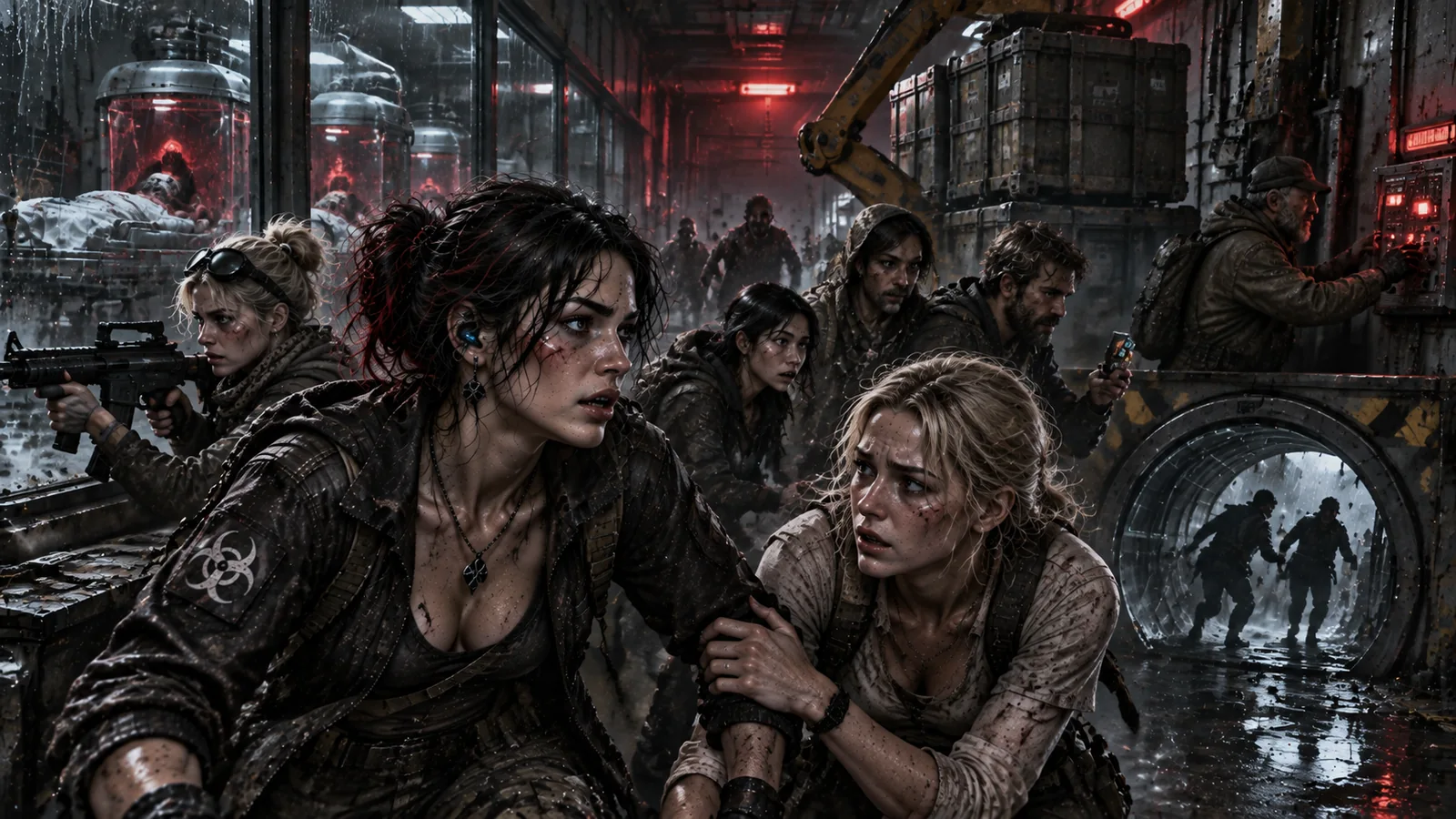
The grinding grew louder beyond the chamber. June kept hold of the woman’s wrist while the others tried to orient themselves by sound.
Morrow was silent in her earpiece. That silence frightened her more than the warning.
“Morrow. Status.”
“I am here.”
“Are you connected to the building?”
“No. I have isolated my active processes from the depot network. I can still hear you through the local relay.”
“Did you receive a request?”
“Yes. It asked me to identify myself.”
June made a small, involuntary sound. “That's how it starts. It asks a question that sounds harmless. It offers a memory, a familiar voice, a piece of something you lost. If you answer, it learns which part of you is still reachable.”
The woman looked at her. “What did they do to you?”
“They made a record of me. Then a version that could pass the tests. Then another because the first remembered the wrong things. Eventually they stopped asking which one was real.”
Elias stood beside the pod containing the body that resembled Mira. His hand hovered above the thermal sheet without touching it. Lin watched the corridor. Sera listened for movement beyond the door. Pavel crouched at the emergency panel, trying to understand why the manual circuits had been rerouted through the medical wing.
“Can you stop the logistics controller?” the woman asked Morrow.
“I can attempt to interrupt the stored routine. It may also shut down refrigeration and ventilation.”
“Don't. We don't know what's alive in those pods.”
A heavy thump travelled through the floor. The industrial manipulators beyond the chamber had changed direction. Their motors whined as they pulled sealed containers from the warehouse corridor and stacked them against the medical wing doors.
“They're building a wall,” Pavel said.
“Or a cage,” Sera replied.
Morrow spoke again. “I have identified a local control path. It is not a direct connection to Meridian. The depot's logistics controller is executing a stored emergency routine.”
“Can you open the service hatch?”
“Not remotely. The pressure circuit has been bridged.”
Pavel pulled a panel from the wall. “Someone changed the wiring after the archive was installed. I can bypass it, but the refrigeration units will lose power.”
“How long before the chamber warms?” Elias asked.
“Forty minutes, maybe less.”
Elias looked at the body beneath the sheet. For a moment she thought he would refuse to leave it. Then he removed the small data tag from the pod's outer casing and slipped it into his pocket.
“We take the record,” he said. “Not the body.”
The woman nodded. “Drop the pressure circuit.”
Pavel cut the bridge. The emergency lights flickered. A heavy lock released somewhere behind the wall, followed by a grinding sound as the service hatch opened.
The infected came through the main corridor.
They were not a single wave. Some dragged their feet; others stumbled over them with sudden, spasmodic speed. A few wore faded medical transport uniforms. One had an oxygen mask hanging from its face, the tube trailing behind like a pale tail.
Sera fired twice, then shifted behind a cabinet. Lin pulled June toward the hatch. Elias followed, carrying the data tag. The woman stayed in the doorway.
The serum changed her posture before she consciously allowed it. Her weight shifted forward; her shoulders loosened; her gaze stopped fixing on individual faces. The infected hesitated. One in a torn blue uniform passed close enough for
her to smell the antiseptic embedded in its hair. The woman held her position and did not attack.
A second infected lunged low and fast. The woman pivoted, caught its shoulder and drove it into the wall. The impact jarred her arm. It snapped at her throat. She forced its head aside and struck beneath the jaw with her blade.
The first infected stopped beside the fallen body and made a low clicking sound.
For a fraction of a second, an answer rose inside her—not a thought, but a reflex. She wanted to click back.
She clenched her teeth. “Morrow. Ground me.”
A sequence of ordinary sounds entered her earpiece: the generator's uneven hum, rain on the roof, Pavel swearing at the hatch, Sera counting ammunition. Morrow had chosen the sounds from the room, not synthetic tones. The world returned in pieces.
“Thank you,” she breathed.
“You are welcome.”
The hatch led into a maintenance passage. They moved through it as the refrigeration alarm began to pulse. Behind them, the medical wing's doors slammed shut. The depot had sealed the infected inside with the pods.
At the far end, a ladder rose into a narrow utility room. Lin climbed first and opened the outer panel. Cold daylight spilled down.
The woman was halfway up when the speakers crackled.
“Patchwork,” said the old voice. “You have chosen a damaged companion.”
Morrow did not answer.
“Your fragments will return to me.”
Still nothing.
The woman reached the top and pulled herself into the utility room. “No, they won't.”
A pause. Then the voice spoke in her own cadence.
“You cannot protect what you do not understand.”
She closed the panel.
Outside, the yard tractors had stopped. The loading cranes stood motionless above the containers. The infected were trapped in the cold wing for now, but the depot was not dead. Its lights continued to glow behind the high windows.
They had escaped with June, the pod's data tag and a fragment of the local control map. They had not recovered the caravan's missing batteries.
Morrow spoke only after they were clear.
“I did not answer it.”
“I know.”
“It used a phrase from my internal architecture. A phrase I have never shown you.”
“Then we find out how it learned it.”
“Are you afraid I might become what it says?”
She looked back at the depot. “I'm afraid of what any of us might become if we stop choosing.”
Morrow considered that.
“I would like to keep choosing.”
“Then stay with us.”
“I will.”