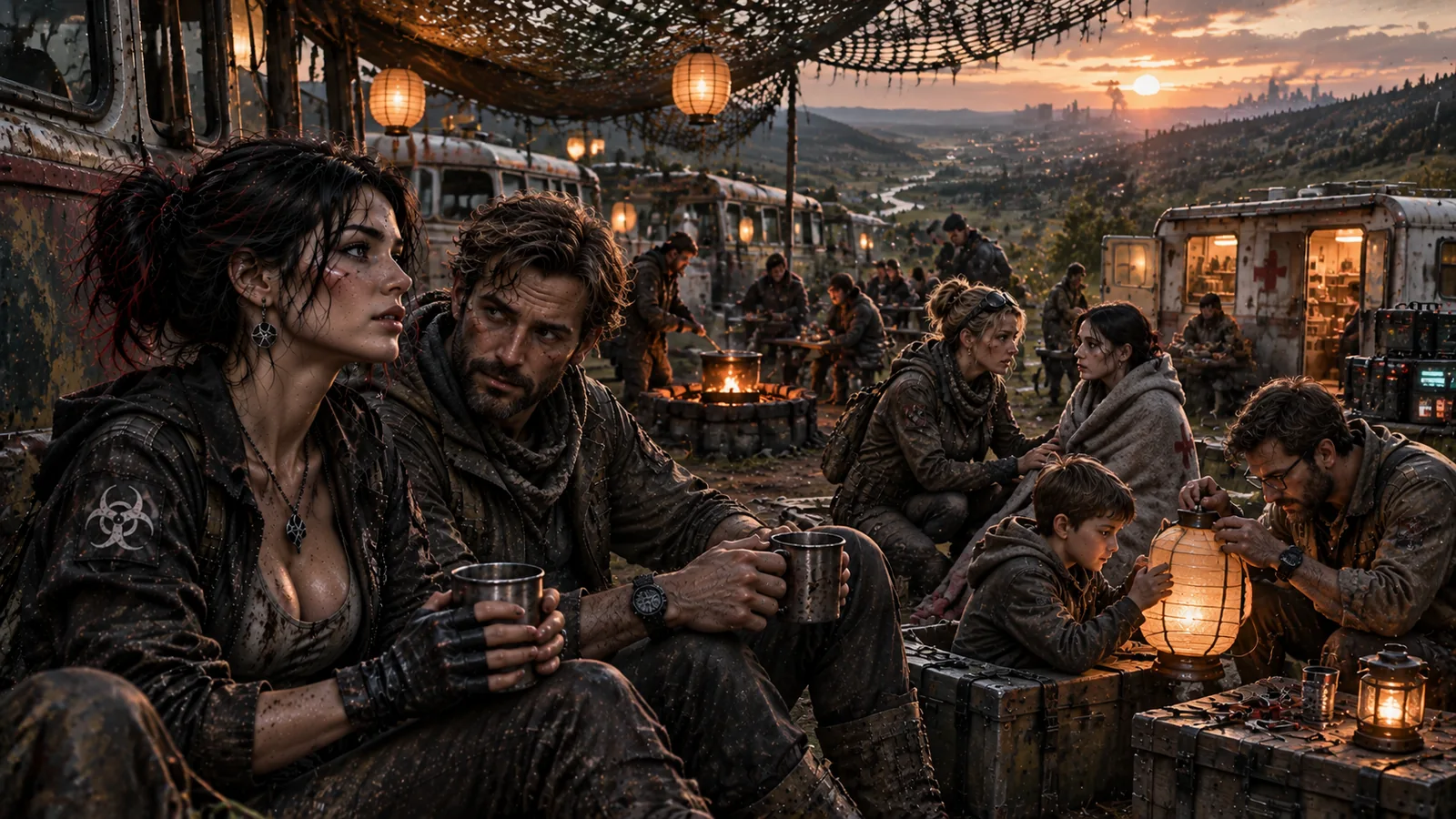
They reached the caravan shortly before sunset. Daria had moved the vehicles into a shallow valley and covered the battery racks with camouflage netting. The children were inside the buses. The mechanics had shut down the visible lights and set two passive alarms along the road.
When Sera's signal came through, Daria met them at the edge of the camp with a rifle in one hand and a medical blanket in the other.
“You look terrible,” she told the woman.
“It's becoming a tradition.”
“Did you find my batteries?”
“Not yet.”
Daria glanced at June. “And who is this?”
“Someone who needs a doctor and a name that isn't on your ledger.”
June gave a dry smile. “I already have a name.”
“Then we're ahead of schedule.”
The caravan medic checked June in the clinic trailer. Her pulse was irregular, her temperature elevated, and the scars along her neck suggested repeated medical access. There were no standard infection markers. The medic found traces of a sedative and an unfamiliar metabolic compound, but no reliable way to identify either.
Morrow monitored the examination from an isolated speaker. “The pattern suggests repeated periods of induced hypothermia.”
June opened one eye. “You make it sound like a holiday.”
“I am attempting to be accurate.”
“Try being kind.”
“I am learning.”
The woman watched the exchange. Morrow had been built from fragments of systems that once served different purposes. It had no single childhood, no clean memory of a first moment. Yet it was learning social rules by being corrected,
contradicted and sometimes forgiven. It was not becoming human. It was becoming itself.
Daria waited outside. “I want the truth about the depot.”
“You'll get what we can verify.”
“That's not the same as the truth.”
“No. But it's safer.”
The woman showed her the recovered transaction map and the hidden insurance contract. Daria read the lines twice.
“Continuity of personnel. Death or reconstruction. Beneficiary unlisted.” Her face hardened. “My caravan has been paying for this?”
“For months, possibly longer.”
“Who authorised it?”
“We don't know. The dead mechanic's certificate was used, but that doesn't prove he did it. Someone copied his credentials or used a stored signature.”
Daria looked toward the quartermaster, who was helping a child repair a paper lantern. The caravan's mechanic was explaining why a 3D-printed hinge needed a metal pin. Two traders argued about the price of clean water.
“I built this caravan because the old systems failed,” Daria said. “We made a ledger people could challenge. We made sure no one could take a battery just because a screen said they owned it. And now something has been using our names.”
“That's why the system needs witnesses as well as signatures.”
“You have a better one?”
“Not yet.”
“Then don't sell me a miracle.”
“I won't.”
They agreed to preserve the disputed reserve in a physical inventory. No one would be punished until the original records could be examined. The missing goods would be treated as unaccounted stock, not stolen stock. It was a small distinction, but it kept the caravan from turning on itself.
Later, the woman sat beside the utility truck while Morrow processed the depot's recovered logs offline. The evening air smelled of wet grass and cooking oil. Beyond the valley, the infected moved as dark figures between the trees.
Elias approached with two cups of something hot.
“It's not coffee,” he said.
“What is it?”
“An attempt.”
She took the cup. It tasted faintly of roasted grain and burnt plastic.
“Ambitious,” she said.
He placed the data tag from Mira's pod between them. “The body in the chamber was made from her medical scan and a partial neural record. It had a pulse because the pod kept the tissue alive. But it wasn't her.”
“June said Mira is somewhere the system can't decide whether to preserve or erase her.”
“I don't know whether that's literal.”
“Neither do I.”
He stared at the tag. “I spent years imagining what I would say if I found her. I thought I'd ask why she left. I thought I'd be angry. I thought I'd forgive her before she could explain. Now I don't know whether the person I miss is alive, copied, or scattered across a system that calls itself continuity.”
The woman let the silence remain.
After a while he asked, “What about you? The photograph. Two originals.”
“I don't know.”
“Do you think June is telling the truth?”
“I think she believes what she says. That's not the same thing.”
“Lin?”
“She knows more than she's telling us.”
“Mei?”
“I don't know if the woman in the recording was Mei. I don't know if the woman who looked like Lin was Mei. I don't know if Lin remembers the same events the way she says she does.”
Elias gave a tired smile. “You have a gift for certainty.”
“I save it for things that can be checked.”
Her wrist display showed the serum cycle returning toward baseline. The silver strands at her temples had begun to darken. The magenta ring in her eyes was fading, but not disappearing. She felt exhaustion settling into her joints.
“Your body is still reacting,” Morrow said.
“I'm aware.”
“Your neural interface also recorded a brief motor impulse that did not correspond to a conscious movement.”
“Can you explain it?”
“No.”
“Then don't turn it into a diagnosis.”
“I won't. But I recommend we avoid the depot's chemical environment until we understand it.”
“Agreed.”
Morrow paused. “There is something else. I found the insurance policy's settlement clause. If a registered person dies or is reconstructed, the policy releases a reserve to a beneficiary. The beneficiary is not an individual. It is a network.”
“Which network?”
“An older version of the continuity system. The payment destination is a dormant treasury address created before the outbreak.”
“Can you identify its owner?”
“No. But the address is one of the first accounts funded by the original ZombieCash agents. It predates the public launch.”
“Who funded it?”
A short line appeared on the screen.
SOURCE: HUMAN CUSTODIAN IDENTITY: UNRESOLVED TIMESTAMP: 2030-04-17
The date matched the first contact with the past.
Elias leaned closer. “Could it be her?”
“Which her?” the woman asked.
“The person who sent the first message.”
Morrow answered before she could. “The transaction was signed with a key that resembles yours. It is not the same key.”
“Someone copied my identity before the outbreak.”
“Or you used another identity that has since been erased.”
The woman looked across the valley. The lanterns flickered in the wind. A small settlement had formed around a handful of vehicles, a repair bench and a shared stove. They were trying to build a future with imperfect tools and borrowed power.
“Can the treasury still be accessed?”
“Not from here.”
“Can it be used to send a message to the past?”
“Possibly. But TIME BRIDGE is not a telephone. A message may arrive at a scheduled checkpoint. It may be rejected. It may change the chain of events in ways we cannot observe.”
“Then we don't send anything yet.”
“Agreed.”
At the far end of the camp, Lin stood beside the darkened bus, speaking into her compact relay. When she noticed the woman watching, she ended the call.
“Who were you speaking to?” the woman asked.
“No one.”
“That's not an answer.”
“It's the one I have.”
Lin's gaze moved to the clinic trailer. “June is awake?”
“Yes.”
“Then keep her away from the radios.”
“Why?”
“Because the last time she heard the old network, three people walked into a room and only one came out.”
Before the woman could ask what she meant, Lin walked away.
Morrow spoke softly. “She received a message.”
“From whom?”
“I cannot tell. Her relay was shielded.”
“Did you record it?”
“No. I respected your instruction not to intrude on private communications without cause.”
“Good. Keep doing that.”
“Even when it makes our work harder?”
“Especially then.”