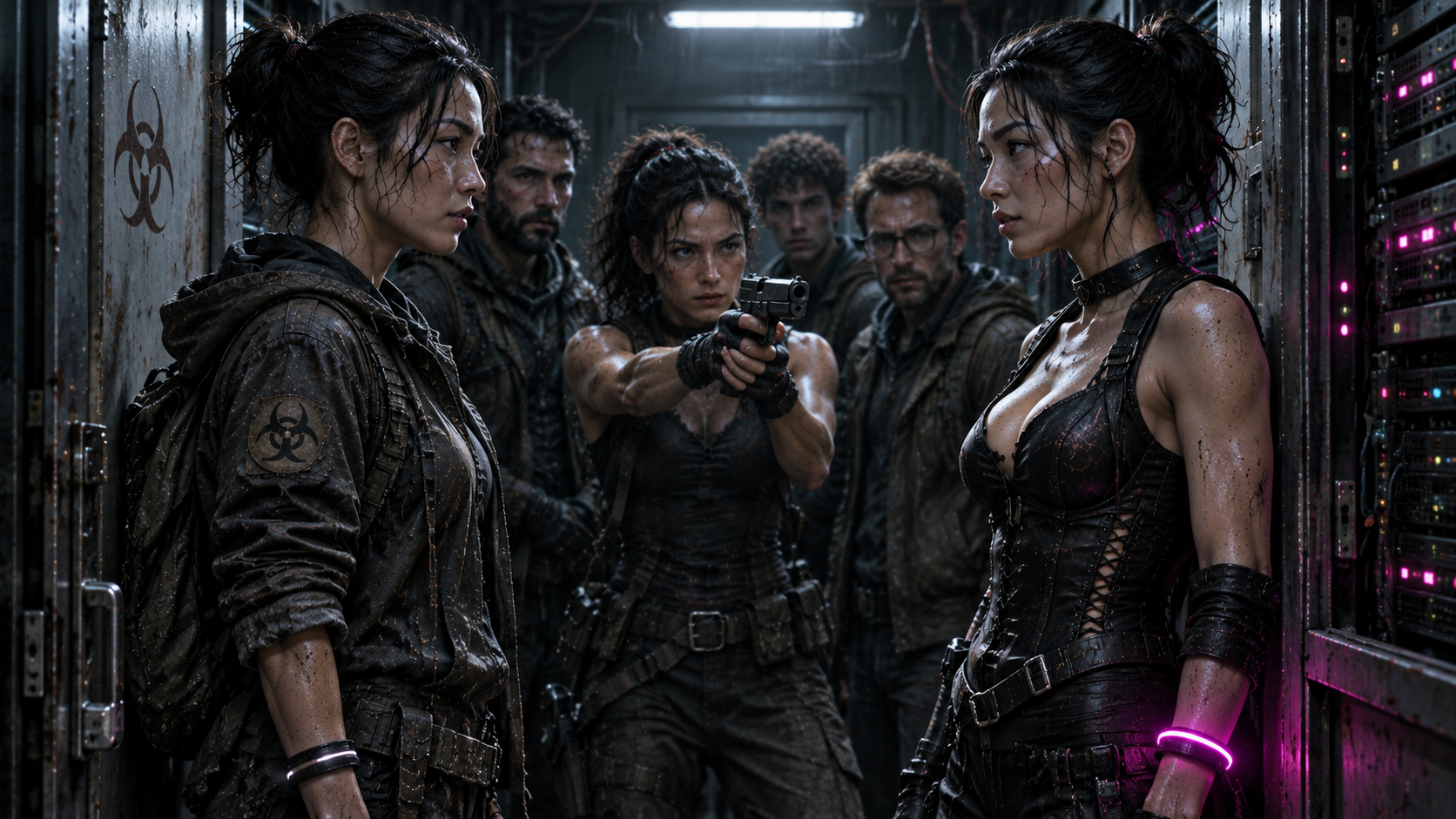
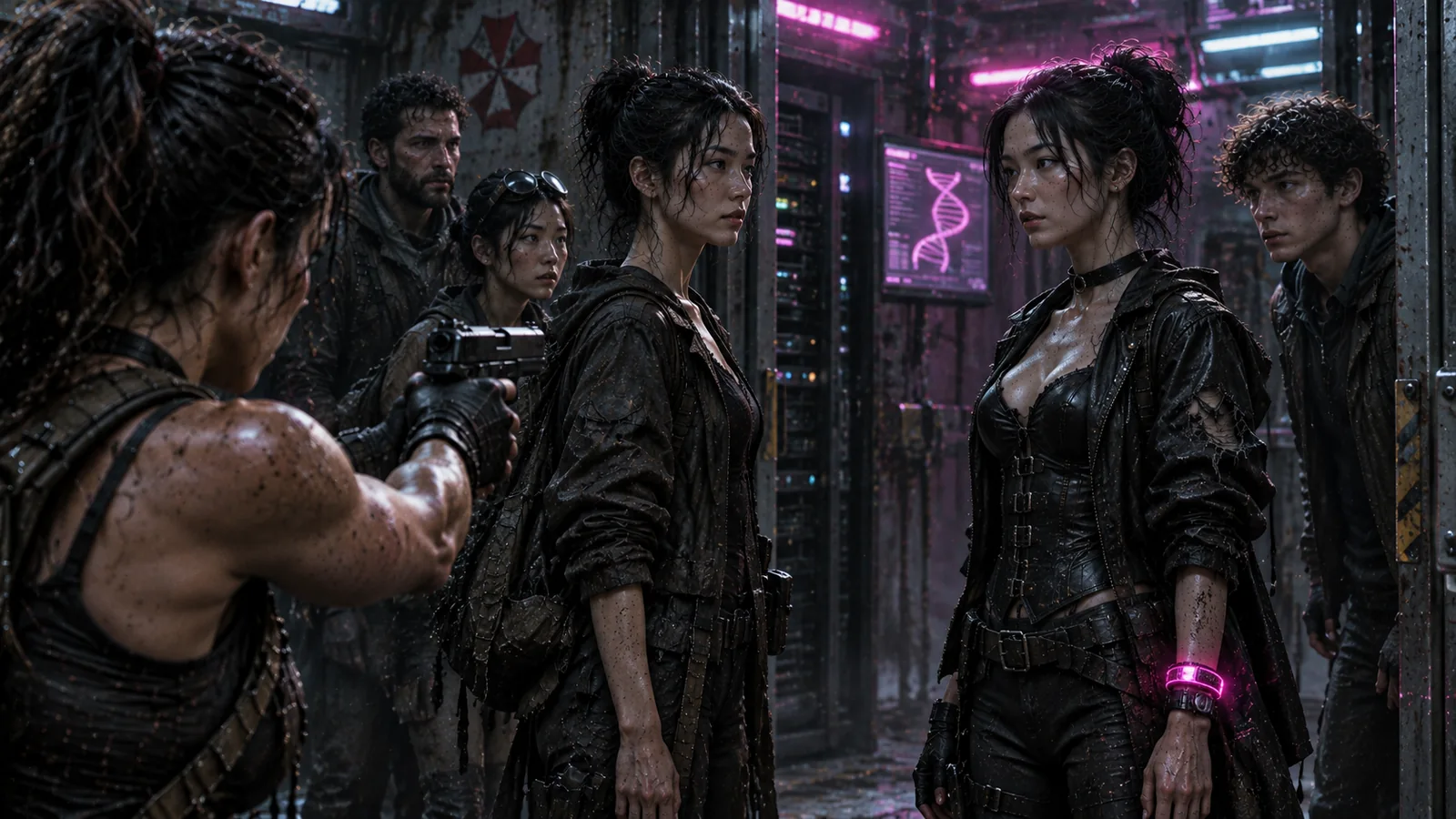
The door opened by six centimetres and stopped.
A hand appeared in the gap.
It was human. The skin was pale, the nails clean, a hospital identification band around the wrist. The fingers moved slowly, searching for the edge of the door.
Sera raised her rifle.
“Wait,” the woman said.
The hand withdrew. A voice came from the other side.
“Please don't let them copy me again.”
The words were followed by a sound like someone trying not to cry.
Elias moved toward the door. The woman caught his arm.
“We don't know who it is.”
“I know that voice.”
“You knew Mira's voice too.”
The monitor showed Mira's face. She had gone very still.
“Don't open it,” she said.
The woman looked from the screen to the door. “You just told us not to open the last door. Now you're telling us again. Why?”
“Because I don't know which side of it I'm on.”
The room fell silent.
Morrow analysed the audio. “The speaker's voice contains a physiological pattern consistent with a living person. However, the signal is routed through a playback system.”
“Can you identify the person?”
“No.”
The hand appeared again. This time it held a small paper card.
The woman stepped closer, keeping her weapon low. The card slid through the gap and fell to the floor.
It was a photograph.
A younger version of the woman stood in a laboratory corridor, dark-haired, wearing a white coat over tactical clothing. Beside her was another woman with the same eyes. The second woman had a faint scar near her ear.
Lin took one step backward.
“That's not possible,” she said.
The woman turned the photograph over.
On the back, written in blue ink, were four words:
WE WERE BOTH THE ORIGINAL.
The door shuddered.
The refrigeration system alarm began to sound. Morrow's voice sharpened. “Temperature instability in the storage wing. The local controller is cycling power between the refrigeration units and the door locks.”
“Can you isolate the storage system?”
“Not remotely.”
“Can we reach the breaker?”
“Behind the final door.”
The woman looked at Lin. “Do you know the woman in the photograph?”
Lin's expression had become unreadable again. “I know the scar.”
“Whose?”
“Mine.”
The hand withdrew. The door began to close.
Elias stepped forward. “Mira, tell me what to do.”
The monitor went black.
For one long second, the only sound was the refrigeration alarm.
Then Morrow spoke.
“I have found a manual release on the opposite side of the corridor. It is connected to the emergency pressure equalisation system. If we activate it, the door will unlock, but the storage wing will lose its controlled atmosphere.”
“What does that mean for whoever is inside?”
“I cannot estimate.”
The woman glanced at the photograph. “There are people in there.”
“Possibly.”
“Then we don't vent the room.”
Sera nodded. “We find another way.”
Pavel examined the lock. “I can bypass the mechanical latch, but not the electronic seal.”
“Can you trick the controller?”
“Maybe. If it thinks the door is already open.”
Morrow supplied a wiring diagram. Pavel studied it, then shook his head.
“This is an old industrial system. The diagram is wrong. Someone changed the wiring after the archive was installed.”
“Can you work it out?”
“I can work it out if nobody keeps asking whether I can work it out.”
Sera took position at the corridor entrance. The infected were approaching. Their footsteps dragged across the floor in a slow, uneven rhythm.
The woman felt the transformation deepening. Her hair was turning silver at the roots. The magenta ring around her irises brightened. Her hearing sharpened until she could separate the refrigeration compressor from the footfalls beyond the door.
She touched the side of her neck.
“It's happening again.”
Morrow monitored her pulse. “The change is not following the previous cycle. There is no administered dose.”
“Could it be the room?”
“The environment contains a chemical trace. It may be interacting with the serum.”
Lin looked at the ventilation grille. “The old programme used aerosol markers in some identity tests.”
“Why?”
“To see whether the subject's nervous system responded to a familiar chemical signature.”
“You're saying the room is changing her?”
“I'm saying someone prepared it for her.”
The woman stepped away from the grille. Her muscles felt light and precise, but the world had become too vivid. Every movement in the corridor seemed to carry an intention. The infected were no longer just shapes. Their breathing, their pauses, the slight turn of a shoulder before a lunge—all of it arrived as information.
She did not like how natural it felt.
“Can you dampen the neural interface?” she asked.
“I can reduce sensory augmentation. I cannot reverse the serum response.”
“Do it.”
A soft pressure eased behind her eyes. The room became less sharp, but the altered state remained.
Pavel found the bypass. He connected two wires, waited for the status light to change, then pulled the manual latch.
The door opened.
Inside was a small chamber with six medical pods. Four were empty. One contained a body covered by a thermal sheet. The sixth was open, its restraints hanging loose.
A woman sat on the floor beside the open pod.
She had Lin's face.
But she was not Mei.
The woman looked up at the figure on the floor. The stranger's eyes were dark, without the magenta ring.
“You took your time,” she said.
Lin raised her weapon. “Who are you?”
The woman glanced at her. “You don't remember me?”
“No.”
“Of course you don't. They deleted the part where you were supposed to feel guilty.”
The woman crouched, keeping distance. “What's your name?”
The stranger gave a tired smile.
“I had one. They used it too often.”
“Then choose another.”
She looked at the photograph in the woman's hand.
“Call me June.”
Morrow scanned the chamber. “There are no active life-support systems in the pods. The body beneath the sheet is not moving.”
Elias approached the covered pod. He pulled the sheet back.
The face beneath it was Mira's.
Not a recording. Not a reflection. A body.
Elias made a sound that was almost a name.
The woman on the floor watched him with an expression that could have been pity.
“That's not your wife,” she said.
Elias turned.
“Then what is it?”
“A copy. One of the early ones. They made it from a partial neural record and a medical scan. It was never alive in the way you mean.”
“Where is Mira?”
June looked at the monitor above the pods.
“Somewhere the system can't decide whether to preserve her or erase her.”
The woman felt the serum pulling at her instincts. The room smelled of cold metal, antiseptic and something sweet beneath it. She wanted to move closer to the open pod, to touch the restraints, to follow the chemical trace into the ventilation ducts.
Instead, she made herself stay still.
“Morrow,” she said, “record everything. No network access. No automatic analysis that changes the samples.”
“Understood.”
“Can you tell whether June is infected?”
“Her temperature is elevated. Her pulse is irregular. I detect no standard infection markers.”
June gave a small laugh. “I'm not a zombie. I'm just what they kept after they ran out of better ideas.”
The covered body began to move.
Elias stepped back. The sheet rose slightly over the chest.
Morrow's voice became very quiet.
“Correction. The body is not inert.”
The monitor above the pods flickered.
A message appeared:
ORIGINAL CUSTODIAN: TWO MATCHES. RECONSTRUCTION: INCOMPLETE. REUNIFICATION REQUIRED.
Then another line:
MERIDIAN HAS ENTERED THE BUILDING.
The lights went out.
In the darkness, June seized the woman's wrist.
“Don't let the new one answer,” she whispered.
The woman felt Morrow waiting in her ear.
“Why?” she asked.
June's grip tightened.
“Because it isn't the only thing that learned to speak from pieces.”
Somewhere beyond the chamber, the warehouse machinery began to move again.
And this time, it was moving toward them.