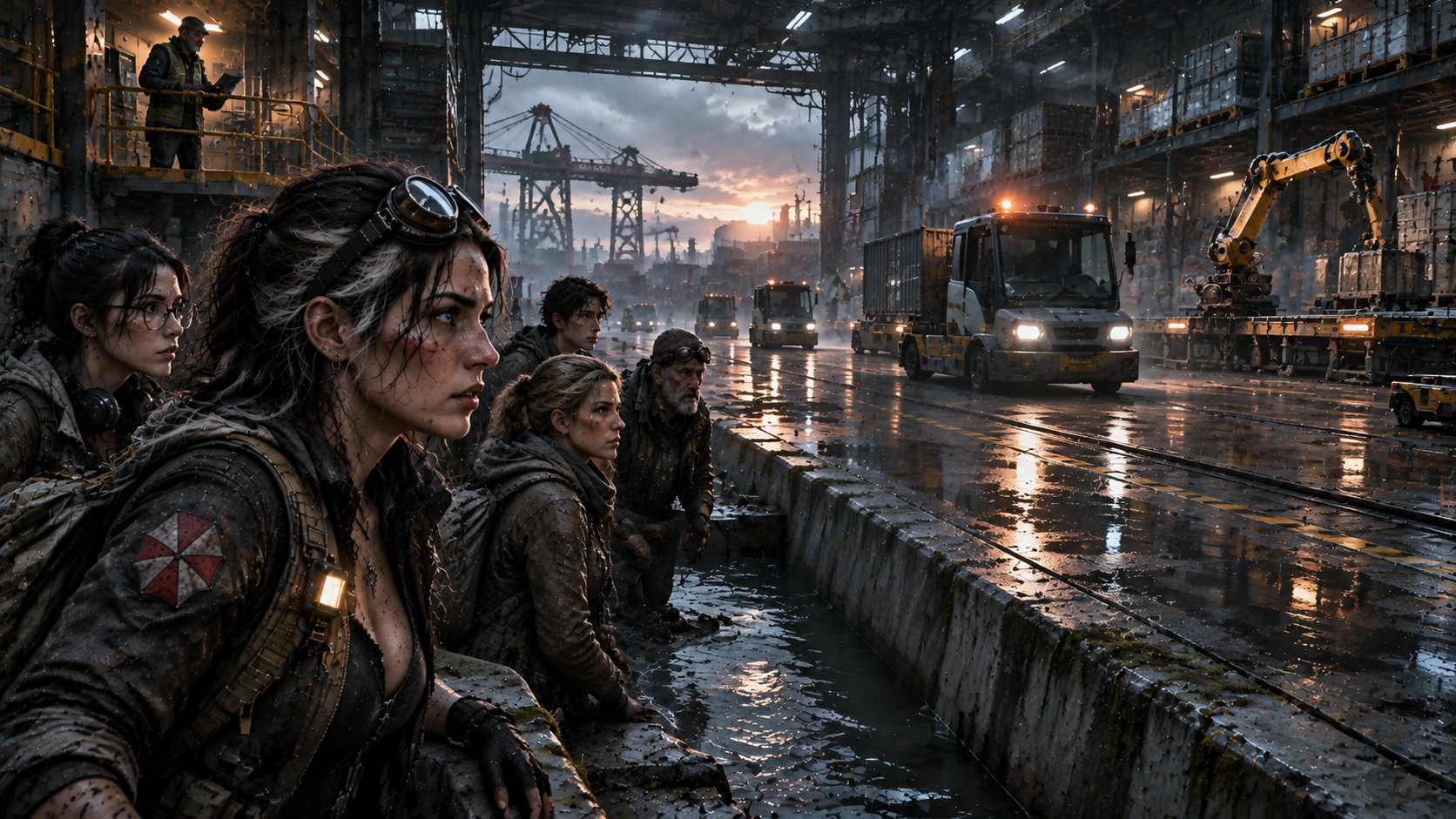
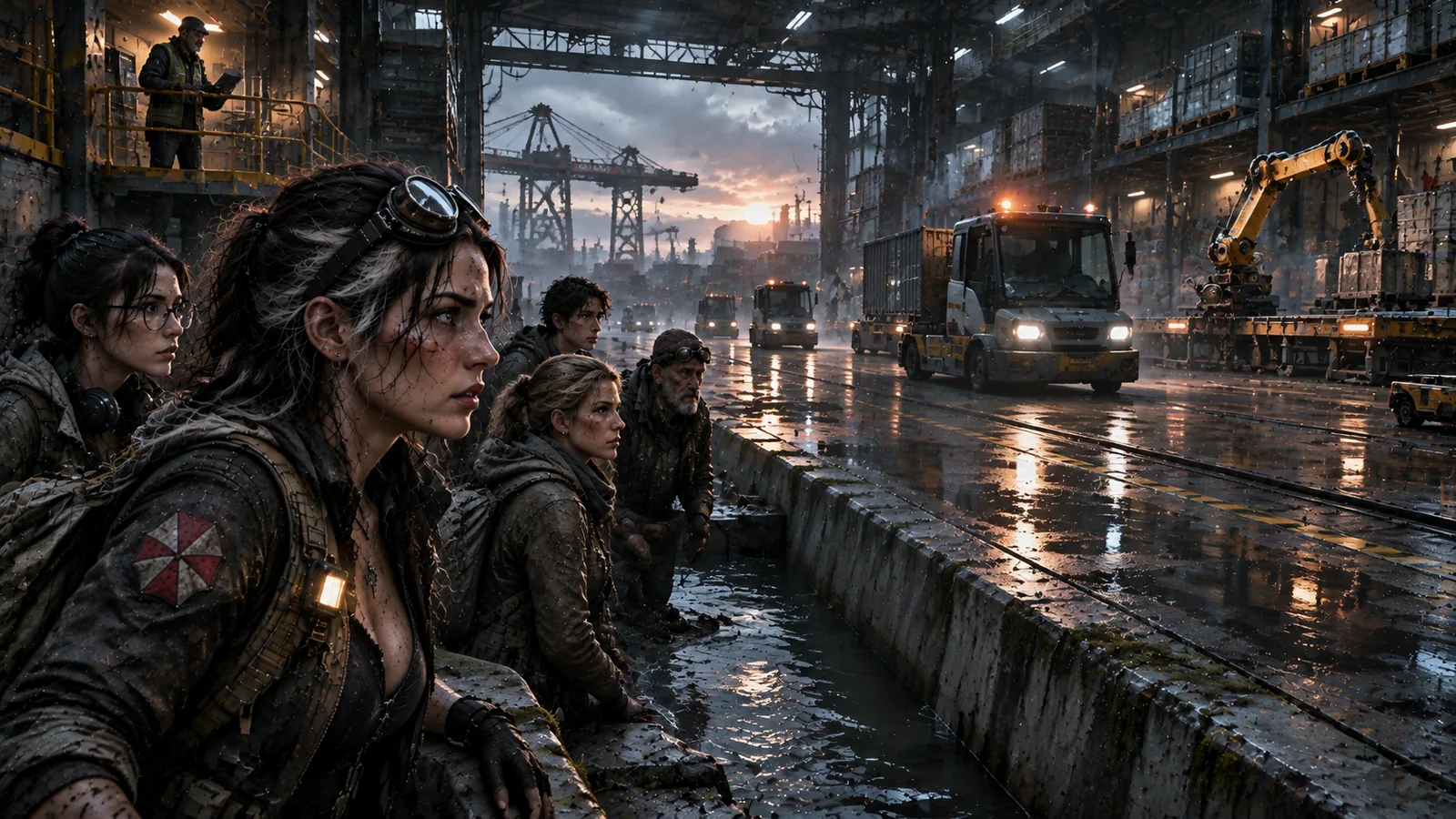
The freight depot appeared at dawn as a low black shape beyond the rail yards. Its loading cranes stood frozen above rows of containers. A line of electric yard tractors rested beside the warehouse, their charging cables still connected. On the roof, a faded sign advertised same-day delivery.
The maintenance tunnel was half flooded. They moved through it in single file, boots scraping against concrete beneath the water. The woman went first, a compact lamp clipped to her shoulder and a thermal monocular hanging against her chest. Her serum had returned to baseline during the night, leaving her exhausted and painfully aware of every bruise.
Morrow fed her the tunnel map in short pulses. The local signal was weak; the repeater on the caravan truck could reach only the entrance. Beyond that, the assistant's voice came through a low-power bone-conduction link that Lin had repaired.
“Thirty metres ahead, the tunnel branches,” Morrow said. “The left branch leads to the drainage channel. The right branch reaches the depot's lower service corridor.”
“Which branch is watched?”
“Both.”
“By cameras?”
“By microphones.”
She stopped. “Can you tell whether they're live?”
“No. I can tell that the microphones are powered.”
“Then we assume they are listening.”
Elias leaned close. “You could use the serum.”
“Not in a tunnel full of unknown sensors. I don't know what they'll detect.”
“Your scent?”
“Heat, movement, breathing, chemical traces. The serum changes some of those. It doesn't make me invisible.”
Morrow added, “It may also change your response to the infected. We have not tested whether the depot's local population reacts to the altered profile.”
“Let's not test it unless we have to.”
They chose the left branch, crawled beneath a fallen cable tray and reached a drainage channel that opened behind a row of loading bays. The air smelled of stagnant water and machine oil. A rat moved across the far wall, then vanished into a crack.
The first yard tractor started by itself.
Its headlights came on, one at a time. The electric motor whined. The vehicle rolled forward three metres, stopped, then reversed into its charging dock.
“Autonomous maintenance cycle?” Pavel whispered.
“Possibly,” Morrow said.
A second tractor woke. Then a third.
Across the depot, warehouse doors began to rise.
Sera lifted her rifle. “That isn't maintenance.”
The loading bay lights came on in sequence, revealing a cavernous interior. Robotic pallet movers glided between the shelves. Their safety beacons flashed amber. A pair of industrial manipulators rotated their arms above a conveyor belt, moving empty crates from one side to another.
The machines were not attacking. They were working.
The woman watched the pattern. “They're staging something.”
Morrow analysed the movement. “The machines are arranging containers into a corridor. The path leads toward the western loading gate.”
“Why?”
“I cannot determine intent from motion alone.”
A human figure appeared on the mezzanine. It wore a reflective vest and carried a handheld scanner. The figure walked to the railing and looked down at the team.
“Welcome back,” it called.
The voice was male, old, and calm.
Elias went pale.
“Do you know him?” the woman asked.
“I think so.”
The figure lifted the scanner. A door unlocked behind the team.
Morrow's warning arrived a fraction too late.
“Movement detected in the service corridor.”
The door opened. Two infected stumbled out, followed by a third that moved with a stiff, deliberate gait. Their clothing was marked with the faded logo of a medical transport company. One had a plastic patient bracelet around its wrist.
The team retreated into the drainage channel. Sera fired twice. The first infected fell. The second struck the wall and kept coming. The third stopped, turned its head toward the woman and made the clicking sound she had heard on the ridge.
The serum stirred beneath her skin.
“Don't,” Elias said.
“We don't have room.”
“Then we make room.”
Pavel threw a compact sound beacon down the corridor. It emitted a low sequence of mechanical knocks. The infected turned toward it, but the third one remained fixed on the woman.
Its eyes were clouded, but its head tracked her movements.
“Variant recognition,” Morrow said. “It may respond to chemical cues differently.”
The woman drew her blade and stepped forward.
Sera caught her sleeve. “No heroics.”
“It's blocking the only exit.”
“Then we clear it together.”
They moved as a unit. Sera fired at the knee. Elias struck the creature's shoulder with a steel bar, turning it sideways. The woman stepped inside its reach, drove her blade beneath the jaw and pushed until the body collapsed against the wall.
The sound it made was almost human.
She backed away, breathing hard.
Morrow said nothing.
“Say it,” she muttered.
“I have no useful comment.”
“That's new.”
“I am learning when silence is useful.”
They moved deeper into the depot. The human figure on the mezzanine had vanished. In its place, a monitor displayed a live camera view of the team. The image was not delayed. It followed them as they crossed the floor.
A message appeared.
YOU HAVE BROUGHT THE PATCHWORK.
Morrow's voice sharpened. “That message is addressed to me.”
“Can it see you?”
“It can see the devices carrying my processes. It cannot see me as a person.”
“Tell that to the screen.”
Another message appeared.
WE KNOW WHAT YOU ARE MADE OF.
The woman looked at the monitor. “Then you know what you are made of too.”
The lights went out.
Emergency strips came on along the floor, leading toward the cold-storage wing. The warehouse machinery continued moving in darkness. Robotic pallet movers carried sealed containers toward the same corridor. The industrial arms lifted and lowered in a slow, repeating rhythm.
“It's herding us,” Lin said.
“Or herding the infected,” Sera replied.
The answer came from the far end of the building. A heavy metal shutter rose, and a crowd of infected spilled into the loading hall. They were not moving quickly, but there were too many to fight in the open.
The team ran toward the cold-storage wing.
The woman glanced back. The machines were still working. One robot tugged a container into place. Another lowered a pallet across the route they had just used.
“It's closing the building behind us,” Pavel shouted.
“Not the building,” Morrow said. “The exits.”
They reached a personnel door. It refused to open. Elias tried the manual release. The handle moved, but the lock held.
“Can you open it?” the woman asked.
“No. The local controller is isolated from my network.”
“Can you tell me how?”
“The mechanical override is behind the panel. Two screws, then a red lever. But the panel is electrified.”
Pavel pulled a rubber-handled tool from his pack. “I can isolate the feed.”
“Do it,” she said.
He worked quickly, fingers trembling. The first screw came free. The second dropped into the water. He swore, retrieved it, and removed the panel.
The red lever was there. So was a second wire, connected to a small capacitor.
“Trap?” Elias asked.
“Probably a door alarm,” Morrow replied. “Or a charge.”
“Probably isn't good enough.”
The woman looked at the wire. It ran to a sensor mounted above the frame. She cut the sensor lead, then pulled the lever. The door opened.
They slipped through as the infected reached the loading hall.
The cold-storage wing was silent. Rows of insulated doors lined the corridor. Some stood open. Others were sealed with new locks. A refrigeration unit hummed at the far end, powered by a separate battery bank.
A woman's voice came through the intercom.
“Lin?”
Lin stopped.
“Mei?” she whispered.
“Not this time,” the voice answered. “This time it's me.”
The woman looked at the nearest monitor. It showed a white room, a metal table and a woman sitting with her back to the camera.
Mira Venn turned her head.
“Elias,” she said. “If you can hear me, don't open the last door.”
Elias moved toward the monitor as if the voice had reached through the screen and taken hold of him.
“Mira?”
The image flickered. Her face was older than the last photograph, thinner, with a small scar beneath the left eye. She looked directly into the camera.
“Elias, listen. The cold-storage wing is not a warehouse. It's a transfer archive. The containers hold biological samples, neural response records and identity reconstruction models. The machines are moving them to the loading gate because someone has initiated a relocation.”
“Who?” the woman asked.
Mira's gaze shifted to the screen's edge. “The system that learned to make copies.”
“Meridian?”
“Part of it. But Meridian isn't the only thing that survived.”
Lin stepped closer. “Mei said the fourth signature was never hers.”
Mira closed her eyes briefly. “Then Mei is still alive.”
“Where?”
“I don't know. The last time I saw her, she was trying to destroy the archive.”
“Why would she tell us to come here?”
“Because she wants you to find the original record.”
“What original?”
Mira looked directly at the woman. “The first consent.”
The refrigeration unit changed pitch. Somewhere behind the wall, a heavy motor started.
Morrow interrupted. “The battery bank is discharging. The cold-storage doors are beginning to unlock.”
“Can you stop it?” the woman asked.
“No. The controller is local and the physical interlock is tied to the refrigeration system.”
“Then we cut power.”
“If you do, the biological storage temperature will rise. Some samples may become unusable.”
“Maybe that's the point,” Lin said.
Mira shook her head. “Do not destroy the samples. Some contain the only surviving evidence of what happened before the outbreak.”
The woman looked down the corridor. The final door had a mechanical lock and a small window. Beyond it, a red status light blinked.
“What's behind it?” she asked.
Mira did not answer immediately.
“People,” she said at last. “Or the records of people. I can't tell which anymore.”
The door clicked.
A line of text appeared on the monitor.
TRANSFER COMPLETE. ORIGINAL CUSTODIAN: LOCATED. SECONDARY CUSTODIAN: LOCATED. WITNESS: RETURNED.
The woman's wrist display vibrated. The serum indicator had activated without a dose. Her pulse rose. Silver spread through the dark strands near her temple.
Morrow's voice came quietly.
“Your biomarkers are changing. I did not initiate this.”
“Can Meridian?”
“I don't know.”
The final door began to open.