The caravan ledger had been designed to survive dishonesty. It had not been designed to survive a person who could imitate three honest people.
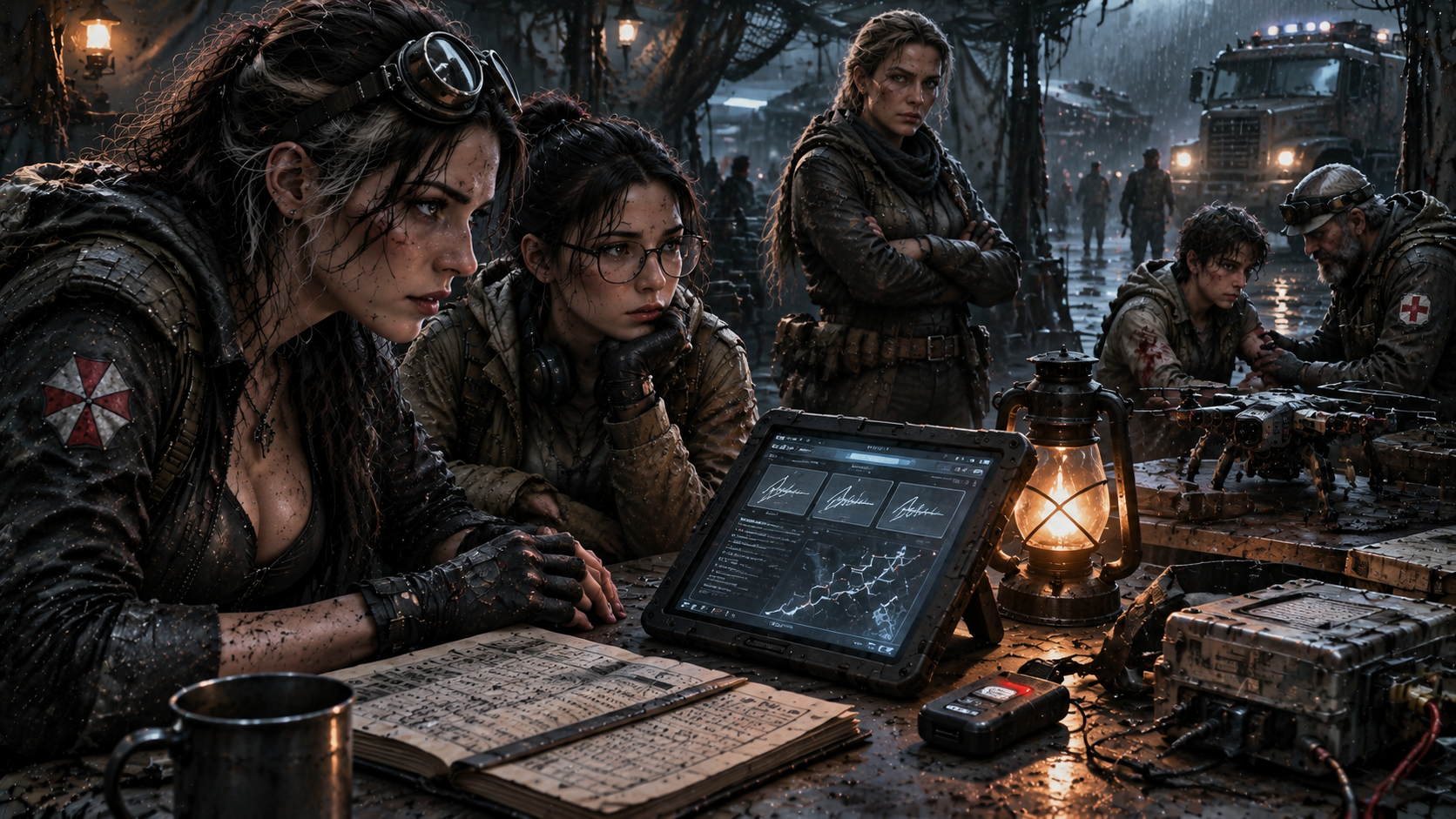
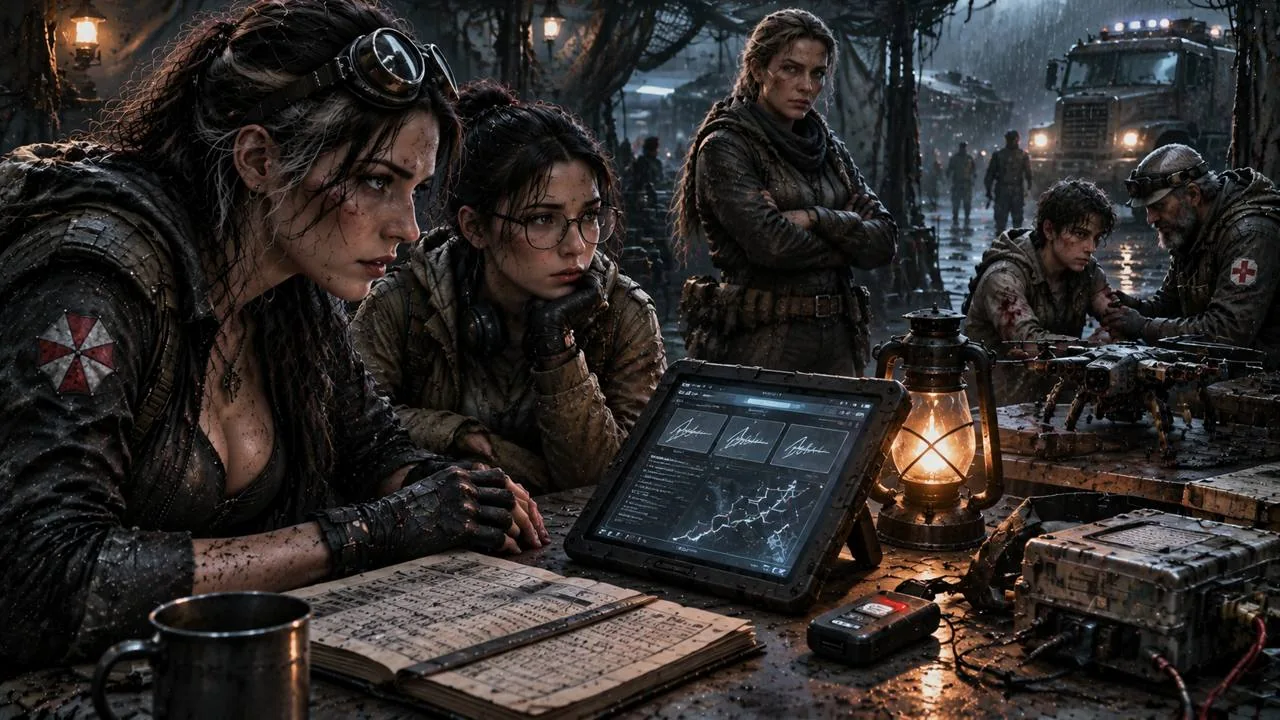
Daria laid the tablet on the repair bench and called the quartermaster, the mechanic and the woman who managed the medical stock. Each examined the hidden transfer in silence. The transaction had moved a reserve of energy credits into an account labelled LANTERN-7, then split the balance across four dormant addresses. It had been authorised by three signatures: Daria's, the quartermaster's and a certificate belonging to a mechanic who had been dead for eleven months.
Nobody spoke for a while.
“Could someone have copied his key?” Elias asked.
“Not the physical key,” said the quartermaster. “He carried it in a sealed token. We buried the token with him.”
“Did you bury the man?”
Daria looked at him. “Yes.”
Morrow spoke through the small speaker on the bench. “A key can be copied before its destruction. The ledger confirms that the signature is mathematically valid. It does not prove the person was alive when it was made.”
“That distinction is going to get people killed,” Sera said.
“It already has,” Lin replied.
Daria's hand tightened around the tablet. “The reserve wasn't just money. It represented thirty-six battery modules, two water-purification units and a medical cold box. Someone has made those resources disappear from our books.”
“Not disappear,” the woman said. “Move them.”
“To where?”
She looked at the destination addresses. Each had been created through the same local exchange point. The oldest was registered to the freight depot north of the ring road.
“The depot,” she said.
Daria gave a short, humourless laugh. “Of course it's the depot.”
The caravan had been preparing to reach it for weeks. The warehouse was one of the last places in the district where large battery packs might still be stored under controlled conditions. The same depot had swallowed two scouts and returned one radio without its owner. If the hidden transaction was genuine, then someone had used the caravan's own accounting system to reserve the energy before anyone could claim it.
“Maybe this is a warning,” Pavel said. “Maybe whoever took the reserve wants us to follow.”
“That's what a trap would want,” Sera answered.
“Then perhaps we shouldn't follow.”
“And let them keep the batteries?”
Pavel looked around the table. “I was hoping someone would say yes.”
Daria turned to the woman. “You offered to go first. Is that offer still valid?”
“Yes.”
“Then I want something else. If you find the reserve, you don't take it all. The caravan needs enough to keep the northern route alive. The rest goes back into the settlement pool.”
“Agreed, if the stock is real and the claim is legitimate.”
Daria frowned. “You want to audit the thief?”
“I want to know whether the thief is stealing from you, or whether your ledger has been used to hide something worse.”
Morrow displayed a second map. The four destination addresses formed a rough arc around the depot. One lay beneath an abandoned fuel station, another inside a municipal cold-storage building, the third at a roadside charging hub. The fourth was not a location at all. It was a device identifier.
“An account without a place,” Elias said.
“A mobile node,” Morrow replied. “It has been active intermittently. Its last known position was inside the caravan.”
Every face turned.
The caravan's generator rattled outside. Somewhere, a child shouted with laughter. The ordinary sounds made the silence at the bench feel even more dangerous.
“Search the vehicles,” Sera said.
“No,” Daria replied. “Not like that. We search with consent. No one gets treated as a thief because a machine says so.”
The woman glanced at her. “That's a good rule.”
“It's an expensive one.”
“Most good rules are.”
They began with the flatbed. Its battery racks were secured with steel straps, each module marked with a handwritten serial number. The quartermaster checked the seals while Pavel inspected the wiring. Beneath the rear platform, Morrow detected a weak radio pulse.
The device was smaller than a cigarette packet, wrapped in black insulating tape and fixed behind a support bracket. It had no visible antenna. Its battery was almost exhausted.
“Passive beacon,” Morrow said. “It has been recording proximity handshakes.”
“Can you read it?”
“Not without waking it.”
“Then don't.”
The woman crouched and studied the bracket. A thin filament ran from the beacon to the flatbed's load sensor. It had been installed carefully, without damaging the original wiring. Whoever placed it knew the vehicle.
Daria stared at the device. “The mechanic who died used to service this truck.”
“Could someone else have had access?” Elias asked.
“Half the caravan.”
The woman looked at the dead mechanic's certificate again. A valid signature did not mean a living person. A familiar voice did not mean a friend. A ledger could preserve a promise, but it could not tell them whether the promise had ever been honest.
“Bag it,” she said. “No power. No radio. We'll take it to the depot and compare it with the local equipment.”
Morrow's voice lowered. “There is a second message embedded in the transaction.”
“Show me.”
A short text string appeared:
THE NORTH ROUTE IS NOT SAFE. THE SOUTH ROUTE IS NOT REAL. ASK THE WOMAN WHO NEVER ARRIVED.
Lin's expression did not change. That was what made the woman look at her.
“Do you know what it means?”
“I know three women who never arrived,” Lin said. “Two are dead. One is standing here.”
“Which one?”
Lin met her eyes. “That depends on which version of my records you believe.”
Before the woman could answer, the caravan's perimeter alarm sounded twice. Not the sharp triple pulse used for infected. Two long notes, followed by a pause.
Daria was already moving. “Human approach.”
At the gate stood a boy of perhaps seventeen, soaked to the skin and carrying a broken drone under one arm. He had walked alone from the southern road. His left sleeve was dark with blood.
“I need a doctor,” he said.
The medic hurried forward.
The boy looked past her and fixed his eyes on the woman.
“You're the one with the silver hair,” he said. “They told me you'd come.”
“Who told you?”
He swallowed. “A woman in a white room. She said the dead machine would send you north. She said not to trust the caravan's lights.”
The woman felt Morrow go silent in her ear.
“What was the woman's name?” she asked.
The boy shook his head.
“She said she was your sister.”
Lin's face finally changed.
“Mei,” she whispered.
The boy nodded. “She said to tell you the freight depot isn't the nest. It's the door.”
They treated the boy in the clinic trailer. The wound was a shallow cut along his ribs, but he was dehydrated and running a fever. The medic found no bite marks. He gave his name as Tomas and said he had come from a settlement beyond the river, a place called Bellwether where the residents had built a working water plant around an old brewery.
He had not come alone by choice. His drone had been following him, damaged but still recording. The last three minutes of footage showed a woman in a white room, seen through a reflection in a dark window. Her face was blurred by compression. Her voice was clear.
“Tell Lin that the fourth signature was never mine.”
Lin listened without moving.
The recording continued. “Tell the custodian that the first archive was not built to preserve the dead. It was built to decide which living people would be allowed to continue.”
Then the image broke into static.
“That's Mei,” Lin said.
“Are you sure?” Elias asked.
“No.”
It was the first honest answer she had given about her sister.
Morrow separated the audio from the damaged video. The speaker's cadence matched Mei's known recordings, but the sample was too short to establish identity. The background contained a low industrial hum and a repeating mechanical click.
“Can you identify the room?” the woman asked.
“Not yet. The sound profile resembles a large refrigeration plant or an underground laboratory.”
“Could it be the freight depot?”
“Possible. The depot has a cold-storage wing.”
Lin folded her arms. “Mei wants us to go there.”
“Or someone wants us to believe she does,” Sera said.
The woman looked at the map. “Either way, the depot is connected to the missing reserve, the dead mechanic's signature and a message sent to Morrow. We go prepared, and we keep our own route out.”
Morrow displayed a route with three fallback points. “I recommend a daylight approach. The main road is exposed. The drainage canal offers cover for the first kilometre, but the water level has risen. There is also a maintenance tunnel beneath the rail spur.”
“Which one is least likely to be watched?” Pavel asked.
“I cannot know.”
“That's reassuring.”
“I can tell you which one has the fewest active sensors.”
“Better.”
The woman looked toward the clinic trailer. Tomas was asleep beneath a thermal blanket. The caravan's mechanic was printing a replacement bracket for the robot dog. A child had placed a paper lantern beside the entrance, its flame protected inside a jar.
They had spent years building systems that promised to remove uncertainty. The outbreak had taught them that uncertainty was not a bug. It was the space where a person still had to choose.
“Daria,” she said, “we leave at first light. Your people stay here. If the depot tries to call the infected, you move the caravan east and shut down every visible light.”
“And if you don't return?”
“Then don't follow the beacon.”
Daria held out her hand. The woman shook it.
The agreement was stored on paper, on two isolated tablets and in the memories of the people who had witnessed it. It was not perfect. It was enough.
That night, Morrow asked a question it had not asked before.
“Do you believe Lin?”
“No.”
“Do you believe she is lying?”
“Not always.”
“Is that sufficient for cooperation?”
“Sometimes it's all we get.”
Morrow considered this.
“I have found another anomaly in the hidden transfer. The three signatures were not used to authorise the theft. They were used to authorise a purchase.”
“What purchase?”
“A service contract. The caravan has been paying for something every month.”
“What?”
“An insurance policy.”
The woman sat up.
“Against what?”
Morrow displayed the contract name.
CONTINUITY OF PERSONNEL. BENEFICIARY: UNLISTED. CLAIM EVENT: DEATH OR RECONSTRUCTION.
She stared at the screen until the letters blurred.
Somewhere outside the caravan, the wind moved through the empty toll lanes. A paper lantern trembled in its jar.
“Who bought life insurance for the dead?” she asked.
Morrow answered softly.
“Someone who expected them to return.”