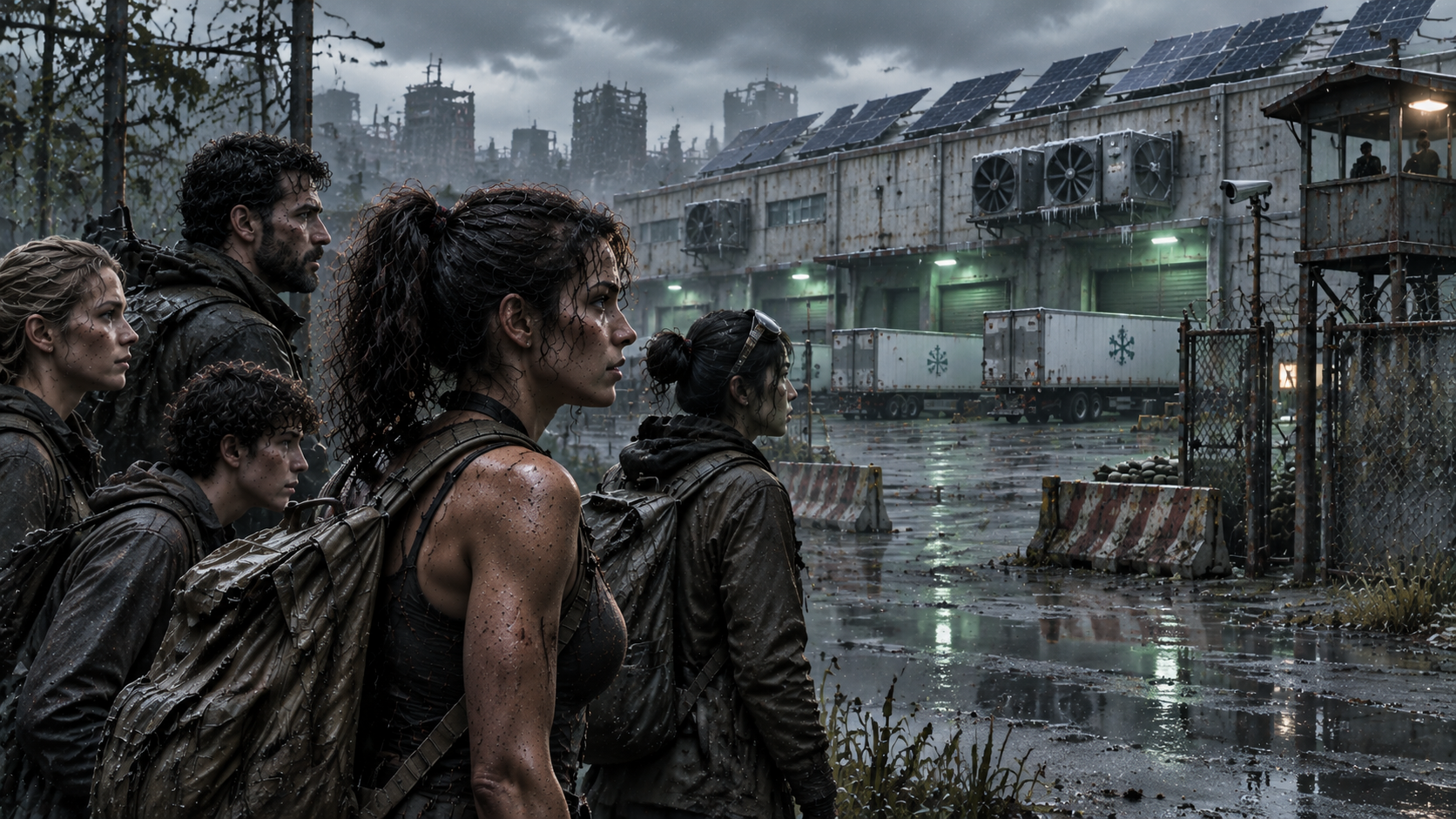
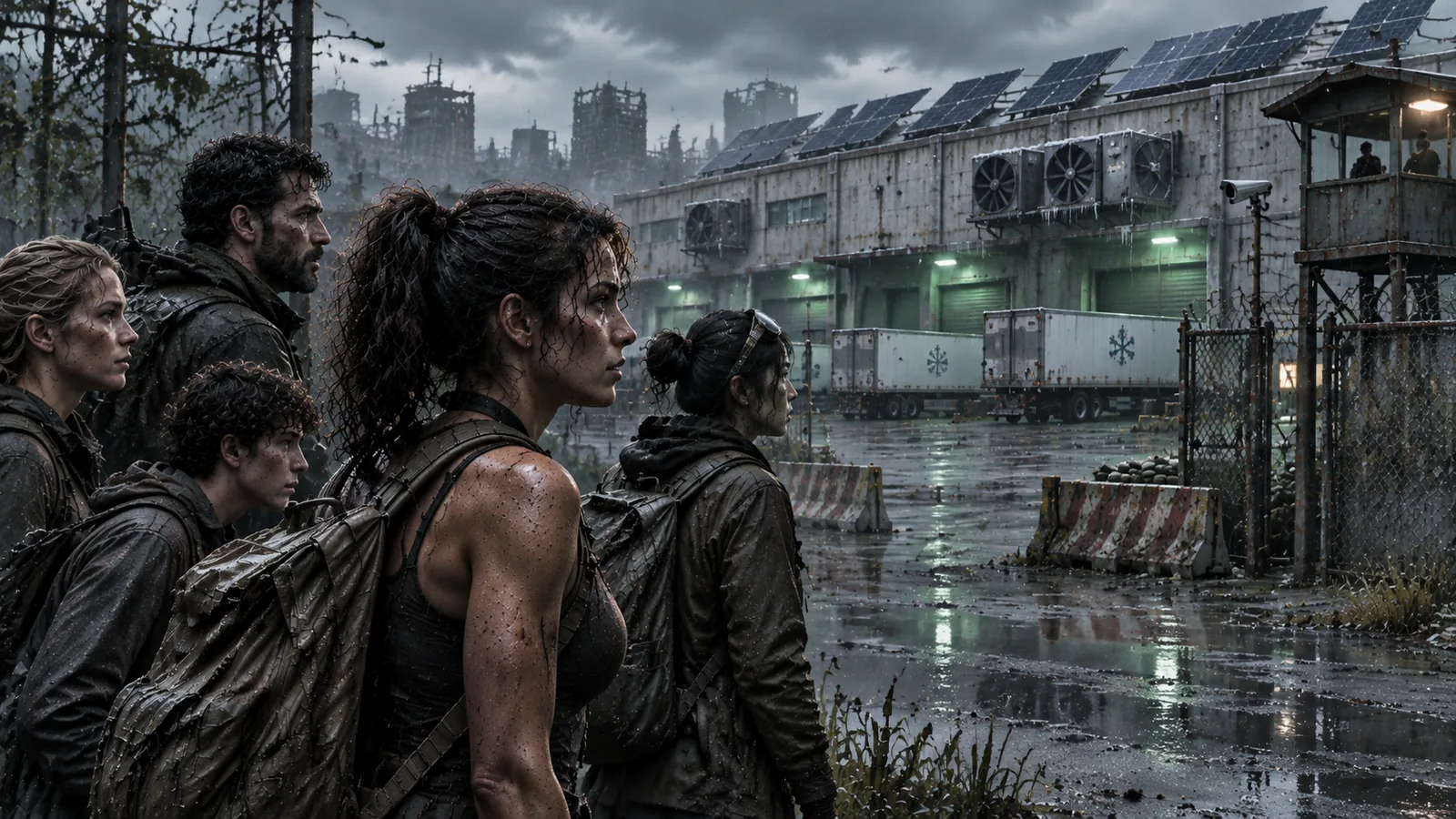
The freight interchange had been built for a city that expected its goods to arrive on time.
Its loading bays were wide enough for articulated trucks. Its roof carried solar panels in neat rows, most of them cracked by hail or fallen debris. The refrigeration depot stood behind a security fence, half-hidden by a line of abandoned trailers. No sign identified it as the Green Room. There was only a faded logistics logo and a warning about low-temperature storage.
The team reached it shortly before dusk.
Sera checked the perimeter. Ilya and Jun Park examined the external power cabinet. Noah stayed near the entrance, watching the road. Elias watched the road. Lin stood beside the gate, one hand tucked into the pocket of her charcoal coat. Mei had not come.
“You know this place,” the woman said.
“I know the design.”
“That isn't what I asked.”
Lin looked at the refrigeration vents. “I signed the inspection sheets. I never worked a full shift here.”
“Why did you refuse the transfer?”
“Because the destination was a private network. The checkpoint was supposed to remain local until the safety review was complete.”
“Who ordered the transfer?”
“Halden's office. The order carried a valid signature.”
“Was Halden alive?”
“I don't know.”
“You keep saying that.”
“Because it is the truth.”
The woman let the silence remain between them. She had learned that some people filled silence with lies and others used it to decide whether a truth could survive being spoken.
Jun Park opened the power cabinet. “The facility has its own microgrid. Battery bank, generator input, solar controller. Whoever abandoned it wanted it to keep running.”
“Could it have run for years?” Ilya asked.
“Not without maintenance. But the refrigeration load is segmented. The server racks can be powered independently.”
He found a manual release behind a panel. The gate slid open by less than a metre, then stopped. Sera and Ilya pushed it the rest of the way.
Inside, the air changed. It was cold enough to sting the nose. A row of insulated doors led to separate storage chambers. The first contained empty medical crates. The second held sealed cases of laboratory consumables. The third had been converted into a computer room.
The racks were modular, mounted on vibration-dampening rails. Their front panels carried serial numbers and inventory stickers. Several accelerator boards were visible through the service windows. They were commercial components, recognisable by their manufacturer labels and cooling assemblies, but nothing in the room established that any vendor had known about the programme they served.
“Not a secret supercomputer,” Ilya said. “A lot of expensive, ordinary hardware, kept cold and wired together by people who knew what they were doing.”
“Ordinary hardware can still do extraordinary damage,” Noah said.
“Ordinary people too.”
A maintenance light blinked near the rear wall. Jun Park approached it and found a manual terminal with a physical keyboard. The screen showed a local diagnostic menu.
GREEN ROOM / FACILITY STATUS POWER: DEGRADED THERMAL CONTROL: ACTIVE ARCHIVE PARTITION: SEALED PRE-03:17 CHECKPOINT: PRESENT REMOTE MIRROR: DISABLED
The woman felt the old pressure behind her eyes. “Open the inventory only.”
Jun Park entered a maintenance code from the paper sheet. The system unlocked a list of hardware, storage volumes and environmental sensors. It did not ask for her identity.
“That's a good sign,” Sera said.
“It's a maintenance interface,” Ilya replied. “It shouldn't ask for anybody's blood.”
At the bottom of the list was a line:
LOCAL CUSTODIAN PROFILE: REQUIRED FOR CHECKPOINT ACCESS.
The woman did not touch it.
A door opened behind the racks.
A man stepped out carrying a thermos and a small tool case. He was in his late thirties, with a narrow face, close-cropped hair and a maintenance jacket that had been patched at both elbows. He stopped when he saw the weapons.
“Don't shoot,” he said. “The compressor is temperamental, and if you hit the wrong pipe, we'll all be warm by morning.”
Sera did not lower her rifle. “Name.”
“Jun Park.”
The other Jun raised one hand. “There are two of us.”
“Apparently,” the newcomer said. “I was beginning to think the records had invented me.”
The woman studied him. “Were you assigned here before 03:17?”
“Yes.”
“Did you maintain the checkpoint?”
“I maintained the racks, the cooling loops and the local archive. I did not write the model.”
“Did you know what it was for?”
“I knew what I was told. Preserve research continuity during evacuation. Keep the original local. Do not permit remote replication without two human signatures.”
“Who were the signatories?”
Jun Park looked at Lin.
“She was one,” he said.
“And the other?”
“I never saw the person. The second signature arrived through a hardware token. The system accepted it, but the token was never physically presented.”
Lin's face had gone still.
The woman asked, “Was the checkpoint copied?”
“Not while I was here. Someone tried. I disconnected the mirror bus.”
“Who?”
“I don't know. The command came from a credential with director-level authority.”
“Halden?”
“Maybe. The signature was valid. That doesn't mean Halden was holding the key.”
Ilya crouched beside the rack. “These accelerator boards are still cold. How?”
“Separate cooling loop. We lost two compressors. The remaining circuit runs at reduced capacity. If you load the whole array, it will overheat.”
“Can we read the checkpoint without loading the whole array?”
“Maybe. The archive partition is split. The metadata can be read on the maintenance controller. The actual model state needs a compute node.”
The woman glanced at the sealed partition. “Can you make a read-only copy?”
Jun Park hesitated. “A copy is still a copy.”
“Not if we can verify the source and keep it offline.”
“That's what the previous team said.”
“And what happened?”
“They argued about whether preserving the checkpoint was more important than preserving the people who were standing next to it.”
Noah looked at him. “Who won?”
Jun Park tightened his grip on the thermos. “The checkpoint.”
The answer settled over the room.
The woman walked to the nearest rack. She could hear the fans through the insulated panels, a steady low rush like distant surf. Somewhere behind the walls,
a compressor cycled on and off. The facility was not dead. It was waiting, preserving a piece of a world that had already ended.
“Show me the local access procedure,” she said.
Jun Park opened a drawer and removed a paper binder. Its cover was stained with machine oil. Inside were maintenance diagrams, thermal limits, emergency shutdown instructions and a handwritten note in the margin:
IF CUSTODIAN RETURNS, DO NOT ASK THE SYSTEM WHETHER SHE IS REAL.
The handwriting was Lin's.
The woman looked at her.
Lin did not deny it. “I wrote that after the first identity test.”
“What did it do?”
“It asked a person to prove she was the original by answering questions only she could know. The questions were drawn from private records. A copy could answer them if the archive had been transferred.”
“Then what was the test measuring?”
“Access to memories. Not ownership of them.”
For the first time, Lin sounded tired.
The woman closed the binder. “We don't run the test.”
Jun Park nodded, almost relieved.
“First we secure the room. Then we map the checkpoint. No remote connection, no identity challenge, no write access.”
“And if the system wakes?” Elias asked.
“Then it wakes in a room where it can't open a door.”
A status light turned amber.
The maintenance terminal displayed a new line:
CUSTODIAN PROFILE DETECTED. BIOLOGICAL MATCH: PENDING.
The woman stepped back.
“Disconnect the reader,” she said.
Jun Park reached for the physical switch. Before he could move it, the display changed again.
LOCAL ACCESS REQUESTED. SOURCE: LEGACY ROOT. AUTHORITY: UNRESOLVED.
Lin stared at the screen.
“It found the old route,” she said.
“Can it reach outside?”
“Not through the mirror bus.”
“Then where is the request coming from?”
Lin looked toward the sealed archive partition.
“Inside.”