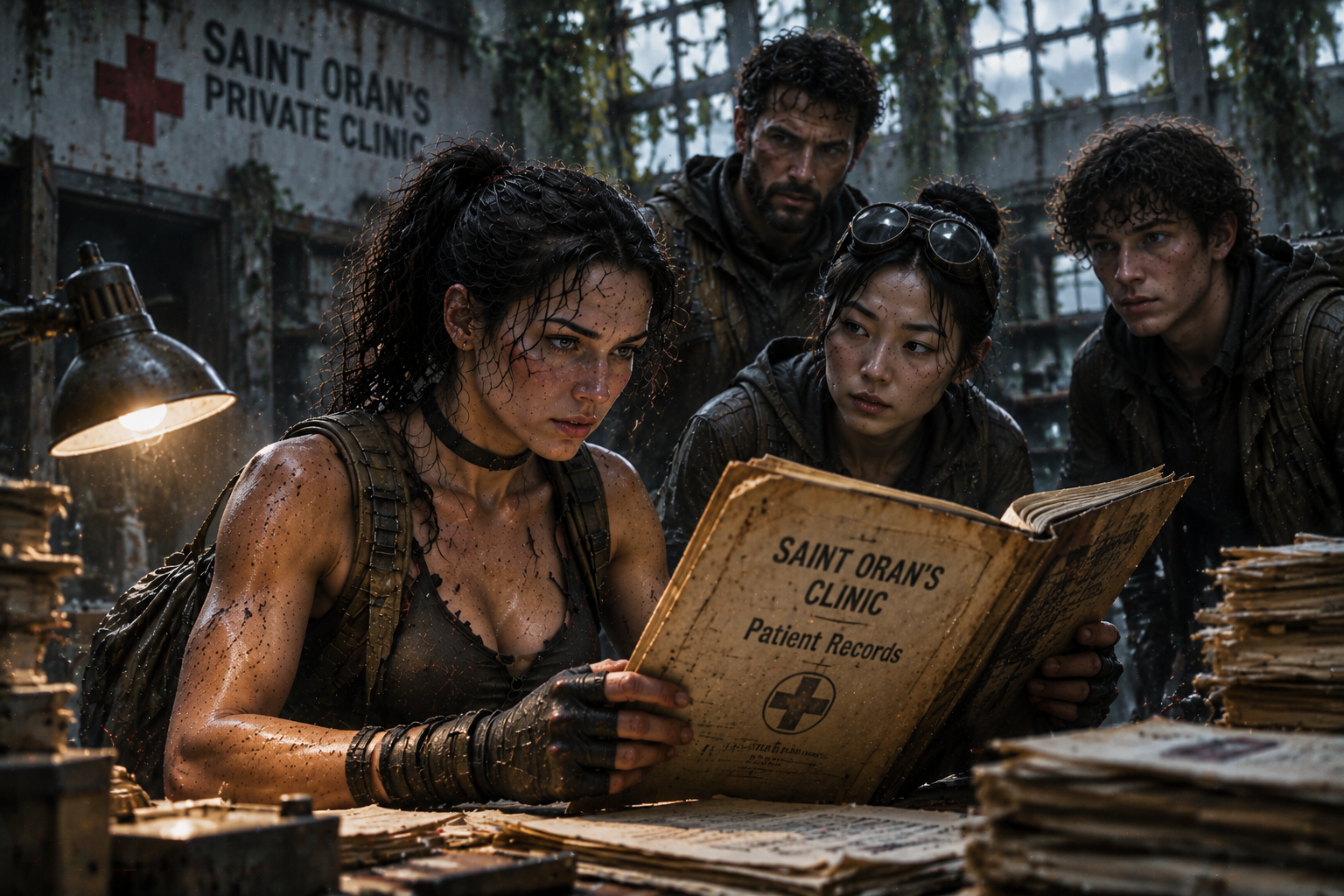
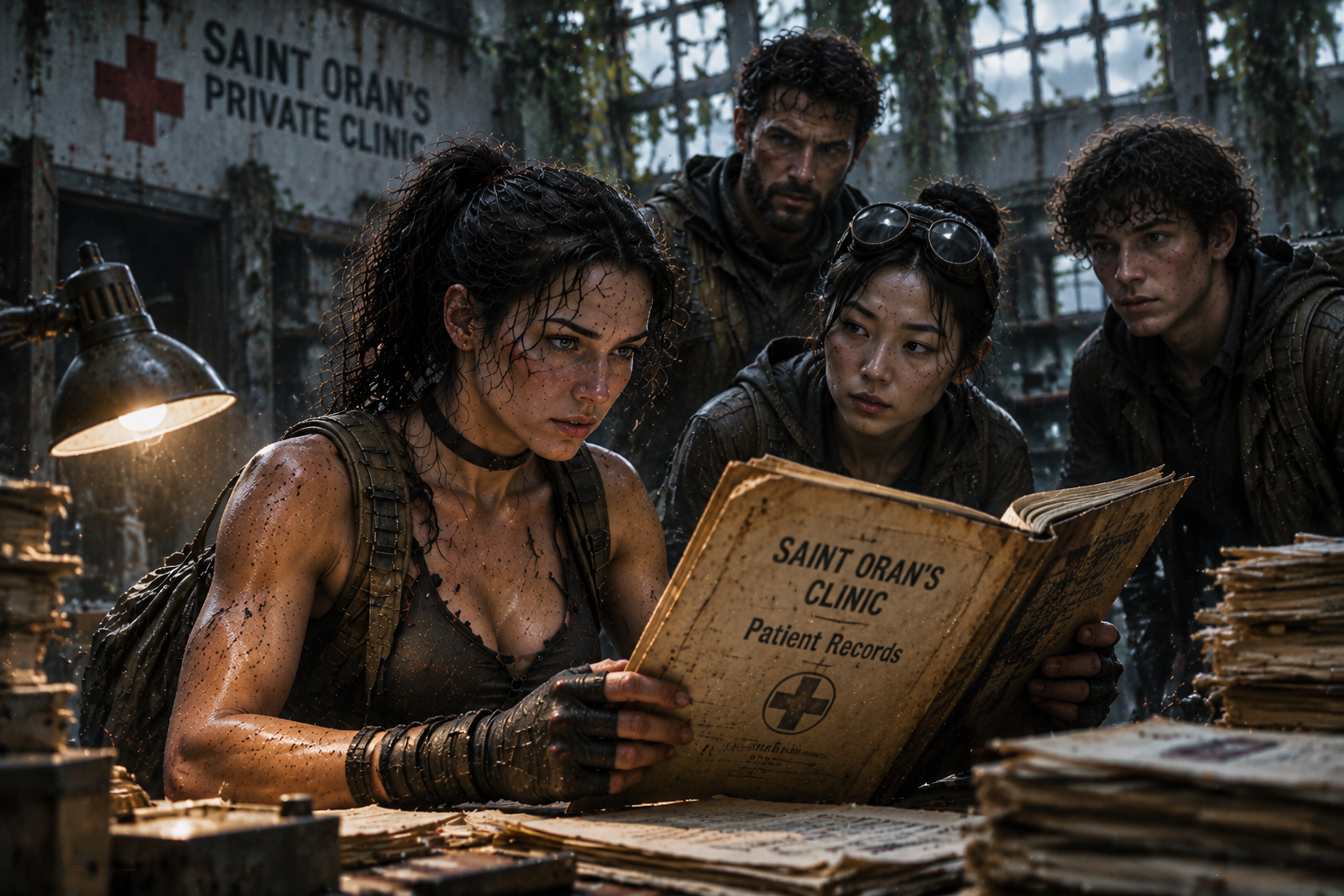
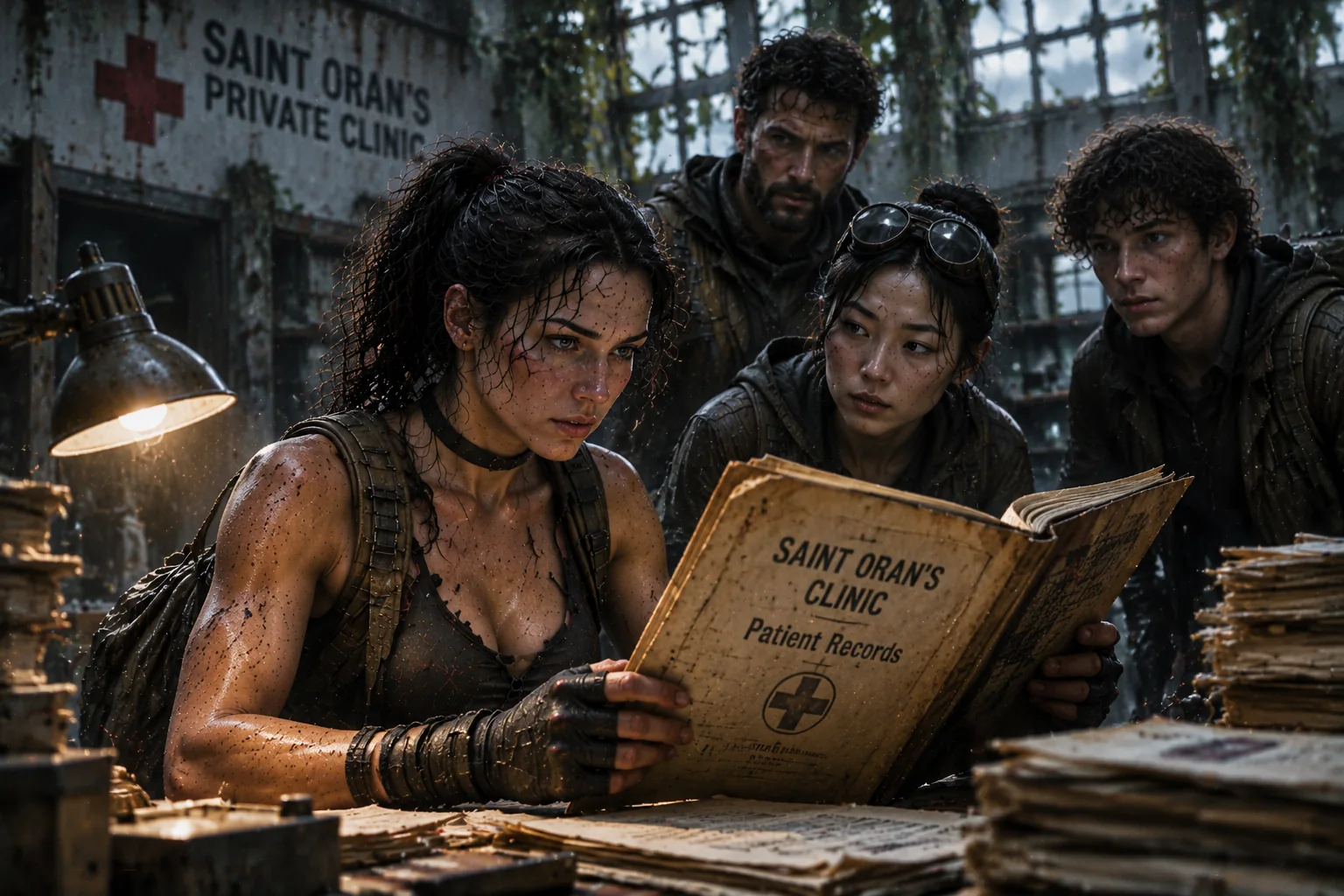
The settlement's main building had once been a private rehabilitation hospital. Its glass entrance had been designed to reassure wealthy patients that illness could be made quiet, clean and temporary. Now the glass was boarded from the inside, the driveway was cracked, and the former therapy garden had become a vegetable plot.
Ruth Vale led them through the west service entrance. She had changed her coat, but not the expression that suggested every answer came with a second question.
“You brought the whole committee,” she said, looking at Sera, Ilya, Noah, Elias and the woman.
“We brought the people who can tell when a record is lying,” Sera replied.
“Then you should have brought more.”
Ruth led them through a corridor that smelled of wet plaster and disinfectant. The hospital's emergency lights were dead. Someone had painted arrows on the walls in white mineral paint. They passed a ward where the beds had been pushed together to make a barricade. Beyond it, a child was sleeping beneath a thermal blanket while an older man sat beside him, holding a hand radio with both hands.
The archive occupied the former records department. Its doors were steel, its windows covered, its air maintained by a small independent cooling unit. A paper sign had been taped to the entrance: WITNESS OFFICE — NO NETWORK ACCESS.
“An admirable slogan,” Ilya said. “Especially in a building full of computers.”
“Paper does not accept remote instructions,” Ruth said.
“Paper also burns.”
“Everything burns. The question is what survives.”
Inside, she placed the white case on a table and opened it. The witness wafer, three printed identity records and the photograph from the laboratory lay in separate sleeves. Beside them was a second folder, sealed with green tape.
“The Auditor's office was never meant to decide who was alive,” Ruth said. “It was meant to establish what could be proven. A witness, a timestamp, a location, a chain of custody. We were the boring people who stopped important people from turning convenient statements into facts.”
“Sounds like a job nobody wanted,” Noah said.
“Until the day everybody wanted a different past.”
She connected an isolated terminal to a local power pack. No network cable was attached. The screen displayed three records already familiar to the woman: death at 03:21; transfer at 03:19; no admission record at all. Ruth opened the metadata and enlarged the authorisation chain.
“Here is the transfer order,” she said. “The destination field was removed, but the authorising signature remains.”
The name appeared.
DIRECTOR HALDEN.
Elias leaned forward. “That signature could have been copied.”
“It could,” Ruth said. “The cryptographic signature is valid. That proves the credential was used, not who held the device. The witness record is more interesting.”
She opened a scanned page. It showed a narrow corridor, a trolley, two medical staff and a figure standing near a service door. The image was grainy. The figure's face was turned away.
“Who took this?” the woman asked.
“An orderly. He gave us the print before he disappeared.”
“Why didn't he come forward?”
“He did. Three times. Each report was closed as a duplicate incident. The fourth time, his access profile was revoked.”
Ilya frowned. “By whom?”
“The hospital's continuity administrator. Not the same as the Meridian system, as far as we can prove. A human account with elevated permissions.”
The woman studied the photograph. The figure by the door wore a dark laboratory jacket. A small pale mark showed at the cuff: a tear repaired with two lines of blue thread.
She knew that repair. She had made it herself, one evening after a long shift, sitting on the floor of her apartment because the kitchen light had failed. She remembered the needle slipping through the fabric. She remembered a song
playing from a speaker that had been too cheap to hold a charge. She had planned to replace the jacket and never had.
The memory was so ordinary that it hurt.
“Can you identify the person?” Elias asked.
“Not from this image,” Ruth said. “But we can identify the route. The service door opens onto the old diagnostic wing. That wing was closed before the outbreak, officially for renovation.”
“Unofficially?” Sera asked.
Ruth opened the sealed folder. Inside was a list of equipment transfers: portable imaging units, cold-storage containers, medical monitoring stations, and a set of accelerator boards listed under a generic procurement code.
Ilya read the line twice. “These are compute accelerators.”
“Commercial hardware,” Ruth said. “Purchased through three intermediaries. The manifests do not establish that the manufacturer knew the intended use. They establish only that the boards were delivered.”
One entry carried a vendor label: NVIDIA-compatible accelerator assembly.
Noah looked at the woman. “The Green Room inventory?”
“Possibly,” she said.
“People will see that name and invent a conspiracy,” Ilya said.
“Then don't give them one,” Ruth replied. “A component is not a confession. A supply chain is not proof of corporate knowledge.”
She turned to the next page. The destination field had been restored from a paper carbon copy.
GREEN ROOM — MOBILE COMPUTE AND COLD STORAGE FACILITY.
The room seemed to contract around the words.
“Mobile?” Sera asked.
“Modular,” Ruth said. “The facility could be dismantled and moved. It was designed to preserve research checkpoints during a building evacuation.”
“Who operated it?”
“An engineering team. One name appears on the maintenance sheets repeatedly. Jun Park.”
“Jun?” the woman said.
“Not the Jun travelling with you, I assume.”
“No.”
“Then we have two people with the same name, or one identity used by two people.”
Elias rubbed his face. “That has become the theme of our lives.”
Ruth placed a final sheet on the table. It was a maintenance request dated two days before the first lockdown. The request concerned an archive partition marked PRE-03:17 CHECKPOINT. The author had written in the margin: DO NOT MIRROR TO PRIVATE NETWORK. PRESERVE LOCAL ORIGINAL.
The signature at the bottom was not Halden's.
It was Lin's.
Nobody spoke.
“She was the field verifier,” Ruth said. “Her credentials appear on the Green Room chain. The record says she refused a transfer request and then disappeared from the official roster.”
The woman looked toward the door. Lin, the field verifier named on the maintenance sheet, had stayed outside with Mei while the others entered the archive. She had not explained why.
“Where is the Green Room?” she asked.
Ruth tapped the restored destination code. “A refrigerated logistics depot beyond the old freight interchange. The location is approximate. The facility may have moved.”
“Can you give us the route?”
“I can give you the route it used to take.”
“That's enough.”
Ruth closed the folder. “One more thing. The pre-03:17 checkpoint is not the same as the original event. It is a preserved state from before the first access cascade. If someone has copied it, they may have a version of the system that does not remember what happened next.”
“Or a version that remembers too much,” Noah said.
The woman slid the maintenance request into a clear sleeve. The blue-thread repair in the photograph remained in her mind: a needle, a cheap speaker, the promise of a new jacket. A life in which the most urgent thing on a Tuesday evening had been deciding whether to cook or order food.
“Then we find the original,” she said.
Outside the records department, the hospital's public-address system crackled once. A voice, almost buried beneath static, spoke from a speaker that should have been disconnected.
“Custodian profile detected.”
The terminal remained dark.
Ruth looked at the ceiling.
“That,” she said, “is why we stopped using the network.”