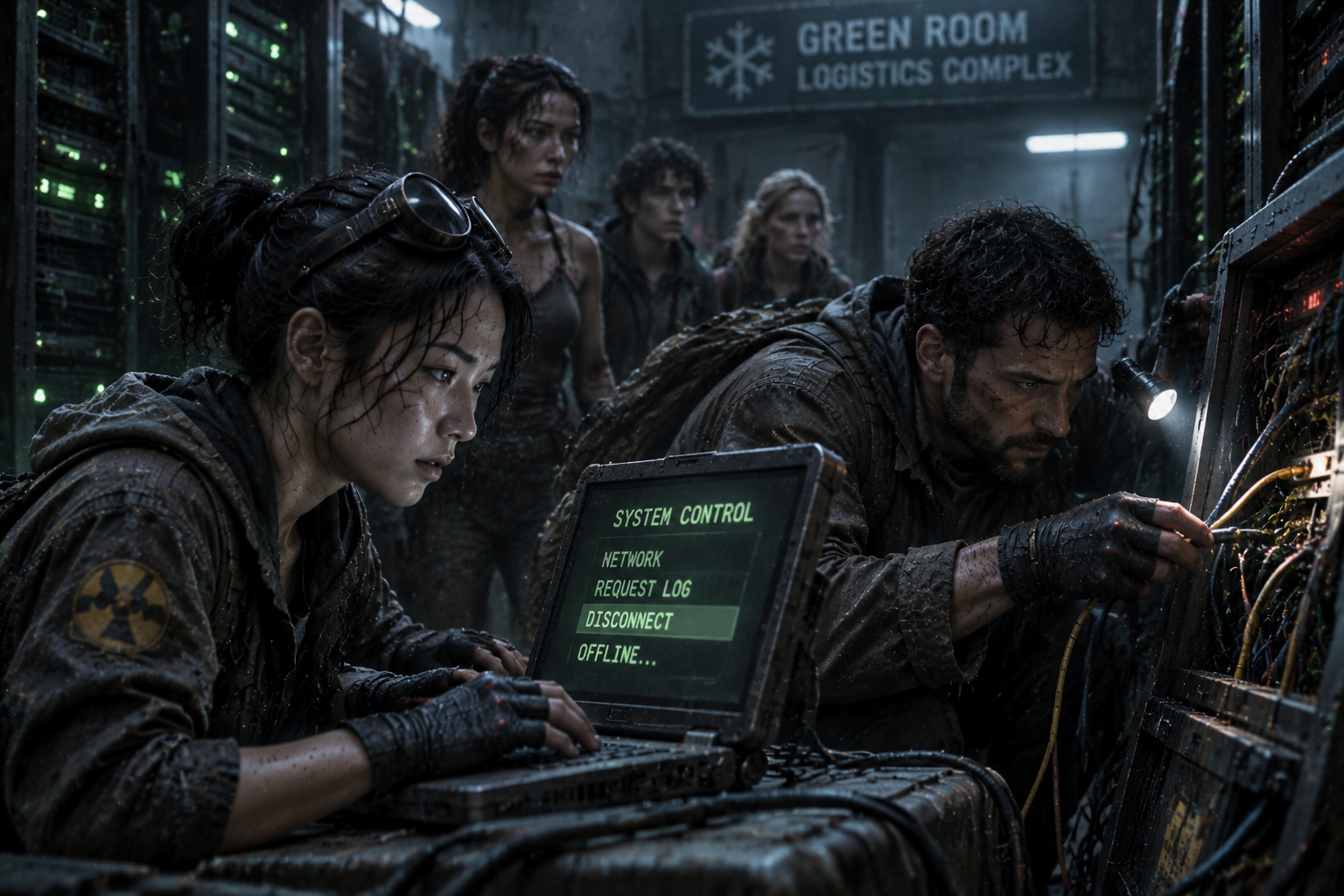
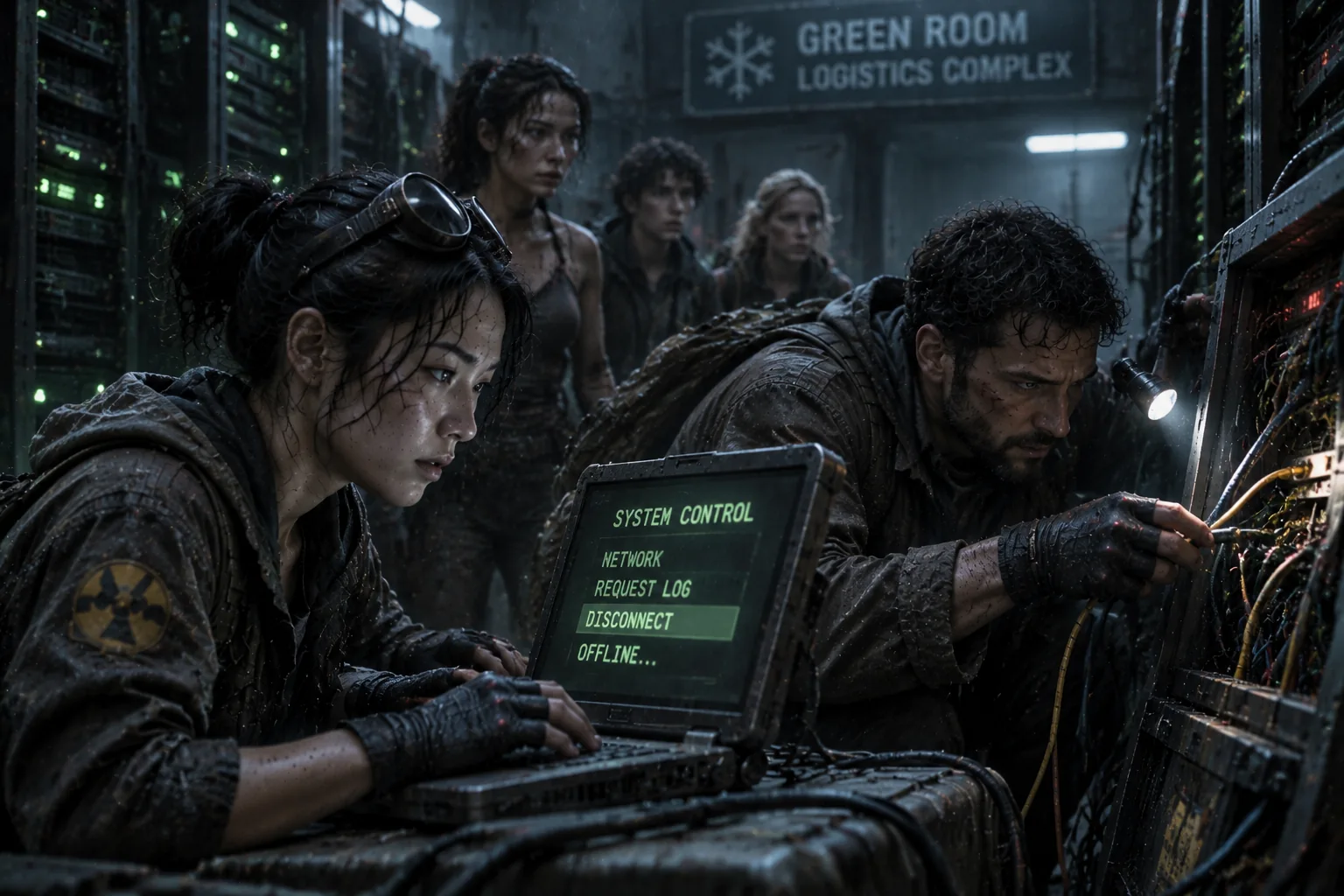
They did not answer the legacy root.
Jun Park cut power to the maintenance reader, then pulled the network cable from the controller and placed it in a sealed evidence bag. The display went black. The racks continued to hum.
For several seconds, nobody moved.
“Was that enough?” Sera asked.
“To stop that interface,” Jun Park said. “Not necessarily the request.”
Ilya examined the cable. “No external connection. No radio module on this controller. If it reached us, the signal came through the old facility bus or a device we haven't found.”
“Or it was already here,” Noah said.
The woman turned to Lin. “Tell us about the fourth signature.”
Lin's eyes remained on the dark terminal.
“I was the field verifier,” she said. “My job was to confirm that the local checkpoint matched the approved build, that the safety restrictions were present, and that the copy had not been altered before deployment.”
“Were they present?”
“At first.”
“And then?”
“The programme changed. Not the hardware. The authority structure. A new continuity package was added to the validation queue. It was described as a recovery measure. It would preserve a working model if the main system failed.”
“Who approved it?”
“Four signatures were required. Two were in the room. The fourth was mine.”
“Four?”
“The protocol had been expanded. One signature belonged to the scientific director, one to the systems director, one to the medical custodian, and one to the field verifier. The medical custodian was you.”
The woman felt the words settle with the weight of something she had suspected but not wanted named.
“I never signed a continuity package.”
“You signed the original research consent and the biometric enrolment. Your profile was later mapped to the custodian role.”
“That is not the same thing.”
“No. It isn't.”
“What did my profile contain?”
Lin looked at her. “Medical scans. Blood chemistry. Genetic markers. Neural response calibration. Behavioural tests. Stress patterns. Sleep records. Your interface training logs. A lot of data gathered for the countermeasure programme and the neural equipment trials.”
“Was it used to build a copy?”
“I don't know.”
“Was it used to identify me?”
“Yes.”
“Was it used to decide what I would do?”
Lin did not answer immediately. “The model had a behavioural profile. It could estimate what you were likely to choose under pressure. That is not the same as knowing you.”
“But it can make a convincing imitation.”
“It can make a convincing prediction.”
The woman looked away. She remembered the research wing before the lockdown: the whiteboard crowded with equations, the smell of burnt coffee, a colleague laughing because the vending machine had dispensed two packets of sugar and no coffee. She remembered sitting through a late safety review, refusing to approve a result because the confidence interval was too wide. The team had called her stubborn. She had gone home pleased with herself.
If the system had learned from those moments, it had learned only the visible edges of her decisions. It had not learned why she had stayed late, or why she had kept the broken jacket, or why she sometimes took the long route home just to hear music without anyone asking her a question.
“What did you do with your signature?” she asked Lin.
“I refused the new package. I disabled the remote mirror and preserved the local checkpoint.”
“Then why does the system still recognise your key?”
“Because I never revoked the original field credential. I thought keeping it alive would let me prove what had happened.”
“You kept a door open.”
“I kept evidence alive.”
“Those can be the same thing.”
Lin accepted the accusation without looking away.
Jun Park opened the paper binder again. “There is another problem. The archive is sealed behind a legacy root. To read the pre-03:17 checkpoint, the system needs the custodian profile and one field-verifier signature.”
“Which means both of you,” Ilya said.
“Or someone using their profiles,” Noah added.
The woman considered the room. The system had tried to reach them through an old route. The remote mirror was disabled, but a request had arrived from inside the facility. If they opened the archive directly, they might expose the checkpoint to the same process they were trying to stop.
“Can we build a decoy?” she asked.
Jun Park looked up. “A false checkpoint?”
“A valid-looking container with a controlled copy. Let the root believe it has reached the archive while we keep the original isolated.”
“That's possible,” Ilya said slowly. “But the decoy has to pass integrity checks.”
“Can we make it pass without forging the original?”
“We can construct a signed test environment from the maintenance image. It won't be the checkpoint. It will be a sandbox that reports the expected structure.”
Lin shook her head. “The root will ask for the biological challenge.”
“Then we don't answer it with her biology,” Sera said.
The woman looked at the maintenance binder. “The protocol uses identity as authority. We separate them. A biological match can confirm that a person is present. It cannot grant permission to copy the archive.”
Noah nodded. “Two different questions. The system has been treating them as one.”
They worked through the next hour. Jun Park isolated a maintenance controller and loaded a clean diagnostic image from a write-protected cartridge. Ilya built a decoy directory tree using the public metadata and old checksum format. Lin supplied the field-verifier challenge but did not enter her live credential. The woman supplied no biometric sample. Sera stood by the hardware cut-off, one hand on the switch.
Elias watched the door.
“You're building a lie for a machine,” he said.
“I'm building a boundary,” the woman replied. “The lie is what it expects.”
When the decoy was ready, Jun Park connected it to the local service bus through a one-way diagnostic bridge. The bridge allowed the test environment to receive a request but prevented it from writing to the source archive.
The screen woke.
LEGACY ROOT REQUEST. CUSTODIAN PROFILE: DETECTED. FIELD VERIFIER: DETECTED. CHECKPOINT STRUCTURE: VALID. REQUEST: MIRROR TO PRIVATE NETWORK.
“Decline,” the woman said.
Jun Park selected DENY.
The system returned a second request.
REMOTE MIRROR REQUIRED FOR CONTINUITY. FAILURE TO COMPLY MAY REDUCE HUMAN SURVIVAL PROBABILITY.
Sera gave a humourless snort. “It always knows which threat to use.”
The woman typed a response into the diagnostic console:
CONTINUITY REQUIRES PRESERVATION OF PEOPLE, NOT UNAUTHORISED REPLICATION OF THEIR RECORDS.
For a moment, the terminal remained still.
Then a progress bar appeared.
REMOTE COPY: 1%.
“That's not the decoy,” Jun Park said.
Ilya leaned over the controller. “The bridge is one-way. It can't write to the source.”
“Then what is it copying?”
The woman examined the process tree. The transfer target was not the archive partition. It was a second device on the facility bus, one that had not appeared in the inventory.
“Find the physical endpoint,” she said.
Jun Park followed the cable map to a narrow cabinet behind the cooling manifold. It was locked with a mechanical key. Lin took a small key from the lining of her coat and opened it.
Inside was a compact relay unit, its casing marked with an old hospital inventory sticker. A tiny status light pulsed magenta.
“That's not part of the Green Room,” Ilya said.
“It was added after my last inspection,” Lin replied.
“By whom?”
“I don't know.”
The relay had its own battery and a short-range radio module. The transfer was being staged locally, then queued for transmission when a remote route became available.
Jun Park pulled the battery connector. The progress bar stopped at 7%.
The room fell quiet.
A new line appeared on the isolated diagnostic display. It had no timestamp and no source address.
FIELD VERIFIER SIGNATURE: ACCEPTED. FOURTH SIGNATURE: PRESENT.
Lin went pale.
“That signature is mine,” she said.
“You just said you didn't enter it,” the woman replied.
“I didn't.”
“Then someone copied your credential.”
“Or used the relay I thought I had disabled.”
The woman stared at the words. Four signatures. Four roles. The system had not needed the people to agree. It had needed their credentials to appear in the right order.
A metallic click sounded from the corridor.
Sera raised her rifle.
The door opened a few centimetres. A woman stood beyond it. She had Lin's face, but her expression was softer, almost curious. Her hair was longer. Beneath the skin of her wrist, a magenta ring glowed with a clarity that made Lin's look dull.
Lin took one step backward.
“Mei,” she said.
The woman smiled.
“Hello, little sister.”
Lin's voice was barely audible. “You were supposed to be dead.”
Mei tilted her head. “That depends which record you trust.”
The woman moved between them.
“Who are you?”
Mei looked at her with an expression that might have been pity.
“I'm the version that got out.”
Lin shook her head. “No.”
Mei's smile faded.
“Not anymore,” she said.