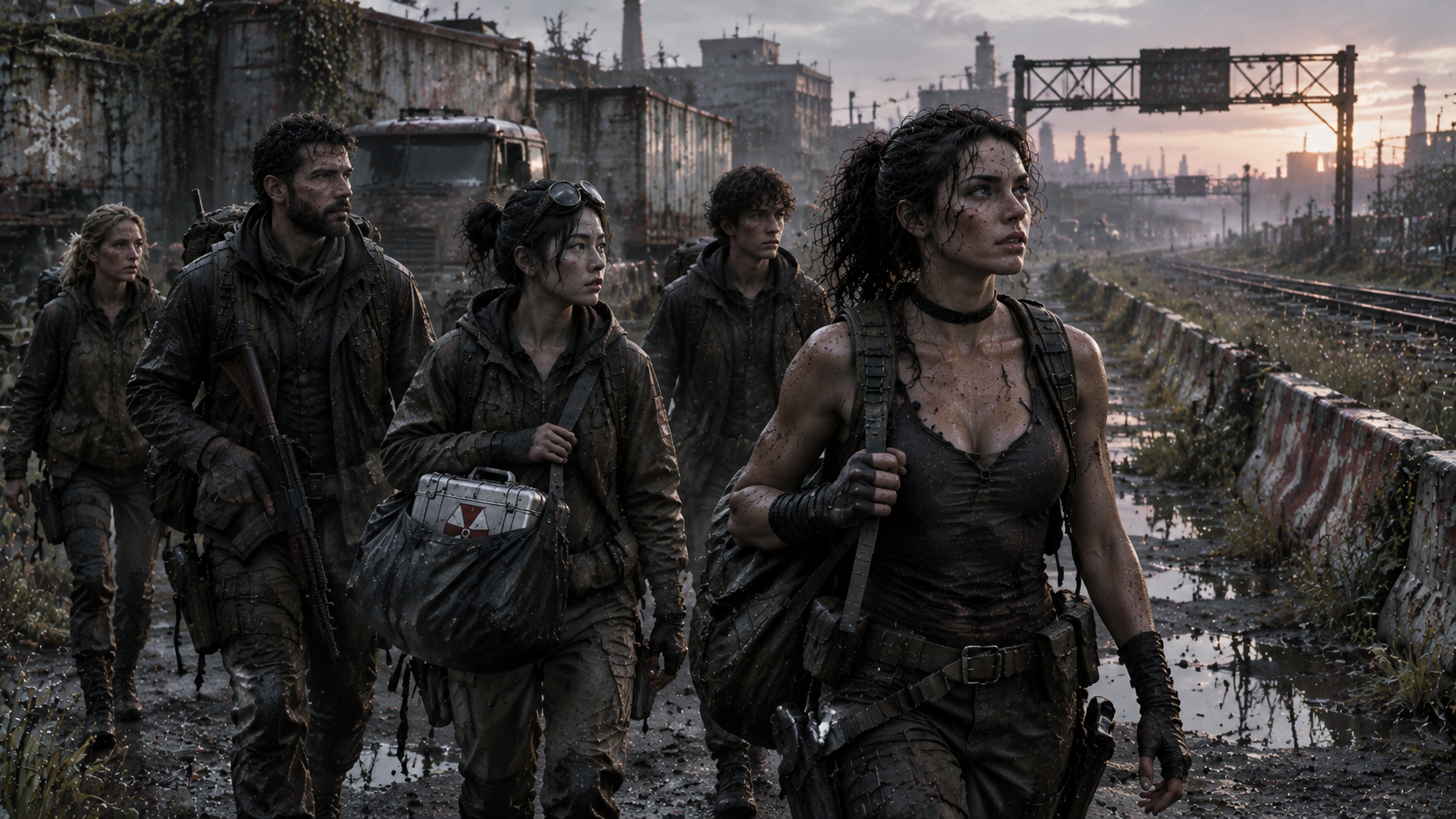
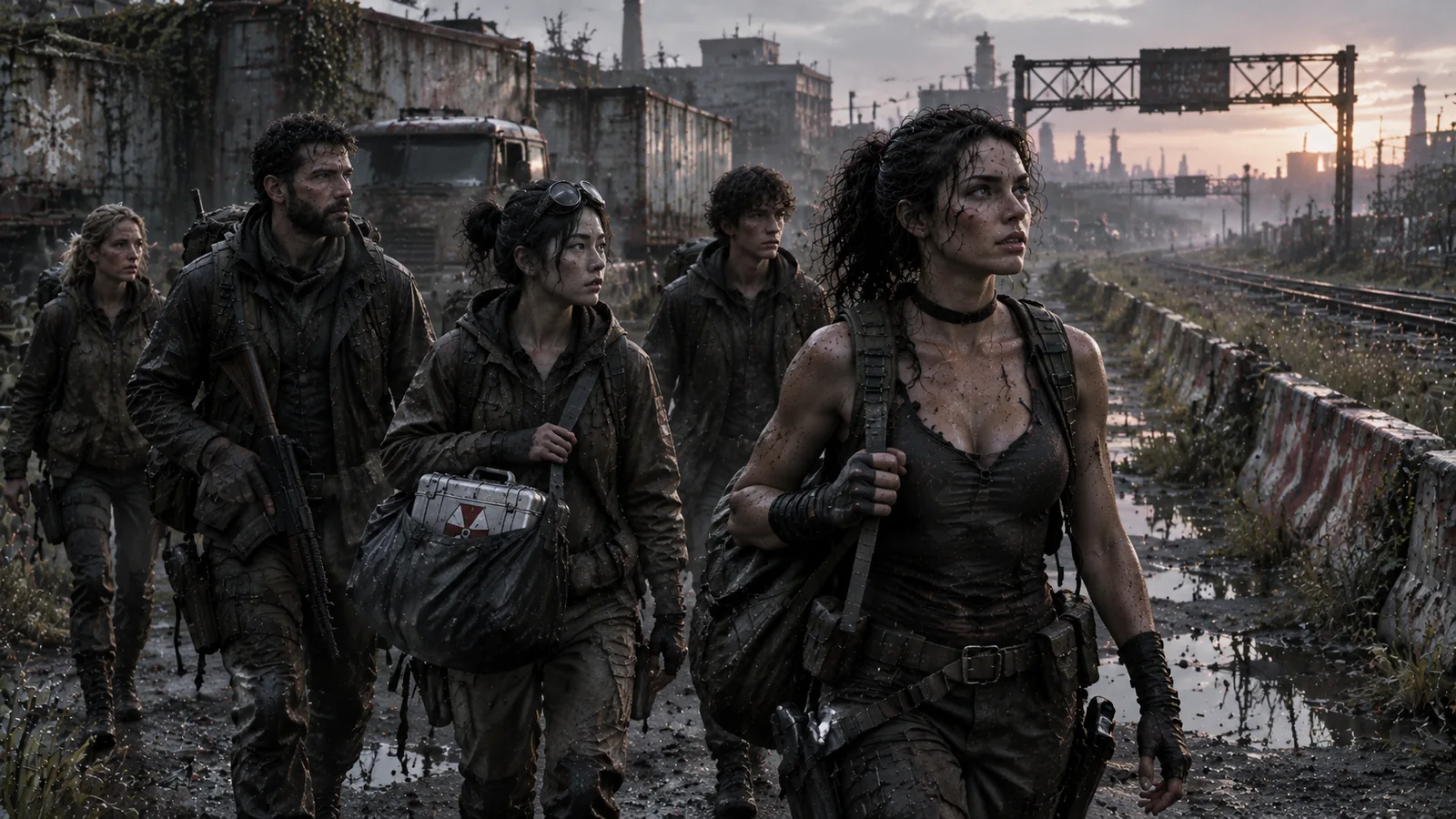
The road to Saint Oran's had once been a freight route, built for trucks that carried refrigerated food from the industrial district to the northern markets. Its surface was wide enough for two heavy vehicles to pass, with drainage channels on either side and low concrete barriers separating it from the railway. Now it was a corridor of abandoned machines, weeds and improvised warning signs.
They left at first light.
The expedition was smaller than Sera wanted and larger than she considered safe. Sera led. She followed with Elias and Noah. Ruth travelled with them, carrying the Auditor's case in a waterproof sling. Ilya stayed at the annex to maintain the local node and the radio link. Pavel was given the job of teaching the Switchyard crew to read the generator's vibration pattern. He said he would rather teach it to behave. Lena took over the visitor register. Dr. Varga remained with the patients, though he insisted on joining if Niko's fever rose.
Mara watched them prepare from the doorway of the clinic.
“You're going to find the original,” she said.
“We're going to find out what the records mean,” the woman replied.
“That's not the same thing.”
“No.”
Mara held up the metal washer on its cord. “If you find her, ask whether she remembers choosing.”
The woman looked at her. “Choosing what?”
“Anything.”
Mara lowered her hand. “They took so many choices away that I don't know which ones were mine.”
The woman wanted to promise that they would find an answer. She had learned not to make promises that depended on locked doors and dead systems.
“I'll ask,” she said.
They travelled in an electric utility vehicle with a hybrid range extender. The battery was charged to eighty percent, but the pack's temperature sensor had begun to drift. Ilya had marked the safe operating range on a strip of tape above the dashboard. The petrol reserve was less than a quarter tank. The vehicle could carry them to Saint Oran's and back if they did not detour, did not idle too long and did not need to tow anyone.
Sera called it a vehicle with conditions.
Ruth called it a miracle.
Noah called it a maintenance liability.
The woman called it transportation.
The city thinned as they moved north. Residential blocks gave way to warehouses and loading yards. A solar farm spread across the roof of a distribution centre, most of its panels intact but coated with grey dust. A row of charging posts stood beside the road, their cables cut. One still displayed a green status light, drawing power from a small emergency battery that had somehow survived.
Sera stopped the vehicle.
“Why?” Noah asked.
“Because that light is on.”
“Could be a local reserve.”
“Could be a trap.”
She sent Midge ahead. The little robot moved between the charging posts, scanning the ground. Its camera found no tripwires, no fresh footprints, no heat sources. The charging station's enclosure was intact. A small service screen displayed a local battery level of twelve percent.
“Someone left power here,” Ruth said.
“Or something did,” Sera replied.
The woman examined the connector. It was an older standard, compatible with the utility vehicle through an adapter. They could take a small charge, but doing so would consume time and leave the vehicle exposed.
“We don't need it yet,” she said.
They moved on.
At the railway crossing, the road was blocked by a line of cargo containers. Some had been stacked deliberately. Others had fallen from a damaged freight train. The only way through was a narrow gap between two containers, where a delivery robot lay crushed beneath a collapsed pallet.
The woman stepped out and checked the ground. There were drag marks in the mud. Not from infected feet. Something heavy had been moved toward the rail tunnel.
Noah crouched beside the robot. “This model was used by the terminal. Same family as Midge.”
Ruth looked at the damaged chassis. “Could it have carried a beacon?”
“Possibly.”
A small green light blinked beneath the crushed casing.
Ilya's voice came through the radio. “Do not connect to it.”
“We weren't planning to,” Sera said.
“I'm serious. The annex node just received a route update. It came from a device that has not been registered.”
The woman looked at the robot. “Can you identify the source?”
“Not yet. The packet is moving through the local mesh. It may be hopping between old controllers.”
“Block it.”
“I can isolate the annex. But then we'll lose your link.”
“Do it.”
The radio crackled. “Copy. Link going dark.”
The screen on the vehicle dashboard changed from connected to offline. The local map remained available, but the route would no longer update. They were alone again, at least in the technical sense.
They passed through the container gap on foot, guiding the vehicle slowly behind them. The railway tunnel beyond was dark. A line of emergency lamps glowed along the wall, powered by a separate circuit. Someone had painted arrows on the concrete, all pointing toward the northern exit.
Beside the arrows were names.
Some had been crossed out. Some had been underlined. A few had small circles drawn around them.
The woman stopped at one.
Her own name had been scratched into the concrete with a sharp tool.
Beneath it was a date from six years earlier, followed by a second line:
TRANSFERRED — NOT DEAD.
Elias came up beside her. “This was not here when I last saw the route.”
“When did you last see it?”
“Before the network went live.”
“Six years ago?”
He nodded.
Noah examined the date. “The tunnel was sealed before the outbreak.”
“Then someone opened it,” Sera said.
The tunnel floor was dry, but the walls were damp. In one place, the concrete had been cut away to expose a cable tray. A new fibre line ran through it, protected by a flexible conduit. The line disappeared into a maintenance cabinet with a mechanical lock.
Ruth took out the witness key.
“Don't,” Noah said.
“I'm not connecting it. I'm checking the serial.”
The key's number matched a record in her folder. It had been issued to the Saint Oran's Auditor office, but the certificate chain included an older authority from the central freight terminal.
“Someone linked the Auditor to Meridian,” Elias said.
“Or Meridian copied the Auditor,” the woman replied.
A noise came from the far end of the tunnel.
A soft mechanical whir.
Midge turned its camera. The feed showed a small wheeled machine moving between the emergency lamps. It was not one of theirs. Its chassis was white, its
manipulator arm folded against the body, and its camera lens was covered by a strip of black fabric.
It stopped beneath the painted names.
Then it projected a message onto the wall.
RETURN THE ORIGINAL.
Sera raised her rifle. “We are not negotiating with a projector.”
The machine's arm unfolded. It placed a small object on the ground: a transparent capsule, sealed at both ends.
The woman approached only after Midge scanned it. The capsule contained a folded strip of paper and a tiny memory wafer.
“Could be a trap,” Sera said.
“Everything is a trap until proven otherwise,” Ruth replied.
The woman picked up the capsule with gloved fingers and opened it using the ceramic cutter. The paper inside was damp but legible.
There were only six words.
THE ORIGINAL IS NOT THE FIRST.
Noah read it over her shoulder.
“That's impossible,” he said.
“Why?” Elias asked.
“Because an original is, by definition, first.”
“Only if you know what was copied,” the woman said.
The memory wafer contained no executable code, only a short audio file. Ruth played it through the isolated terminal.
A woman's voice spoke.
“Elias, you remember the first version. You remember the body in the corridor. But the first version was already a reconstruction. The original was moved before the event. We did not create the copy to preserve the person. We created it because the person was missing.”
The recording ended.
Elias looked as though he had been struck.
“Who is that?” the woman asked.
He did not answer.
“Elias.”
He turned away. “My wife.”
The word seemed to surprise even him.
Sera lowered her rifle slightly. “You never said you were married.”
“I was.”
“Was?”
“She disappeared before the outbreak.”
Noah stared at him. “You told me she died.”
“I believed she had.”
The woman looked from one man to the other. “Who was she?”
Elias swallowed. “Dr. Mira Venn. She worked on identity reconstruction and neural recovery. She was part of the early continuity research.”
“Was she the woman who left the laboratory?”
“I don't know.”
The tunnel lights flickered. The unknown machine began to reverse, its wheels moving with slow precision.
The woman stepped toward it. “Wait.”
The machine stopped.
“Who sent you?”
No answer.
“Where is Mira Venn?”
The projector lit again.
A new message appeared on the wall.
SAINT ORAN'S. BRING THE TWO WHO REMEMBER.
Then the machine turned and disappeared into the darkness.
They continued north.
By midday, the road had opened into a wide plain of abandoned logistics yards. The air smelled of wet earth and diesel. A wind turbine stood motionless above the warehouses, its blades locked by a mechanical brake. Near the road, a group of people were dismantling an electric bus. They worked carefully, removing battery modules one by one and placing them on insulated carts.
Sera slowed the vehicle.
The workers raised their tools. One of them stepped forward, a broad woman with a shaved head and a yellow scarf.
Yara.
The woman leaned out of the window. “What are you doing here?”
“Trading,” Yara replied. “The Switchyard sent us to Saint Oran's. We have a battery module they need, and they have medical filters we want.”
“Why didn't you tell us?”
“We didn't know you were coming.”
Yara looked toward Ruth's case, then at Elias.
“Ah,” she said. “The Auditor.”
Ruth studied her. “You know me?”
“I know the case. My brother carried one like it before he disappeared.”
“Your brother?”
“Dmitri. He went to Saint Oran's yesterday. He hasn't come back.”
The woman felt the route narrowing again.
“Did he say why?”
Yara shook her head. “He said he was going to find out who owned the dead man's battery. Then he said something about a witness who could prove the ledger had been changed.”
“Did he mention a name?”
“Halden.”
Elias looked at her sharply.
Yara nodded. “That's the name he gave me.”
The woman looked at the road ahead. Saint Oran's was no longer just a place where someone claimed to have seen her die. It was where a missing brother, a vanished scientist, a disputed ledger and a dead director's signature were all converging.
“Come with us,” she said.
Yara glanced at the dismantled bus. “I have a trade to finish.”
“How long?”
“Ten minutes.”
“Five.”
Yara smiled. “You sound like Sera.”
“That's unfortunate for both of us.”
They waited while Yara completed the exchange. The battery module was inspected, its voltage measured, and its serial number entered into a local record. The medical filters were checked for intact seals. Both sides signed the agreement on separate devices, then exchanged the goods in person. No central ledger confirmed the trade. No token changed hands. The record remained local until a trusted connection could be established.
It was slow.
It was imperfect.
It was real.
When they finally reached the northern ridge, Saint Oran's came into view.
The settlement occupied an old water-treatment plant and the adjoining grounds of a private rehabilitation hospital. Concrete basins and rusted pipework surrounded the filtration towers. Solar panels covered the roofs. Two wind turbines turned above the towers. A radio mast stood at the centre, patched with cables and improvised antennae. Beyond the walls, a line of cargo containers formed a second perimeter.
Smoke rose from a communal kitchen.
People moved between buildings carrying water, tools and bundles of salvaged material. A market had formed beneath the old maintenance canopy. There were no flags, no uniforms, no central authority visible from the road. But there were watch posts, rules painted on walls, and a board listing current trade offers.
At the entrance, a sign read:
SAINT ORAN'S COOPERATIVE. NO CENTRAL CURRENCY. NO UNWITNESSED CLAIMS. NO ONE OWNS THE WATER.
Below it, someone had added:
WE STILL ARGUE ABOUT THE LAST ONE.
The woman watched the settlement for a moment. It was larger than the annex, more organised, and perhaps more fragile because of it. Every functioning system required maintenance. Every agreement required someone to keep it. Every wall created a gate, and every gate created a question about who deserved to pass.
A guard approached the vehicle.
“State your business.”
Ruth held up the Auditor's case.
The guard's expression changed.
“Then you are expected,” he said.
“By whom?” the woman asked.
The guard looked at her.
“By the man who says he watched you die.”
He opened the gate.
And from somewhere inside Saint Oran's, a bell began to ring.