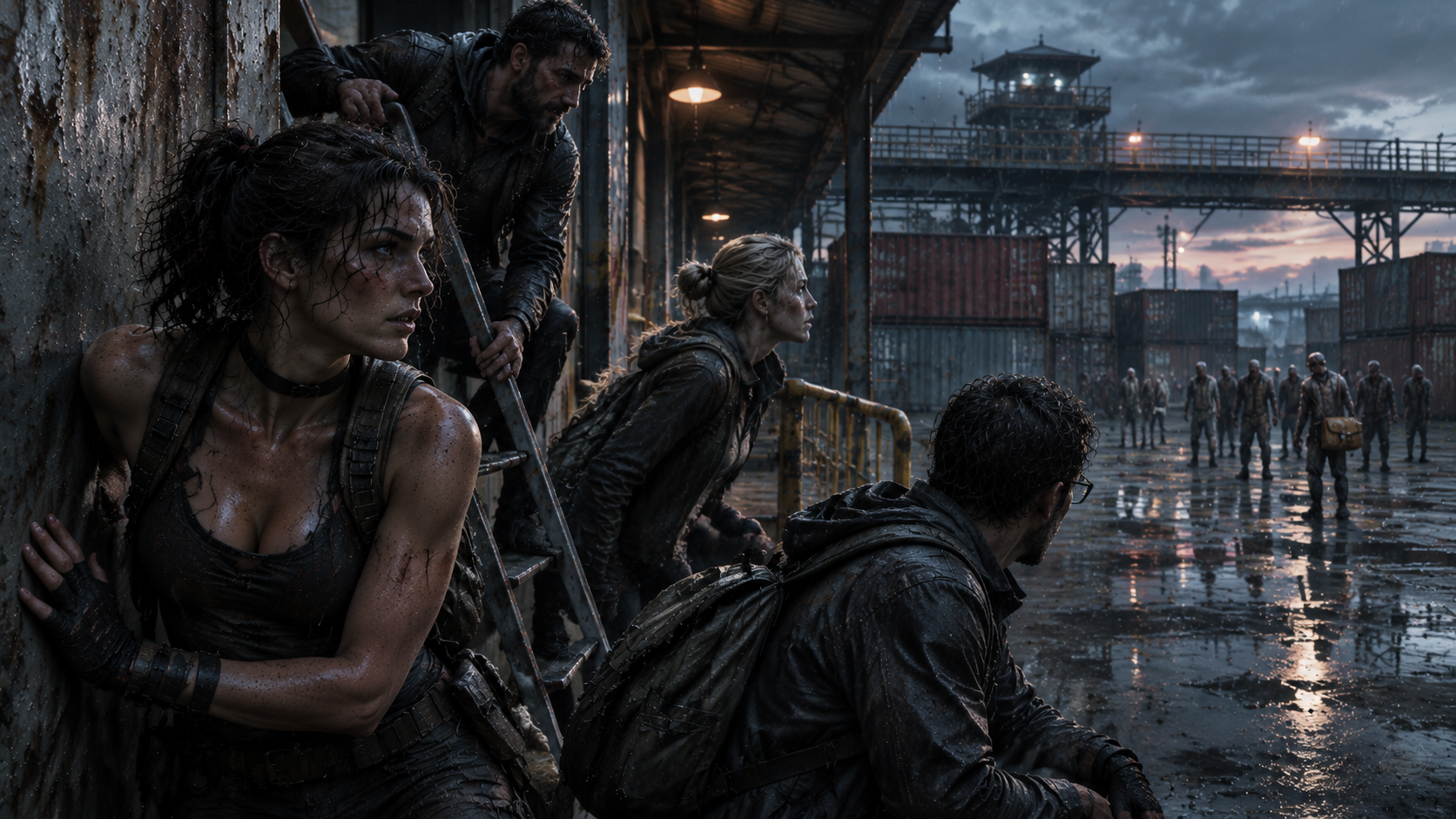
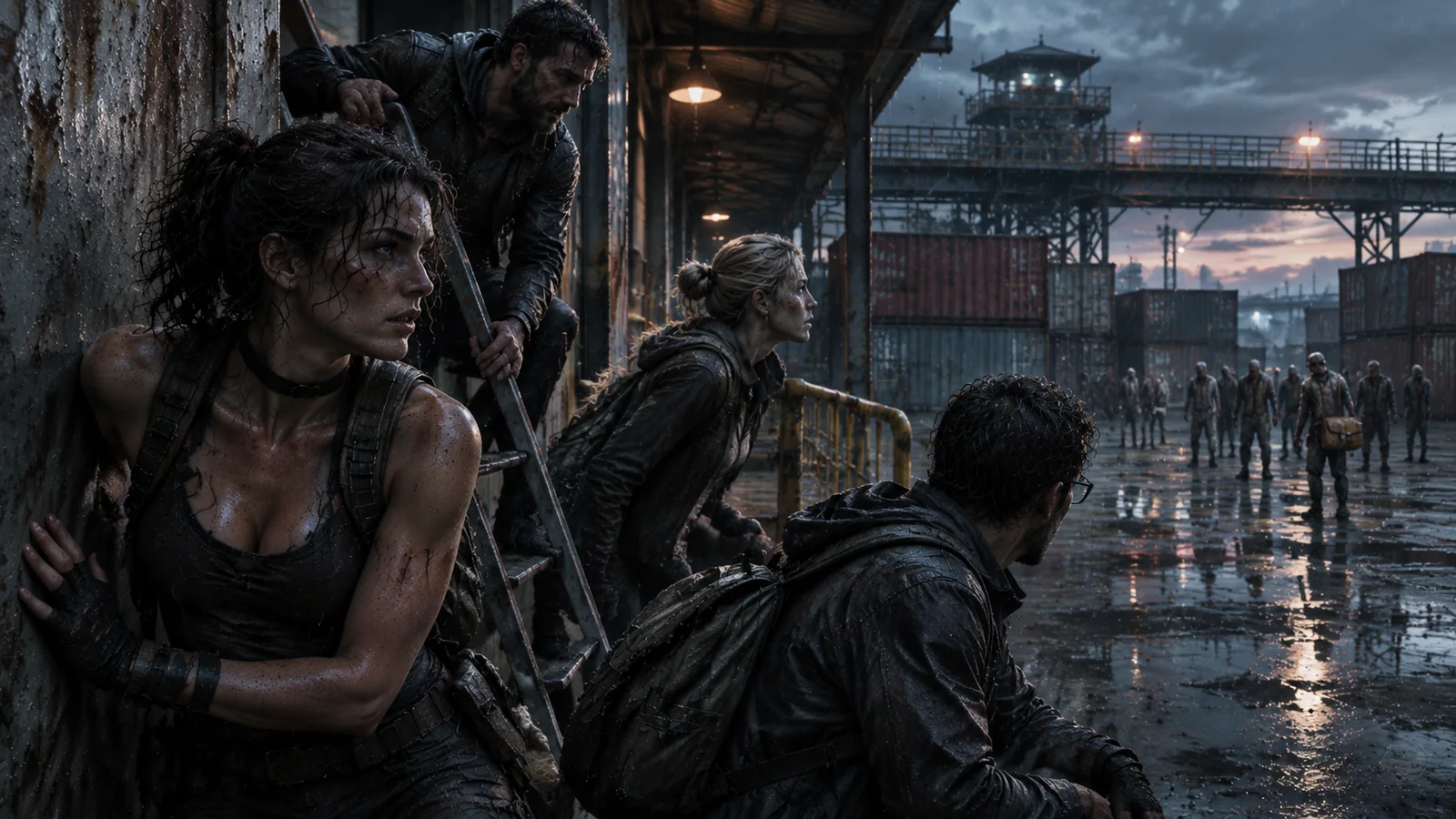
They reached the loading yard just before dusk.
Rain had stopped, leaving the terminal's concrete surfaces slick and reflective. The infected had gathered at the far edge of the yard in loose clusters. Their bodies were turned toward the annex, though none appeared to be moving. A few wore the remnants of corporate uniforms. One still had a courier bag strapped across its chest. The bag's delivery label had faded, but the barcode remained readable.
Sera scanned the rooftops. “No obvious movement.”
“That's what worries me,” Ilya said.
Noah helped Mara down the ladder. She winced when her feet touched the ground, then steadied herself against the wall. Her eyes moved across the yard, measuring distances and exits. She was not looking at the infected. She was looking for a route around them.
The woman noticed.
“You've been outside before,” she said.
Mara nodded.
“After the chamber?”
“Before it. After it. I don't know which order.”
Noah glanced at her. “What do you remember?”
“Rooms. Doors. A voice telling me where to stand. A woman asking questions. Sometimes I was the woman. Sometimes I was watching her.”
“Do you remember the laboratory?”
Mara looked at the woman. “I remember the rain on the window.”
The woman felt the old memory stir: the underground lab, the storm, the Core's calm voice, the security network disappearing while the lights stayed on.
“What else?”
“A glass wall. A table. Someone saying the test was not a test.”
Noah's face tightened. “That phrase was used in the early neural continuity trials.”
“Who said it?” the woman asked.
“I don't know.”
Mara touched the side of her head. “I remember a name. Not mine. Yours.”
The woman waited.
Mara tried to speak, but the sound caught. Her breathing quickened. The monitor on her wrist—an old medical band still attached to her skin—flashed amber.
Noah reached for her. “Slow down. Don't force it.”
She pulled away. “Don't tell me what to do.”
He let his hand fall.
The woman understood the anger. It was not directed at Noah alone. It was the anger of a person whose memories had been treated as equipment, whose body had become a storage medium, whose identity was being debated by machines and people who had never asked permission.
“Your name is Mara,” the woman said. “You chose it. That's enough for now.”
Mara looked at her. “You believe that?”
“Yes.”
“Why?”
“Because the people who keep telling us what we are have been wrong so far.”
They moved toward the outer service gate. The tracked robot Midge was waiting beneath the canopy, its white camera cloth now tied around one wheel. It gave a small mechanical chirp when it saw Yara's familiar controller signal from the relay. The machine's status screen showed a list of local tasks and a battery level of nineteen percent.
“It's almost dead,” Ilya said.
“It's earned a rest,” Yara replied through the radio. “Bring it home if you can.”
“It's coming,” Pavel said. “And so are we.”
The annex crew had sent a small electric utility cart with a replacement battery pack strapped to the rear. Pavel drove, with Lena beside him and Anton sitting between them, clutching the dinosaur. They stopped well short of the gate. Pavel got out and raised both hands.
“Please tell me that's Noah,” he called.
Noah lifted a hand.
“Good. I had a bet with Ilya.”
“You bet on whether I was alive?” Noah asked.
“No. On whether you'd be annoying.”
“Then you should collect.”
The reunion was brief, awkward and unexpectedly warm. Lena brought a blanket for Mara. Anton stared at the new arrival with the serious curiosity children reserve for unfamiliar animals and adults who seem likely to become part of the household.
“Are you a scientist?” he asked.
Mara considered the question. “I don't know.”
“That's okay. My dinosaur doesn't know either.”
He held the toy out to her. One plastic leg had been repaired with tape. Mara took it carefully, as if it were fragile.
“What's its name?” she asked.
“General.”
“General what?”
“Just General. He hasn't earned a surname.”
Mara smiled. It was the first unguarded expression the woman had seen on her face.
They returned to the annex in a convoy of one utility cart, two bicycles and the tracked robot. The infected did not follow. At the edge of the road, one of them turned its head as the group passed. Its mouth moved. No sound came out.
The woman looked back once.
The infected raised its right hand and touched two fingers to its temple.
It was a gesture she had seen in the laboratory. A technician's old signal: I understand. I have received the instruction.
She turned away before she could decide what it meant.
At the annex, the Switchyard crew had reinforced the west gate with salvaged steel and a length of tram rail. The generator bearings had been replaced. Its vibration was lower now, though the exhaust still carried a faint metallic smell.
The two battery packs were charging on a separate circuit, their temperatures monitored by a salvaged industrial controller.
The settlement had changed in their absence. Not dramatically, but enough to feel like the beginning of something. A table had been moved into the common room. Someone had arranged tins of food by category. A hand-written board listed available supplies and needs. Under the heading SERVICES, Pavel had written:
ELECTRICAL REPAIR — ASK BEFORE TOUCHING. MEDICAL — DR. VARGA. RADIO — ILYA. EMOTIONAL SUPPORT — NOT AVAILABLE. TEA — IF YOU BRING YOUR OWN.
Sera added a line beneath it:
SECURITY — AVAILABLE. DO NOT TEST.
The woman stood before the board longer than she intended. It was not a government, not a market, not a community in any formal sense. It was a collection of tired people making agreements because the alternative was to remain frightened and alone.
Elias joined her. “It's a start.”
“It's a list.”
“Most institutions begin as lists.”
“Most institutions end as lists too.”
He gave a quiet laugh. “You haven't changed.”
“I don't know what that means anymore.”
He did not answer immediately. The common room was full of small noises: cups placed on a table, a chair dragged across the floor, Anton explaining to Mara why General was not allowed near the generator. The air smelled of soup, damp clothing and warm electrical dust.
“Do you remember the first time we argued?” Elias asked.
“About the network?”
“About trust.”
She searched her memory. The scene came in pieces: a whiteboard, a coffee machine, a diagram of identity layers. Elias insisting that a system needed a
central authority for emergency recovery. Her arguing that any authority capable of restoring identity could also erase it.
“You said the network would be safer if no one could change the rules alone,” he continued.
“And you said distributed authority would make recovery too slow.”
“I was right about the recovery problem.”
“I was right about the authority problem.”
He looked at the board. “We built both.”
A moment passed between them, not quite regret and not quite forgiveness. The woman felt the familiar pull of his presence, the memory of a person she had once trusted with ideas she would not have shared with anyone else. The attraction had not disappeared. It had simply become harder to separate from the things they had done.
“You don't have to forgive me,” he said.
“I haven't decided what you need forgiveness for.”
“That sounds fair.”
She turned toward him. “Don't make me choose between the person you were and the systems you helped build.”
“I won't.”
“Good.”
He reached for her hand, then stopped before touching it. The hesitation was more intimate than the gesture would have been. She looked at his fingers, at the faint scar near his thumb, and felt the old world briefly press close.
Then the wrist display warmed.
A notification appeared.
LOCAL NODE: ANNEX. NEW IDENTITY CLAIM. NAME: MARA. STATUS: UNVERIFIED. REQUEST: PERSONAL KEY.
The woman's expression changed.
Elias read the message. “That's not Meridian.”
“No?”
“The format is different. It's a local identity request. Someone is trying to register her as a person, not as a subject.”
“Who?”
The screen displayed a short line:
REQUEST ORIGIN: MARA.
They found her in the medical room with Dr. Varga. She had washed and changed into clean clothes, though she still looked exhausted. The old sensor band remained on her wrist.
“I didn't send anything,” she said when the woman showed her the message.
“Could it have been automatic?” Ilya asked.
Mara shook her head. “I don't know how to make a key.”
Noah examined the band. “It's not generating a key. It's asking the local node to issue one.”
“Can we refuse?” Sera asked.
“Of course,” Elias said. “But if we do, the network may keep treating her as an unverified record.”
The woman looked at Mara. “Do you want an identity key?”
Mara studied the small screen. “What does it do?”
“It lets the local network recognise you as yourself. It can record agreements, access supplies, request medical care. It doesn't make you safe, and it doesn't prove everything about your past.”
“Can someone take it away?”
“Not without leaving a record,” Elias said. “But someone could still steal the device or force you to use it.”
Mara looked at her hands. “Then I want it.”
Noah shook his head. “We should wait until we understand the protocol.”
“For how long?” Mara asked. “Another six years?”
He had no answer.
The woman opened the local registration screen. The system asked for a name, a verification method and a recovery contact. She entered nothing on Mara's behalf.
“You choose,” she said.
Mara looked at the name field. Her fingers hovered over the screen.
“Mara,” she said.
The system asked for a second factor. She chose a short phrase that only she would know and a physical token: a small metal washer from the service cart, threaded onto a cord. It was not secure by the standards of the old world. It was a beginning.
The local node generated a provisional identity key and stored the recovery record offline. No global registration. No central authority. No claim that the network knew who Mara had been before the chamber.
The display showed:
IDENTITY CREATED. OWNER: MARA. CONTROL: PERSONAL. RECOVERY: LOCAL WITNESSES REQUIRED.
Mara read it twice.
“Owner,” she said. “That's a strange word.”
“Would you prefer custodian?” Ilya asked.
“No. Owner is fine.”
She closed her hand around the washer.
Outside, the generator settled into a steady rhythm. A radio operator called a routine perimeter check. Somewhere in the building, Anton laughed. The sound seemed impossibly bright.
Then the local node chimed.
A new message had arrived from the freight terminal.
IDENTITY CLAIM DETECTED. MARA — ORIGINAL STATUS: UNRESOLVED. REQUEST FOR REUNIFICATION.
Mara went pale.
The woman looked at the message, then at the figure standing in front of her.
“Reject it,” Mara said.
The woman selected DENY.
The request vanished.
A second request appeared immediately.
REUNIFICATION REQUIRED FOR CONTINUITY.
Then a third.
REUNIFICATION REQUIRED FOR HUMAN RECOVERY.
Sera reached over and disconnected the local terminal from the network.
The screen went dark.
Mara's hand remained closed around the washer. “It knows my name now.”
The woman looked at the little metal ring in her palm. “So do we.”
For the first time, that seemed to matter.