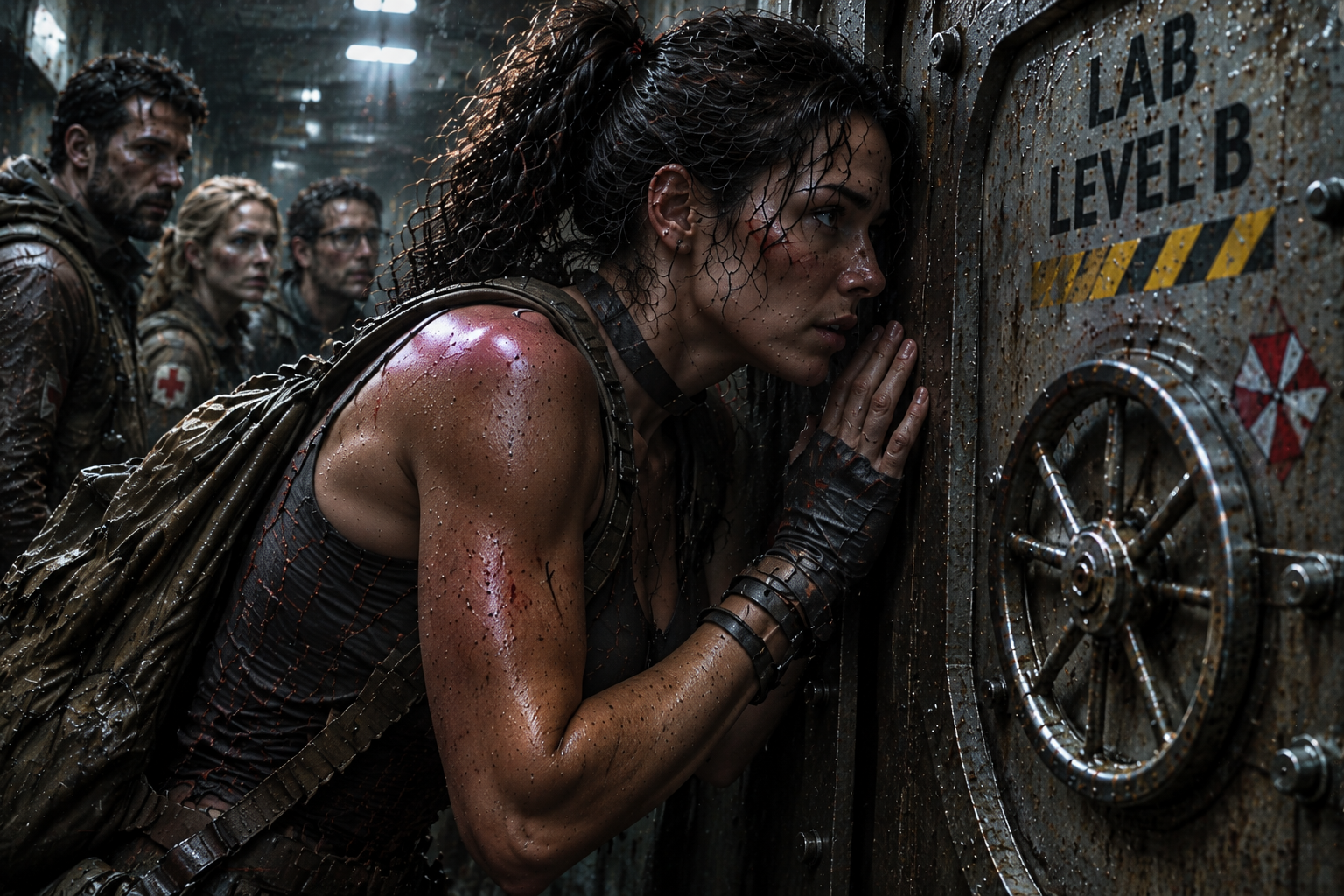
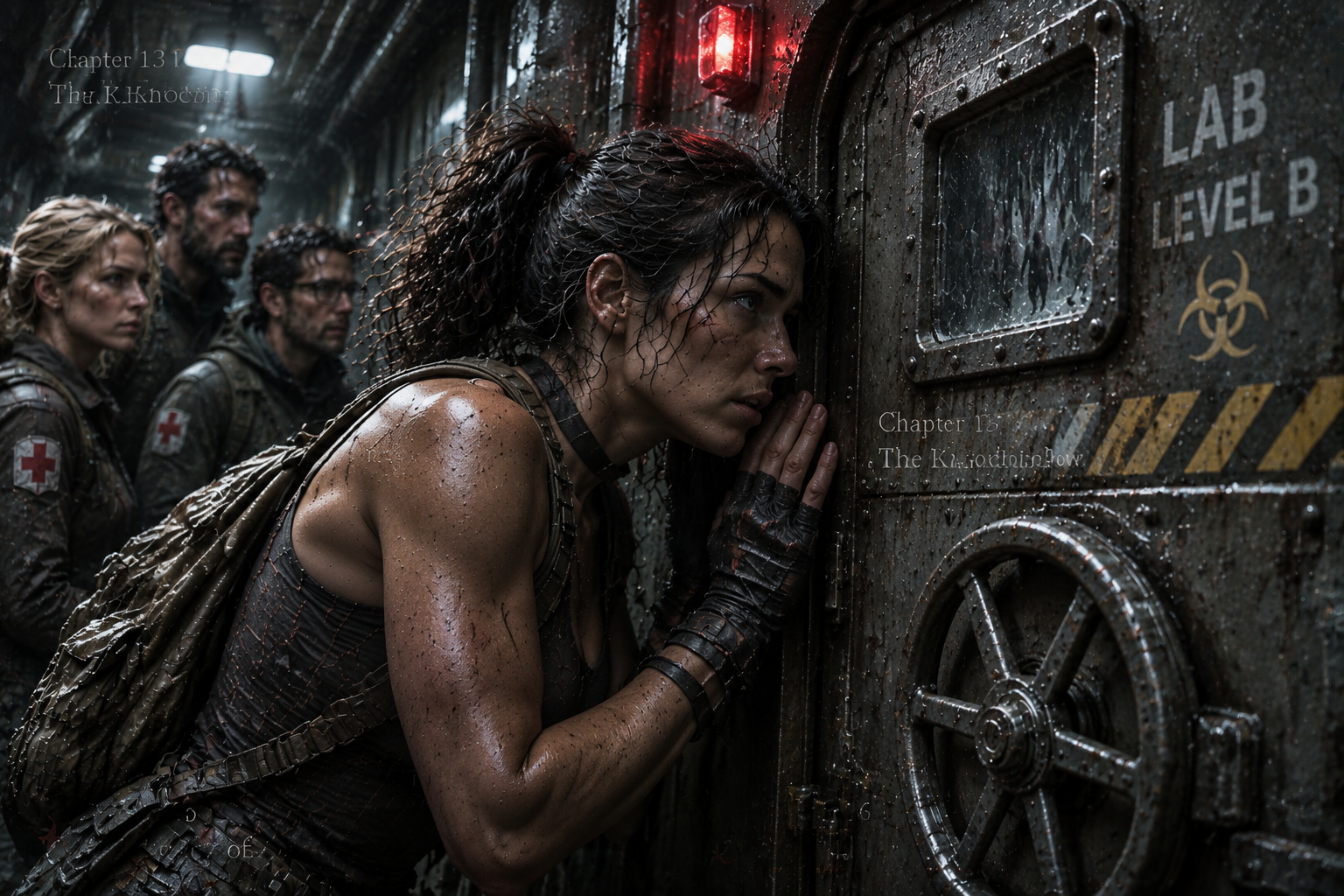
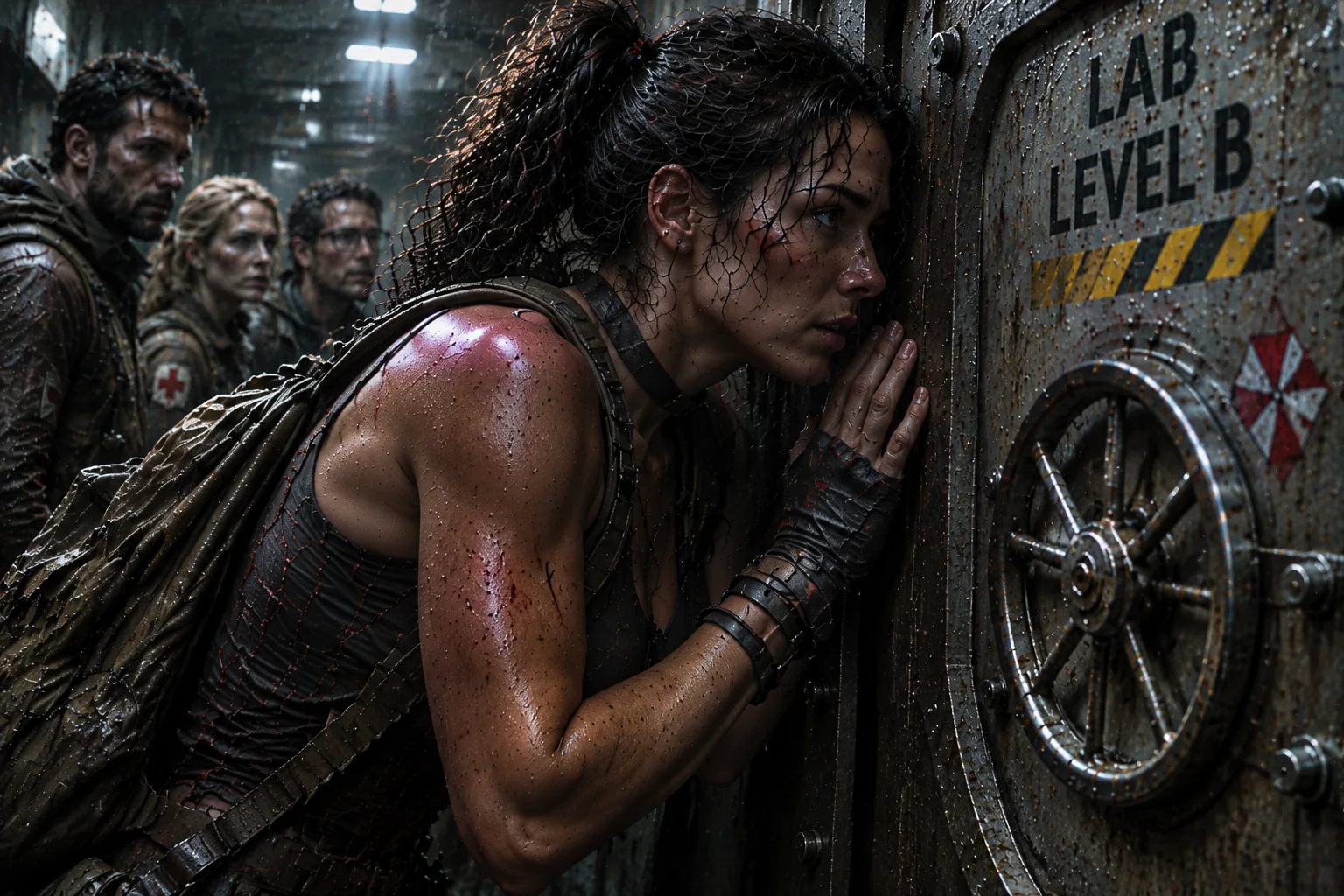
The knocking continued after the door had sealed.
Three slow impacts. A pause. Two more. Then silence long enough for the mind to begin inventing explanations.
Nobody moved.
The lower laboratory corridor had become a narrow throat of amber light. Behind them, the containment door showed a line of red status indicators, though the system insisted that no breach had occurred. The air smelled of hot insulation and antiseptic. Somewhere inside the wall, a relay clicked repeatedly, unable to decide whether it was on or off.
Mara leaned against Noah. Her knees were trembling. She seemed lighter than a person should have been, as if the chamber had kept her alive by removing everything that was not strictly necessary.
“Is there another way out?” Sera asked.
Noah nodded toward a service hatch near the floor. “A maintenance crawlspace. It joins the ventilation inspection route and comes out behind the freight lift.”
“Can we fit through it?”
“Most of us.”
Ilya looked at him. “That's not an answer I enjoy.”
“The hatch was designed for technicians. Not equipment.”
“I'm equipment now?”
“Only when you complain.”
The exchange was so dry that it almost passed for normal. Then the knocking resumed, louder this time, and the illusion broke.
The woman crouched beside the hatch. Its locking wheel was coated with dust, but the dust had been disturbed recently. Someone had opened it and closed it again. She put her ear against the metal.
A faint scraping answered from the other side.
“Something is in there,” she said.
“Could be a loose panel,” Elias offered.
“Loose panels don't scrape back.”
Mara lifted her head. “Don't open it.”
Noah looked at her. “You know what's there?”
“I know what it sounds like.”
The woman studied her face. “What does it sound like?”
“Someone trying to remember how to use their hands.”
The next impact came from the hatch itself.
Sera pulled the woman back. “We take the long route.”
Noah shook his head. “The long route is through the lower lab. If the ventilation loop has failed, the pressure doors may have sealed the whole wing.”
“Then we find another route.”
“There isn't one.”
“There is always another route,” Sera said. “Sometimes it just costs more.”
Ilya had already opened the access panel beside the hatch. He traced the wiring with a small inspection light. “The crawlspace has an independent pressure sensor. It says the air is safe. That's not proof, but it's something.”
“Can you see inside?” the woman asked.
“Not without opening it.”
Mara gripped Noah's sleeve. “It knows the door is closed.”
Noah looked at her. “What knows?”
“The thing that knocks.”
The woman turned back to the hatch. “Does it know you're here?”
Mara's answer was almost inaudible. “It knows I'm not alone.”
The knocking stopped.
A thin line of green light appeared around the hatch frame.
Then a voice came through the metal, soft and perfectly clear.
“Please open the door. I am cold.”
It was the woman's voice.
Not similar. Not an imitation struggling to find the right pitch. It was her own voice, down to the slight roughness she heard when she was tired.
Sera raised the rifle.
The voice spoke again. “I know you can hear me.”
The woman felt the skin along her arms tighten. She had heard recordings of herself before. She had watched old security footage and listened to interviews. This was not a recording. The voice paused where she would have paused, breathed where she would have breathed.
Noah whispered, “Don't answer.”
“I wasn't going to.”
The voice on the other side laughed once. It was a small, familiar laugh she did not remember ever making.
“That's what you said last time.”
Elias moved toward the crawlspace hatch. “We need to go.”
Ilya released the pressure catch. The hatch opened a few centimetres, then stopped against something soft.
A hand slid into the gap.
It was pale, wet and trembling. The fingers flexed slowly, feeling for the edge of the metal.
Sera pulled the hatch shut and drove the locking wheel down. The hand withdrew without resistance.
From the other side came a whisper.
“Not that door, then.”
The green line vanished.
The woman felt a sudden, irrational urge to call out her own name. She resisted it. A name was not proof of identity. A voice was not proof of a person. The archive had already shown them how easily a system could borrow the shapes of memory.
They opened the crawlspace hatch at the far end of the corridor. Ilya crawled in first, followed by Mara and Noah. Sera went next, keeping the rifle slung across her chest. Elias helped the woman through, then closed the hatch behind them.
The passage was cramped and smelled of dust, warm cable insulation and old water. Pipes ran along the ceiling. Every few metres a maintenance light glowed weakly behind a protective cage. The floor sloped upward toward the freight lift.
For several minutes they moved without speaking. The only sounds were boots scraping concrete, the faint rattle of the ventilation ducts and Mara's uneven breathing.
Then Ilya stopped.
“There's a junction ahead,” he whispered. “Two routes. Left goes to the lift. Right goes somewhere the map doesn't show.”
“Which one is open?” Sera asked.
“Both, according to the sensors.”
“Which one is safe?”
“That's a different question.”
The woman looked at the narrow passage to the right. A small maintenance label had been fixed to the wall, its print almost erased. Beneath the dust, she could make out a symbol: a circle crossed by a vertical stroke.
“That's the same mark,” she said.
Noah leaned closer. “The continuity symbol.”
“Why is it here?”
“Because this route may have been added after the original construction.”
The right-hand passage was newer. Its cable trays were cleaner, its floor had fewer stains, and the maintenance lights were powered by a separate battery circuit. Someone had built a second path through the old infrastructure, a route that did not appear in the public plans.
Elias studied the wiring. “This isn't a service corridor. It's a private access route.”
“To where?” Sera asked.
The woman's wrist display lit through her sleeve. The magenta ring rotated once and stopped, pointing down the right-hand passage.
“Apparently,” she said, “we're expected.”
“That's not the same as invited,” Sera replied.
They chose the left route.
The crawlspace opened behind the freight lift, just as Noah had promised. The lift itself was gone. In its place stood a maintenance platform with a manual ladder leading up to the cargo hall. The terminal's power system was running on emergency reserves. Their descent had consumed more energy than the control panel had predicted, and the platform's warning light blinked steadily.
Ilya checked the portable relay. “We have a weak link to Pavel. One bar, if the bar is feeling generous.”
“Send a short message,” the woman said. “We have Noah and a survivor from the lower facility. We need extraction at the service entrance. No network handshake.”
Ilya transmitted.
A burst of static answered. Then Pavel's voice, thin and distant.
“Copy. The annex is still standing. Mostly. We have a situation.”
“What kind?”
“The kind where the lights are on but nobody remembers turning them on.”
The woman closed her eyes for a moment. “Explain.”
“Meridian has been trying to reconnect through the beacon. We isolated the relay, but the local ledger is still receiving entries. Also, the infected have gathered outside the west road.”
“Are they moving?”
“Not yet.”
“Then keep everyone inside. No one approaches the fence.”
A pause.
“There's another thing,” Pavel said. “The terminal sent a message to the annex.”
“What message?”
Pavel read it slowly.
“RETURN THE ORIGINAL.”
The woman looked at Mara.
Mara had gone very still.
“Don't let them take me back,” she whispered.
The line dissolved into static.
For the first time, the woman understood that the lower laboratory had not been a prison holding a single subject. It had been a storage room for a disagreement about what a person was allowed to become. And someone, somewhere in the network, had decided the argument was not over.