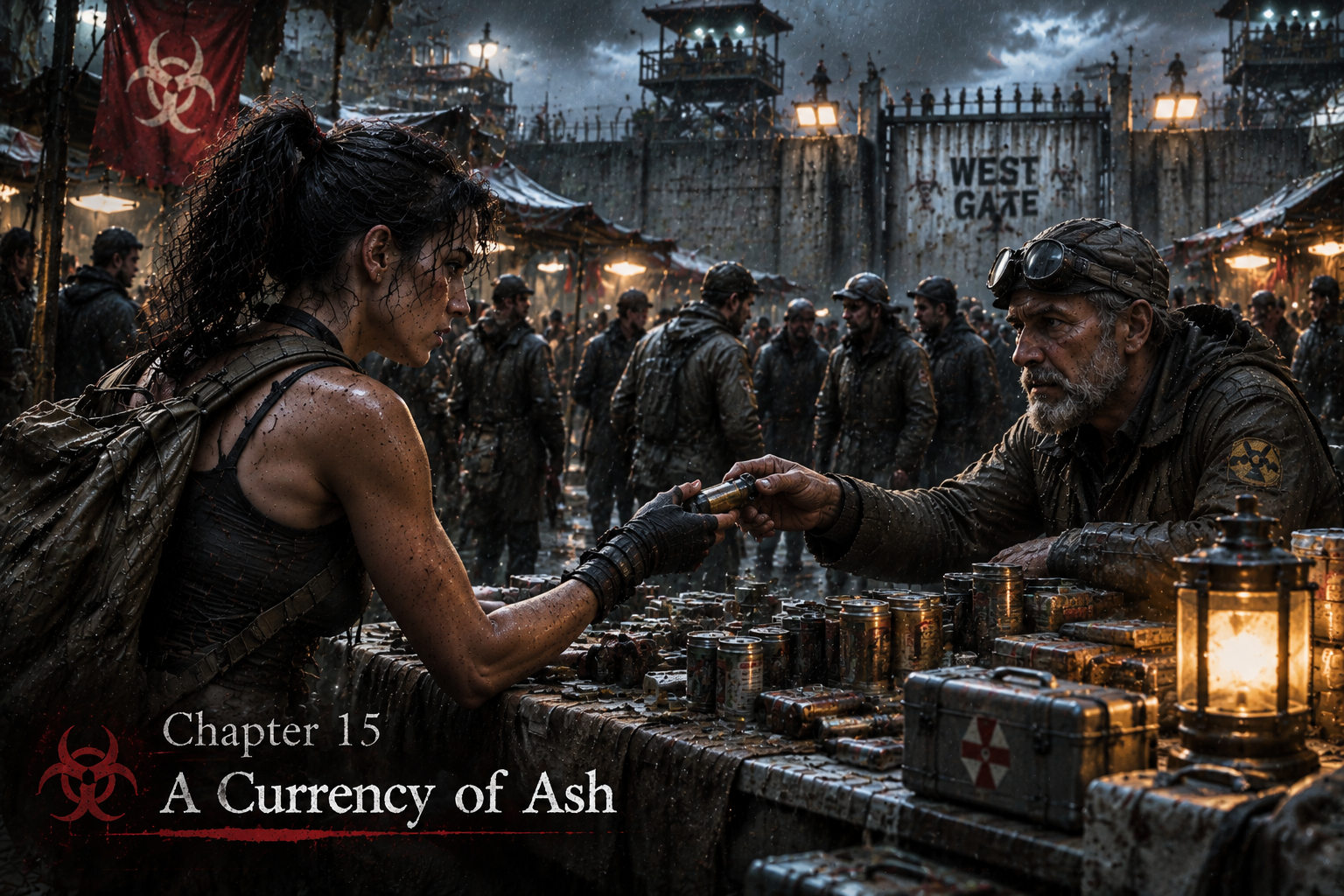
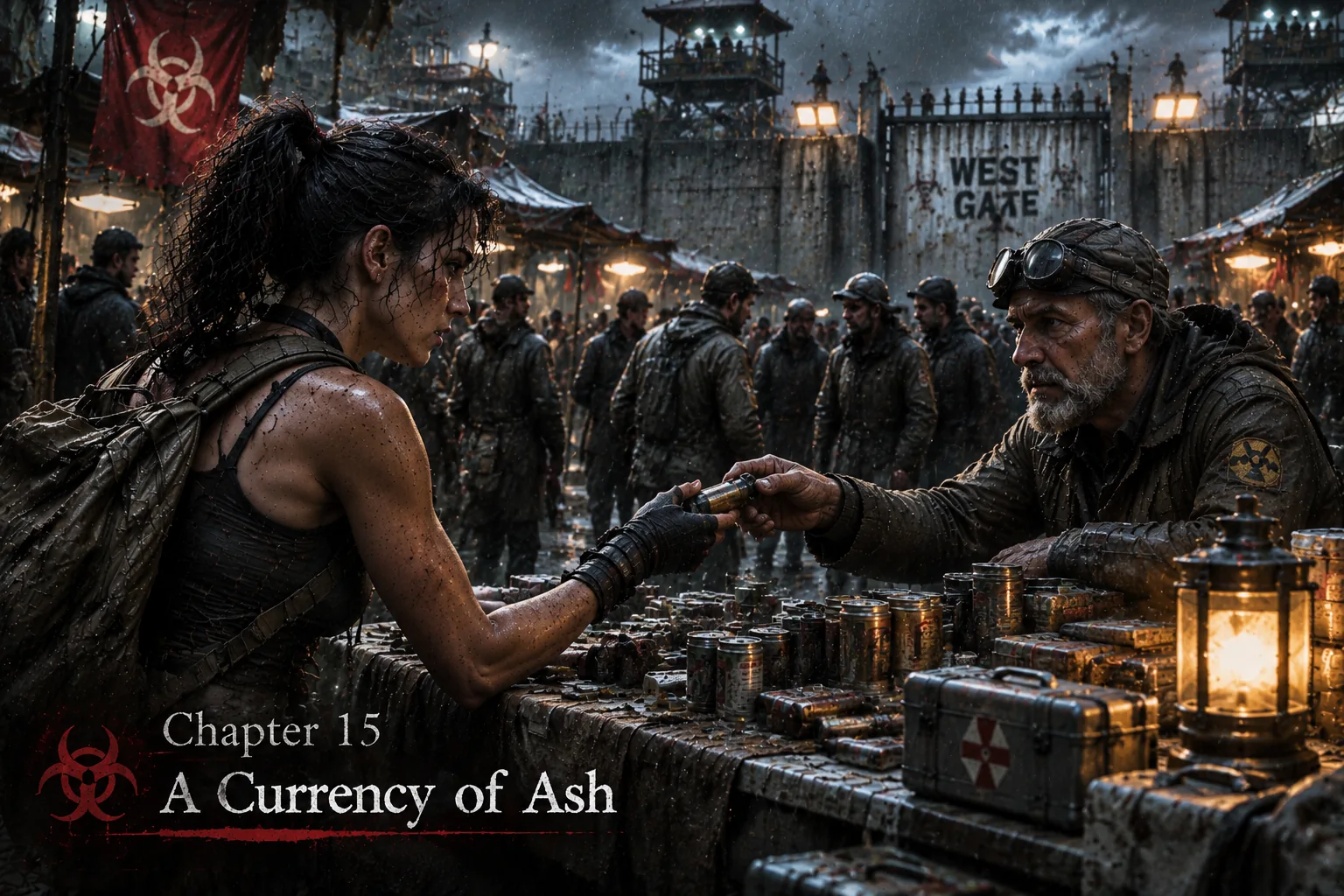
By morning, the annex had acquired a queue.
It began with the Switchyard crew asking to charge their second battery pack. Then a man from the neighbouring block arrived with a cracked radio and a sack of dried beans. A woman came carrying two bottles of disinfectant and a list of names written on the back of a property tax notice. By nine, three more people had appeared at the west gate, each with a different problem and the same wary expression.
The annex had not announced itself as a settlement. It had not hung a flag or declared a district. But the lights were on, the water pump worked, and somebody had heard that a doctor was treating children. In a city where most doors stayed shut, those facts were enough to become an address.
Sera wanted a strict limit on visitors. Dr. Varga wanted to examine anyone who might carry an infection. Lena wanted a way to separate urgent needs from ordinary requests. Pavel wanted a sign that said PLEASE FORM A QUEUE, because he had seen a queue once in a documentary and thought it looked organised.
Ilya wanted everyone to stop touching the radio.
The woman listened to the arguments from the doorway of the common room. The room had become a small market without anyone deciding to build one. A table held tools, spare cables, tins of food and a handwritten list of services. Someone had placed a jar beside the list, labelled FOR THE GENERATOR. It contained three coins, a button and a small silver earring.
“That's not enough for fuel,” Pavel said.
“It's not a fuel fund,” Lena replied. “It's what people have chosen to contribute.”
“Then we need a proper record.”
“We need to keep the generator running.”
“Those are not mutually exclusive.”
“Neither are you and silence, but we rarely get both.”
The woman smiled despite herself.
Elias had spent the night examining the local ledger. The system was capable of recording resource offers, delivery confirmations, identity claims and witness
statements. It could not make the claims true. It could not prevent coercion. It could not create food or medicine. But it could preserve agreements and make it harder for a person to deny a promise after the fact.
The problem was that everyone wanted to know what the records were worth.
“People are asking whether the settlement credit can be exchanged,” Elias said, joining her by the doorway. “They want to know if one unit means a litre of water, an hour of charging, or a meal.”
“It means whatever the person accepting it agrees it means.”
“That answer won't survive a market.”
“Then the market will have to learn to ask better questions.”
He showed her the ledger. Three offers had been entered since dawn. The Switchyard had provided mechanical service and two battery packs. In return, the annex had provided a medical examination, one charging cycle and a supply of clean water. A local farmer had offered dried beans in exchange for a repaired pump controller. Each agreement had a different unit of account.
“It's messy,” he said.
“Reality often is.”
“People want a common measure.”
“People want a common measure because they don't want to negotiate every time they need something.”
“And that's unreasonable?”
“No. But a common measure becomes dangerous when people start believing it is the thing itself.”
Elias considered that. “You sound like you still work in the lab.”
“I hope not.”
They walked to the table. A man in a patched coat was arguing with Ilya about the value of a portable solar panel. The panel was scratched, its output cable had been repaired with electrical tape, and one corner of the casing was cracked. The man wanted enough credits for a week of food. Ilya said the panel would barely charge a radio.
“It can charge more than a radio,” the man insisted.
“Then show me.”
“I don't have a meter.”
“Then I can't price it.”
The man looked toward the woman. “You people have a machine that counts everything. Why can't it tell us what this is worth?”
The woman looked at the panel. “Because the machine doesn't know whether the cells are damaged, whether the cable will fail tomorrow, or whether you stole it from someone who needs it more.”
“I didn't steal it.”
“Then you won't mind telling us where it came from.”
He hesitated.
Sera stepped closer. “That was a simple question.”
The man took the panel and left.
Pavel watched him go. “We should make a form.”
“No,” Lena said. “We should make a rule.”
“Forms are rules with boxes.”
“Rules are forms without boxes.”
The woman raised a hand. “Enough. We need a basic agreement for trade, but we don't need to pretend the ledger is money.”
Elias opened a blank record.
They began with the things people actually needed: clean water, food, charging, medical supplies, repair work, transport, safe storage, information and skilled labour. They recorded units where units made sense. Litres for water. Kilowatt- hours for charging where the meter worked. Hours for labour, with a note about the task. Items for goods. Medical treatment was not priced as a commodity; urgent care would be allocated by clinical need, with contributions handled separately.
The ledger could record a promise, but the promise had to state what would be delivered, when, and under what conditions. No credit would be issued for goods that had not been inspected. No settlement claim would be treated as ownership
of a physical item until the item was actually transferred. Disputes would be witnessed by people from both sides.
It was not elegant. It was not a currency in the old sense. It was a record of obligations, designed to survive a day when everyone was tired and nobody trusted anyone.
“What's the unit called?” Pavel asked.
“Don't name it,” Sera said. “Names make people think it's official.”
“Everything needs a name.”
“Then call it a promise.”
Ilya shook his head. “You can't put promises in a battery meter.”
“You can put them in a ledger,” Elias said.
The woman looked at the display. “Call the record a claim. A claim is not a guarantee. It says someone offered something and someone else accepted the terms.”
“And the token?” Pavel asked.
“No token,” she said. “Not yet.”
He looked disappointed.
“Later,” she added. “If the network grows, if people agree on a shared unit, if there are enough independent nodes to verify records. We do not build a currency before we have a community.”
Elias smiled faintly. “You just delayed the birth of an economy.”
“I've delayed worse things.”
Outside, the queue had grown to nine people.
The first serious dispute arrived with a woman named Anika, who claimed that a battery pack listed in the ledger belonged to her brother. The Switchyard said it had been traded to them by a mechanic. The mechanic had disappeared. The ledger showed a valid signature, but the signature belonged to a device that had been reported stolen two days earlier.
The battery sat on the table between them.
“It's mine,” Anika said.
“We paid for it,” Dmitri replied.
“You paid a thief.”
“We didn't know.”
“You didn't ask.”
Dmitri's jaw tightened. “We asked. He showed us the record.”
The woman studied the transaction. The seller's identity had been verified by an old local node. The node's certificate was still valid, but its revocation list had not updated since the outbreak. The record proved that a device had signed the sale. It did not prove that the person holding the device had the right to sell the battery.
“Can you identify the battery?” she asked Anika.
She nodded and pointed to a small scratch near the connector. “My brother marked it. Three cuts, then a circle.”
The woman checked. The mark was there.
Dmitri looked at the battery, then at the ledger. “We can return it.”
“And lose what we paid?” one of his people asked.
“It's not ours.”
“We gave him two filters.”
“Then we have a claim against the person who took them.”
The argument could have become violent. Instead, the people around the table watched to see what the annex would do. The woman understood that the decision would matter beyond the value of one battery. If they favoured the person who had signed the record, the ledger would become a shield for theft. If they ignored the record entirely, nobody would trust it.
She turned to Anika. “Can you prove the battery was yours before the sale?”
Anika produced an old service tag with the same serial number and a faded repair receipt. It was enough to establish prior possession, though not enough to explain how the battery had left her home.
The woman looked at Dmitri. “You return the battery. The ledger records that the transaction was disputed and reversed. You keep a claim for the filters against the seller, not against Anika. If the seller is found, the claim follows him.”
“And if he's never found?” one of the Switchyard men asked.
“Then you lose the filters.”
“That isn't fair.”
“No,” the woman said. “It isn't. But making Anika pay for a theft she didn't commit would be worse.”
Dmitri nodded. He handed the battery to Anika.
The ledger recorded the dispute, the evidence and the reversal. It did not declare anyone innocent. It preserved the reason for the decision.
When the people dispersed, Elias looked at her. “You know they'll expect us to judge every dispute now.”
“I know.”
“And we don't have the authority.”
“Then we don't pretend to have it. We can help people make agreements. We can record evidence. We can refuse to enforce a lie.”
“That's a narrow foundation.”
“It's a foundation.”
At noon, the radio brought news from Saint Oran's.
The settlement had suspended trade after a dispute over a high-capacity battery. Three people had claimed ownership. One had been executed. The broadcast was short, recorded by someone who sounded too tired to be frightened.
“Do not trust a transaction merely because it has a signature. Do not trust a signature merely because it is old. If you are trading power, inspect the battery. If you are trading medicine, inspect the seal. If you are trading a promise, make sure the other person is still alive to keep it.”
Then came a pause.
“This message is being repeated by the Saint Oran's radio cooperative. We are not affiliated with any central authority, former government, corporate platform, celebrity-backed survival fund, or billionaire's plan to relocate humanity to a more expensive planet.”
Pavel laughed. “That last part was for Musk.”
“Could have been for several people,” Ilya said. “The apocalypse has a crowded sponsor list.”
The broadcast continued.
“We have heard rumours of a network called Meridian. We have heard rumours of a new currency. We have heard rumours that the dead are being moved by signals. We cannot verify these claims. We can verify that water still needs boiling and batteries still need charging. Saint Oran's out.”
The signal ended.
Elias looked at the map. “They're close enough to matter. If the network is reaching them, we should establish contact.”
“Not through the beacon,” Sera said.
“No. Through the radio. Human-to-human.”
The woman agreed. “Send a message asking for a voice exchange. No keys, no ledger sync, no remote access.”
Ilya prepared the transmitter. It took twenty minutes to find a frequency that wasn't crowded by emergency traffic. The first call went unanswered. The second received only static. On the third attempt, a voice came through.
“Annex station, identify.”
“This is the annex settlement. We have medical support, a working generator and a local repair team. We are not asking you to join a network. We want to compare information about the freight terminal and the Meridian system.”
A pause.
“Who is speaking?”
The woman looked at Elias, then took the microphone.
“Someone who was in the laboratory at 03:17.”
The static changed.
The voice on the other end became very quiet.
“Then you should know,” it said, “that Saint Oran's has a man who claims he saw you die.”
The woman tightened her grip on the microphone.
“Who is he?”
“He calls himself the Auditor. He says he has a record of every identity Meridian has copied.”
“Can he prove it?”
“He says the proof is coming.”
“When?”
The voice hesitated.
“Tonight.”
The connection cut.
By nightfall, the common room had gone silent. Even Pavel had stopped making jokes.
The woman looked at the ledger on the table. A small green light marked the annex's local node as active. Beneath it, the first agreements remained stored: water for power, repairs for food, treatment for batteries. A fragile economy of people who had chosen to trust one another for one more day.
She wondered how many copies of a person could exist before the original became only another claim in a ledger.
Outside, the infected at the west road began to move.
Not toward the gate.
Away from it.
They parted down the centre of the road, leaving a clear path through the rain- dark street. At the far end, a figure stood beneath the broken billboard. It wore a long coat and held a small white case.
The figure raised one hand.
The radio crackled.
“Annex station,” the unknown voice said. “The Auditor is here.”
Then the figure began walking toward them.