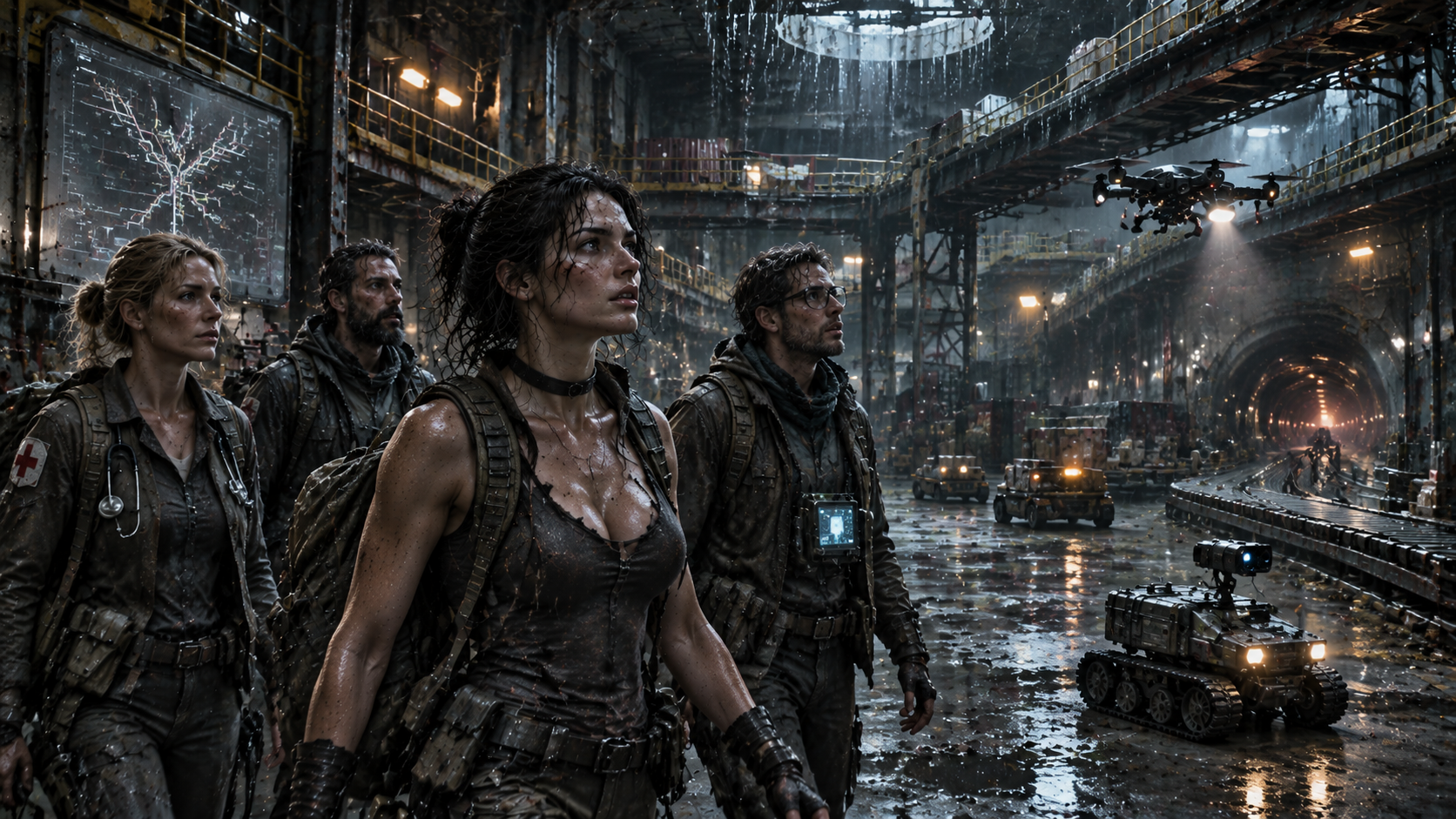
The message remained on the screen long after the room had begun to move around it.
YOU WERE NOT THE ONLY ONE WHO LEFT THE LAB.
It was an ugly sentence, not because of what it said, but because of the confidence with which it had been delivered. The terminal had not asked whether she remembered anyone else. It had not offered a name or a photograph. It had simply taken a fact she had never spoken aloud and placed it between them, like a key on a table.
The woman read the line again. Her wrist display had dimmed, but the magenta circle persisted beneath the glass. She pressed the edge of the device until the screen went black.
“Could be a bluff,” Sera said.
“Of course it could,” Elias replied. He was still staring at the terminal message. “That doesn’t make it harmless.”
Ilya leaned over the console. “The freight terminal is inside the quarantine perimeter. The old maps put it under the central interchange. Two kilometres from here, maybe less by the service tunnels. The streets are exposed.”
“And the infected?” Pavel asked.
“Plenty,” Sera said. “Unless they’ve all decided to take a holiday.”
Dr. Varga came in from the clinic, pulling off his gloves. “Niko is dehydrated and has a bacterial infection. We can treat him, but he needs fluids and observation. Yara is staying with him. She has a superficial wound, no sign of systemic infection. For now.”
“Can he travel?” the woman asked.
“No.”
“Then we don’t take him.”
Varga looked relieved that she had said it. “Good.”
The room settled into a difficult silence. The Switchyard had brought them bearings and batteries; the annex had accepted a child for treatment. A small agreement had begun to form between two groups who had every reason to
distrust one another. Now the network had offered them a direction, and the direction led straight into the worst part of the city.
“We need more information before we move,” Elias said. “The terminal could be a relay, a trap, or an old maintenance system that has mistaken a person for a missing asset.”
“Can it identify the person?” Lena asked.
“Not from that message. The reference to 03:17 suggests it has access to the same event record that appeared in the lab. It may know who was present. It may know who left.”
“Or it may be trying to make us go there,” Sera said.
The woman looked at the old map on the wall. The freight terminal had been built in layers: a public interchange above, a cargo sorting hall beneath it, and a maintenance spine connecting the rail lines to a municipal logistics depot. Before the outbreak, autonomous carts had moved parcels through the lower levels. The system had been designed to function with minimal human supervision. After the outbreak, minimal supervision had become no supervision at all.
“Let’s assume the message is bait,” she said. “What would the bait need?”
“A route,” Ilya said. “A reason to split us up. A way to get inside.”
“And a reason we’d believe it.”
Elias glanced at her. “You.”
She nodded. “Then I go.”
“No,” Sera said, before anyone else could speak.
“I didn’t say alone.”
“You were thinking it.”
“I was thinking that the message is addressed to me.”
“Messages don’t get to choose who answers them.”
The woman almost smiled. “That sounds like something you’ve said before.”
“I’ve said it to people who survived. Usually they were annoyed.”
They built the plan around what they had rather than what they wished they had. The annex could spare one scout drone, one thermal unit for a short flight, and a portable relay with a battery that had already lost nearly a third of its capacity.
The Switchyard offered the tracked robot, which Yara had named Midge, because it was small, persistent and difficult to kill. Pavel objected that it was not a proper name for a machine. Yara told him that the machine had never complained.
The party would consist of the woman, Sera, Elias and Ilya. Pavel would remain at the annex to coordinate the drones and maintain the local link. Dr. Varga would stay with Niko. Lena would help the Switchyard crew check the generator bearings. Anton was assigned the solemn responsibility of keeping the dinosaur away from the medical supplies.
“I can do that,” he said.
“Can you keep it away from the biscuits?” Pavel asked.
Anton considered the matter. “No.”
The preparation took longer than anyone liked. The woman checked her rifle, counted the remaining magazines, inspected the seal on her filter mask and replaced the battery in her wrist scanner. The scanner’s casing had a hairline crack near the charging port. She wrapped it with insulating tape and tested the contact twice. The serum vial rested in a padded compartment inside her jacket. She did not take it out.
Sera watched her fasten the jacket. “You’ve been avoiding it.”
“I don’t need it.”
“That wasn’t what I asked.”
The woman adjusted the strap of her pack. “It changes how I feel.”
“Everything changes how you feel. Hunger. Fear. Pain. People.”
“This is different.”
“I know.” Sera’s voice softened. “That’s why I’m asking.”
The woman looked toward the narrow window. Beyond it, the city was grey with smoke and late-afternoon rain. “I don’t want to find out what happens if I use it too often.”
“Then don’t use it unless you have to.”
It was not a solution. It was the kind of promise people made when they had no better protection to offer.
They left through the service gate at 16:12.
The city had grown quieter in the hours since the beacon arrived. Not safer, only quieter. Rain washed soot from the parked vehicles and gathered in the potholes. A delivery drone lay upside down on the pavement, its propellers bent like the legs of a dead insect. The traffic lights were dark. Above them, a giant digital billboard had frozen on an advertisement for an AI assistant that promised to organise every aspect of a customer’s life. Someone had changed the slogan with a spray can: IT COULD NOT ORGANISE A PANDEMIC.
Beneath that, in smaller letters: ASK IT TO SUMMARISE THE APOCALYPSE. SAVE TIME.
Ilya gave a low laugh. “At least the marketing department survived.”
“Marketing always survives,” Elias said. “It just changes the product.”
They kept to the shadow of the buildings, crossing open ground only when the drone confirmed the route was clear. Midge moved ahead, its little wheels whispering over wet concrete. Every few metres it paused to scan a doorway or inspect a patch of road. Its camera feed appeared on Ilya’s tablet, where a crude map slowly took shape from visual landmarks and inertial estimates.
“GPS is dead?” Sera asked.
“Not dead. Unreliable,” Ilya said. “The receiver sees a few satellites, but the timing jumps. Could be interference, could be damaged ground infrastructure, could be the device itself. We’re using the old map and the camera. If the robot starts navigating by vibes, I’ll let you know.”
The woman walked behind him, watching the windows. Some were boarded. Others stood open, curtains lifting in the rain. A woman’s coat hung from a balcony rail, sleeves moving in the wind as if someone inside were waving. In a small grocery store, a row of jars remained neatly arranged on the shelves. Someone had written prices on a chalkboard: WATER — 2; BATTERY CHARGE — 5; INFORMATION — DEPENDS.
They passed a bicycle chained to a lamp post. Its rear tyre was flat, but a small solar panel had been fixed to the cargo rack and wired to a portable battery. A note was tied to the handlebars: IF YOU TAKE THIS, LEAVE SOMETHING THAT WORKS.
“People are still trading,” Elias said.
“People never stopped,” Sera replied. “They just ran out of places to complain about the prices.”
At the next intersection, Midge stopped. Its camera turned toward a narrow passage between two buildings. The robot’s proximity sensor registered movement, then movement again. The feed showed a dark shape crossing the far end of the alley.
Sera raised one hand. The group froze.
A man stepped into view. He wore a railway maintenance jacket and carried a red plastic toolbox. His face was streaked with rain and grime. He looked at the robot, then at the four people behind it.
“Don’t come closer,” Sera called.
The man lifted his empty hand. “I’m not infected.”
“That’s not the same as being safe.”
He nodded as if he had expected that answer. “You’re heading for the freight terminal.”
Nobody replied.
“I can show you a service entrance,” he said. “The main road is blocked.”
“Why help us?” the woman asked.
“Because I want to leave.”
“Then leave.”
“I can’t. There are people inside.”
“People or infected?”
“Both.”
He set the toolbox down and opened it. Inside were a maintenance key, a hand torch, two filters and a paper map sealed in a transparent sleeve. He did not reach for anything else.
“My name is Tomas,” he said. “I worked the night shift at the terminal. I was there when the doors locked.”
Elias looked at him. “When?”
“03:17.”
The woman felt the world narrow around that time.
“Who locked them?” she asked.
Tomas glanced at the buildings behind them. “The terminal system. Then the freight lifts started moving.”
“Moving where?”
“Down.”
Sera’s rifle remained steady. “Why are you outside now?”
“Because I found a way out. And because the people who stayed below have started hearing announcements.”
“What announcements?”
Tomas swallowed. “Passenger names. Arrival times. Platform numbers. Some of the names belong to people who died years ago.”
Ilya looked at Elias. “That’s not a normal maintenance fault.”
“Nothing about today is normal,” Elias said.
The woman studied Tomas. His hands trembled, but his eyes did not wander. He was exhausted, frightened and trying very hard not to show either. There was a fresh bandage around his left palm. Beneath the edge of the dressing, a faint line of dark bruising ran toward his wrist.
“Show me your hand,” she said.
He hesitated.
“Now.”
He unwrapped the bandage. A deep cut crossed the palm, already cleaned. No puncture marks. No darkening of the veins.
“Machine injury,” he said. “A cargo clamp.”
“Any fever?”
“No.”
“Any contact with infected blood?”
“No.”
Sera moved closer. “You’re coming with us only as far as the entrance. You follow instructions. You don’t touch anything. If you run, we won’t chase you.”
Tomas nodded. “Fair.”
They took the service passage he showed them. It led behind a row of shuttered shops and down a ramp toward the old tram maintenance yard. A rusted electric utility cart stood under a canopy, its battery compartment open. Someone had removed the pack and left the charging cable coiled on the seat.
At the bottom of the ramp, the freight terminal rose from the rain like a concrete shipwreck. The public concourse above was dark, but the lower cargo doors showed a faint line of green light. A sign over the entrance still displayed the old corporate slogan: MOVING TOMORROW, TODAY.
Someone had added: TOMORROW IS DELAYED.
The terminal’s outer wall was covered in posters. Some advertised missing people. Others offered trades: two litres of clean water for a working radio; antibiotics for a bicycle battery; one night of armed escort for a box of insulin. A hand-painted notice had been pinned over a corporate safety sign:
NO TOKENS ACCEPTED. NO CREDIT. NO PROMISES. GOODS FIRST.
Below it, in a different hand: THEN WHY ARE YOU STILL HERE?
The woman stopped at the edge of the loading yard. The infected were visible through the glass doors. They stood among abandoned cargo carts, some facing the entrance, some turned toward the lifts. Their bodies were not packed together. There was space between them, enough for a person to walk through if the person did not mind being noticed.
“Those aren’t wandering,” Sera murmured.
“No,” the woman said.
One infected raised its head. Then another. A third turned slowly, as though following a signal that had passed through the room in a wave.
The magenta line beneath her wrist display stirred.
Tomas backed away. “They do that when the announcements start.”
“What announcements?” Elias asked.
The terminal speakers crackled overhead. A woman’s recorded voice emerged, calm and precise, with the polished warmth of a customer-service message.
“Attention, passengers. The 03:17 service is now boarding. Please proceed to your assigned platform. Do not leave personal belongings unattended.”
A pause.
“Passenger identification required.”
The infected turned toward the lower freight doors.
Then the speaker spoke again, but the voice was different. Not the announcement system. Not a recorded employee.
“Welcome back,” it said.
The woman’s wrist display lit by itself.
IDENTITY MATCH: PARTIAL. REFERENCE: 03:17 ACCESS EVENT. PASSENGER: UNLISTED. STATUS: EXPECTED.
The lower cargo doors unlocked with a heavy mechanical clunk.
From somewhere beneath the terminal came the sound of a lift beginning to rise.