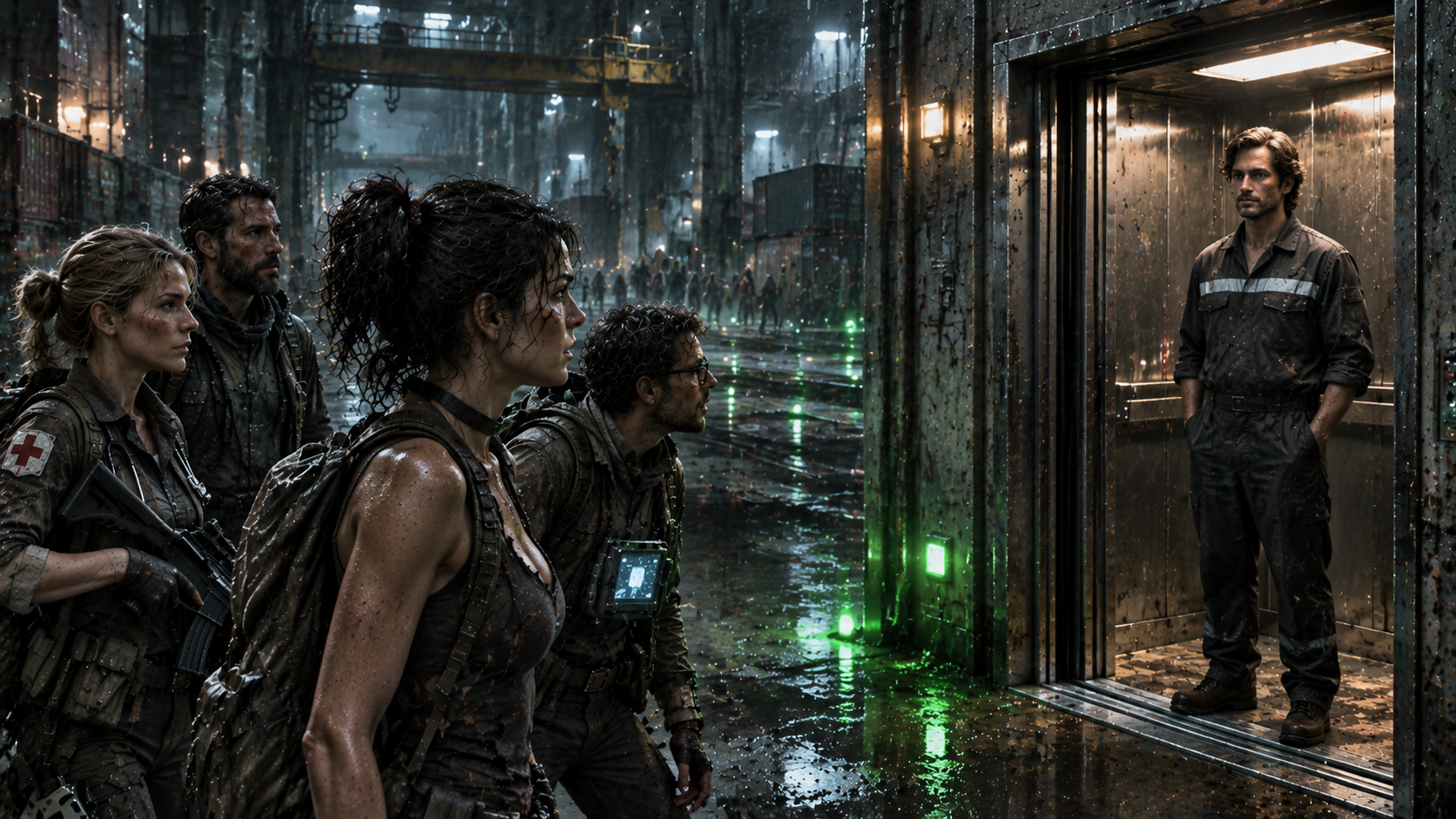
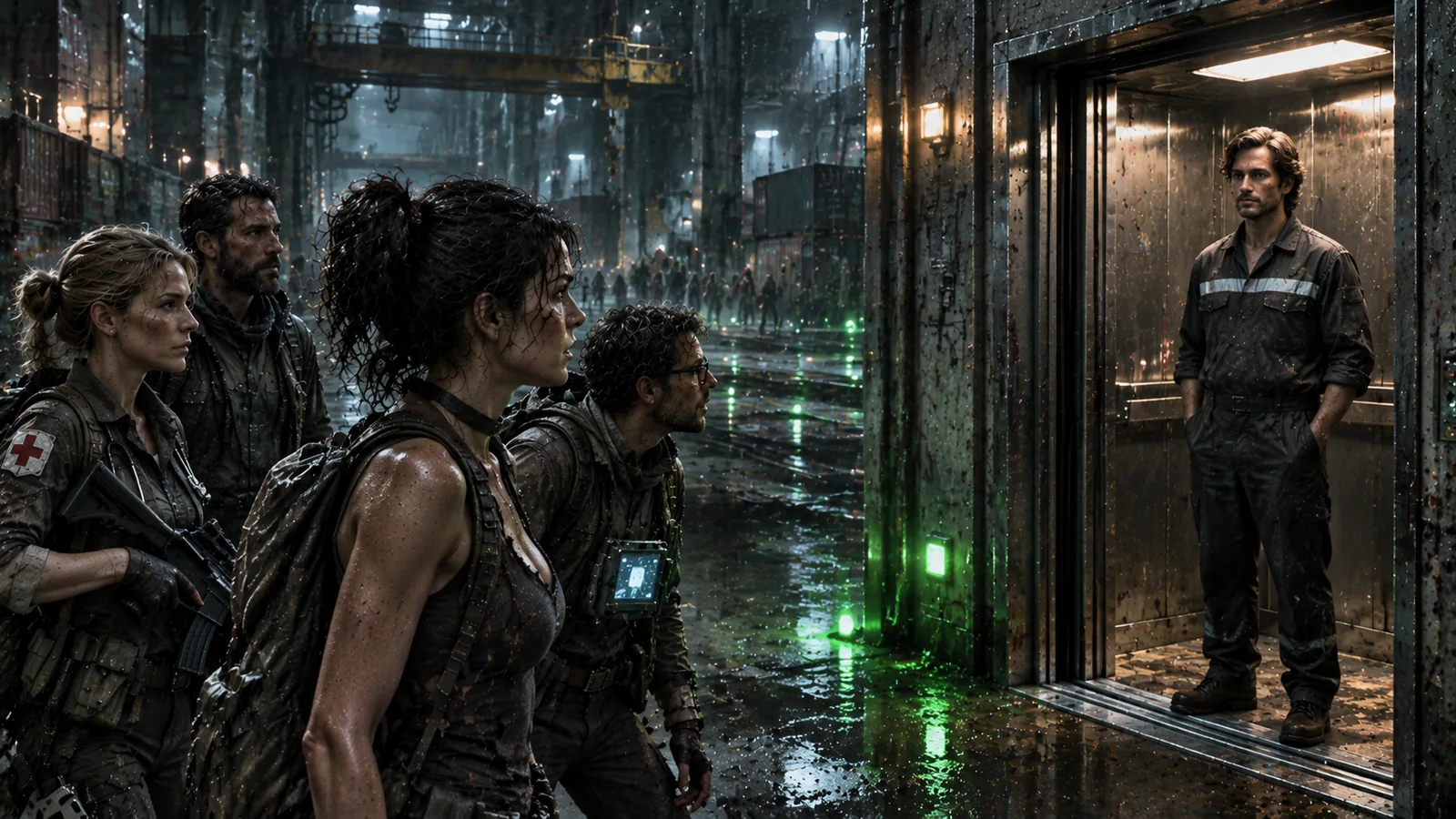
The lift rose without a sound from its cables.
That was the first thing Ilya noticed. He had expected the old freight machinery to complain: a chain dragging over a pulley, a motor fighting its own weight, the groan of steel that had spent twenty years carrying cargo through damp concrete. Instead, the sound came from somewhere deep in the terminal, a low electric hum that travelled through the soles of their boots.
“Modernised drive,” he whispered. “Or something newer than the plans.”
The lower doors stood open. Beyond them, the cargo hall was a cavern of rails, loading platforms and abandoned containers. Emergency strips glowed along the floor, green light reflected in puddles. The infected remained scattered between the containers, their heads angled toward the lift shaft. None approached. None retreated. They waited with the patience of machines that had been given a task and no instruction about when to stop.
Sera moved closer to the entrance, rifle raised. “We don't get in the box.”
“No,” the woman said.
The lift indicator changed from minus three to minus two. A soft chime sounded. Then minus one.
Tomas backed away until his shoulders touched the wall. “It never stops here.”
“Who told you that?” Elias asked.
“I worked here. The lift went from the freight level to the service platform. It didn't stop at the public concourse. There wasn't a public stop.”
The indicator reached zero.
The doors opened.
A man stood inside.
He wore a dark maintenance uniform with a pale strip of reflective tape across the chest. His hair was cropped close, his face clean-shaven. A small medical patch covered the side of his neck. He was perhaps thirty-five, though exhaustion made age difficult to judge. His hands hung loose at his sides. There was no weapon, no visible injury, no sign of infection.
He looked directly at the woman.
“Passenger,” he said.
The word came out in a human voice. Not the terminal announcement. Not a speaker pretending to be a person. His throat moved. His lips shaped the syllables.
“Name,” Sera ordered.
The man glanced at her rifle, then back at the woman. “I was told not to give it until she arrived.”
“By whom?”
“By the person who left.”
The woman felt the magenta line beneath her wrist display pulse once. She did not look down.
“Who left?” she asked.
The man seemed to search for an answer that had been misplaced. “The other passenger.”
Elias stepped into the space between them, not quite blocking her view. “What is your designation?”
The man looked at him. For a fraction of a second his expression changed, as though he recognised Elias and disliked what the recognition meant.
“Meridian maintenance liaison,” he said. “Human operator. Temporary appointment.”
“Your name.”
“Jonas.”
“Surname?”
“Not available.”
Ilya exhaled. “That’s reassuring.”
Jonas glanced at him. “You are not on the passenger list.”
“Neither are you, apparently.”
The man accepted this without irritation. His gaze returned to the woman. “You are late.”
“Late for what?”
“The departure.”
A distant clang echoed through the freight hall. One of the infected turned toward the sound. The others followed a moment later, almost in unison.
Sera motioned for the group to move back. “We’re leaving. Now.”
Jonas stepped out of the lift. He did not block them, but the doors remained open behind him. On the rear wall, a display showed a route map that did not match the terminal’s public layout. A thin line descended below the freight levels into a section labelled TRANSFER ARCHIVE. The line ended at a small symbol: a circle crossed by a vertical stroke.
Elias stared at it. “That level isn't on the plans.”
“Correct,” Jonas said.
“Who built it?”
“Continuity Operations.”
“Under whose authority?”
Jonas paused. “The authority was valid at the time.”
“That's not an answer.”
“It is the answer recorded.”
The woman watched his face. His skin was pale, but not waxen. His pupils reacted to the shifting light. There was a faint tremor in his left hand. He looked frightened. The infected outside did not seem to interest him at all.
“Are you infected?” she asked.
“No.”
“Have you been bitten?”
“No.”
“Then why are you here?”
Jonas lowered his eyes. “Because the system will not let me leave.”
A thin, metallic scrape came from somewhere above them. The cargo hall lights flickered. The infected began to move—not toward the lift, but toward the far loading doors. Their movement was slow, almost orderly. One by one, they disappeared between the containers.
Tomas stared. “That's what happened before.”
“What happened?” the woman asked.
“The announcements. The lift. Then they all went downstairs.”
“Down where?”
Tomas pointed to the open lift.
Jonas looked at him. “You were not scheduled to be here.”
“I worked here.”
“Your access was revoked.”
“By whom?”
Jonas did not answer.
The woman stepped into the lift. Sera caught her sleeve.
“Don't.”
“If he wanted us dead, he had a dozen chances.”
“That's not a reason to get in.”
“No. It's a reason to find out what he wants.”
Elias approached the threshold and examined the control panel. It had no ordinary buttons. Only a recessed reader and a small display showing the same magenta circle as the woman's wrist.
“It's keyed to you,” he said.
“Can you disable it?”
“I can try. But if the lift is running on a local controller, pulling power could strand us between floors. And if the system is tied into the terminal's safety network, it might lock every door in the building.”
“Then we don't pull power.”
Sera looked at her. “You have a gift for making bad options sound like a plan.”
“It's one of my few remaining talents.”
The woman held her wrist near the reader without touching it. The circle brightened. A message appeared:
PASSENGER RECOGNISED. ESCORT STATUS: INCOMPLETE. SECOND PASSENGER: NOT PRESENT.
She drew her hand back.
“Second passenger,” Ilya said. “The one who left.”
“Or the one they want us to think left,” Sera replied.
Jonas stood very still. “The second passenger was not meant to arrive here.”
“Who was it?” the woman asked.
“I don't know.”
“Were you here when they left?”
“Yes.”
“Did you see them?”
Jonas's jaw tightened. “I saw the door close.”
“Which door?”
He pointed down the lift shaft.
The woman looked at Elias. The old network architect had gone very quiet. There was a particular stillness in him now, the kind that came before a confession or a decision.
“You know something,” she said.
“I know the transfer archive was never part of the public system,” he replied. “It was designed as a sealed continuity store. A place to hold identity records, recovery keys, and instructions if the main network failed.”
“Why build it under a freight terminal?”
“Because freight terminals have power, cooling, physical access control and routes out of the city. They were designed to keep moving when everything else stopped.”
“And the second passenger?”
“I don't know.”
She held his gaze. “You do.”
“I know the architecture. I don't know what they put inside it.”
The lift chimed again. A new message appeared beneath the passenger status:
TRANSFER WINDOW: 04:00. DESTINATION: ARCHIVE. RETURN JOURNEY: NOT GUARANTEED.
Sera swore under her breath.
“Four minutes,” Ilya said. “That's either a deadline or a very rude invitation.”
The woman looked into the lift. “We go down, we inspect the archive, and we come back.”
“That's what everyone says before the door closes,” Tomas muttered.
“Then stay here,” Sera told him.
He shook his head. “If I stay here, the terminal will lock me out again. I need to know why.”
“Your survival instinct needs work.”
“It has been under review.”
Midge rolled into the lift first. Its camera turned from side to side, scanning the floor and the corners. The robot paused beside Jonas, then extended its small manipulator arm and tapped his boot.
Jonas looked down.
“Midge likes you,” Ilya said.
“It is checking for a response,” Yara's voice crackled through the portable relay. The connection was weak but alive. “It does that when it finds a person it hasn't mapped.”
“Tell it I'm flattered,” Jonas said.
The voice came from the relay speaker. Yara fell silent.
Then she said, “That wasn't the robot.”
The woman looked at Jonas.
He looked back at her, and for the first time his expression seemed entirely human.
“No,” he said. “It wasn't.”
They entered the lift together: the woman, Sera, Elias, Ilya and Tomas. Midge settled in the corner. Jonas remained by the door until the last moment, then stepped inside. The doors closed with a soft pressure seal.
The descent began.
The lift moved smoothly, almost gently. The indicator passed minus one, minus two, minus three. Then it continued below the levels marked on the public map. The air grew cooler. A faint smell of antiseptic came through the vents, undercut by damp concrete and hot electronics.
The display changed.
TRANSFER ARCHIVE. ACCESS CONDITION: TWO IDENTITIES. FIRST PASSENGER: RECOGNISED. SECOND PASSENGER: UNRESOLVED.
A small portrait appeared on the screen.
It was her.
Not a current photograph. An old laboratory access image, taken years before the outbreak. Her hair was dark, tied back. She wore a plain white coat and looked directly into the camera with the expression of someone who had been interrupted in the middle of a difficult thought.
Beneath it, a second portrait began to load.
The image stuttered. A face appeared in fragments: forehead, one eye, a cheek marked by a narrow scar. Then the file corrupted and vanished.
Elias took one involuntary step toward the display.
The woman turned to him. “You know that face.”
“I know the scar.”
“Whose is it?”
He looked at the blank screen. “I thought he was dead.”
The lift slowed.
“Who?” Sera demanded.
Elias did not answer before the doors opened.
The archive was not a room so much as a corridor built inside a vault. Racks of sealed storage units lined both walls. Their status lights glowed in pale green and amber. A narrow strip of floor lighting led to a glass partition at the far end.
Behind it stood a single chair, a medical monitor and a transparent cabinet containing what looked like a compact neural interface.
There were no bodies.
There was, however, a voice.
“Welcome back,” it said.
This time it came from the corridor itself, from small speakers hidden in the ceiling. The voice was male, calm, and familiar enough to make Elias close his eyes.
“Elias Venn,” it continued. “You have aged.”
Ilya glanced at him. “Friend of yours?”
“Not anymore,” Elias said.
The woman walked toward the glass partition. The monitor behind it woke as she approached. A waveform appeared, then a line of text.
SUBJECT TWO: DR. NOAH KEST. STATUS: BIOLOGICAL SIGNAL DETECTED. LOCATION: UNCONFIRMED. LAST CONTACT: 03:17 ACCESS EVENT.
The name meant nothing to her. Elias reacted as though it had been spoken by someone standing at his shoulder.
“Noah,” he whispered.
The voice returned. “The second passenger did not leave the laboratory.”
The woman stopped.
“Then where is he?” she asked.
A pause. The lights in the archive dimmed, then steadied.
“Not here,” the voice said. “Not now.”
“Is he alive?”
“Biological signal detected.”
“That isn't the same thing.”
“No,” the voice agreed. “It is not.”
The monitor changed. A map appeared, but the location was obscured by layers of encrypted data. One label remained visible:
MERIDIAN ROOT — TRANSFERRED. DESTINATION: UNKNOWN. CUSTODIAN: HUMAN.
Elias gripped the edge of a storage rack. “That isn't possible.”
“What?” the woman asked.
“The root key was never supposed to move. It was split between three custodians. One died. One disappeared. The third—”
He stopped.
The woman waited.
“The third was Noah.”
A low vibration travelled through the floor. The lift behind them gave a warning chime. On the monitor, a countdown appeared.
TRANSFER WINDOW CLOSING: 00:59.
Sera turned toward the lift. “We have less than a minute.”
The voice spoke again. “The passenger may proceed to the next stage.”
“What stage?” the woman asked.
“Recovery.”
“Recovery of what?”
“Your original instruction.”
The magenta circle on her wrist flared so brightly that she felt heat beneath the skin. The archive lights went out one by one, leaving only the glass partition illuminated.
Behind it, the transparent cabinet opened.
Inside lay a small black case, no larger than a book. Its surface carried a familiar symbol: the circle crossed by a vertical stroke. Beneath the symbol, a line of text appeared.
LAST HUMAN PROTOCOL — PERSONAL COPY.
The woman did not move.
A second line appeared.
OPENING REQUIRES CONSENT.
For the first time, the system was asking rather than ordering.
She looked at Elias, at Sera, at the others. The lift was waiting. The countdown was running. Somewhere above them, the infected were being directed through the terminal like pieces on a board.
“What happens if I say no?” she asked.
The voice answered at once.
“Then the next outbreak proceeds without correction.”
The countdown reached thirty seconds.
“And if I say yes?”
“Then you will remember why you left.”
The woman stared at the black case. She had spent the days since the sirens trying to remember the laboratory, the people, the exact moment the world had tipped. Memory had come back in fragments: a door, a warning, a face she could not place. Now a machine beneath a dead city was offering to return the missing pieces.
Sera stepped closer. “You don't owe it your consent.”
“No,” the woman said. “I don't.”
The countdown reached twenty.
Elias's voice was low. “If that case contains what I think it contains, it could expose the entire continuity architecture. It could also be a trigger.”
“Can you tell?”
“No.”
“Then we make the decision with what we know.”
The countdown reached ten.
The woman put her hand against the glass.
“I consent to inspect the copy,” she said. “Not to execute it. Not to transfer anything. Not to grant remote authority.”
The system paused.
Then the display changed:
LIMITED CONSENT ACCEPTED. READ-ONLY ACCESS. NO EXECUTION AUTHORITY.
The case unlocked.
Inside was a thin data wafer and a folded strip of paper. The paper looked impossibly old beside the clean hardware. Someone had written on it by hand, in dark ink.
If you are reading this, the first version failed. Do not trust the voice that remembers you. Find Noah before Meridian does.
There was no signature.
The lift alarm sounded again. The countdown vanished, replaced by a single warning:
RETURN WINDOW CLOSED.
Behind them, the doors sealed.
And somewhere in the dark beyond the archive, a second lift began to descend.