By the following afternoon, the beacon did not look like money. It looked like a mistake someone had left in the rain.
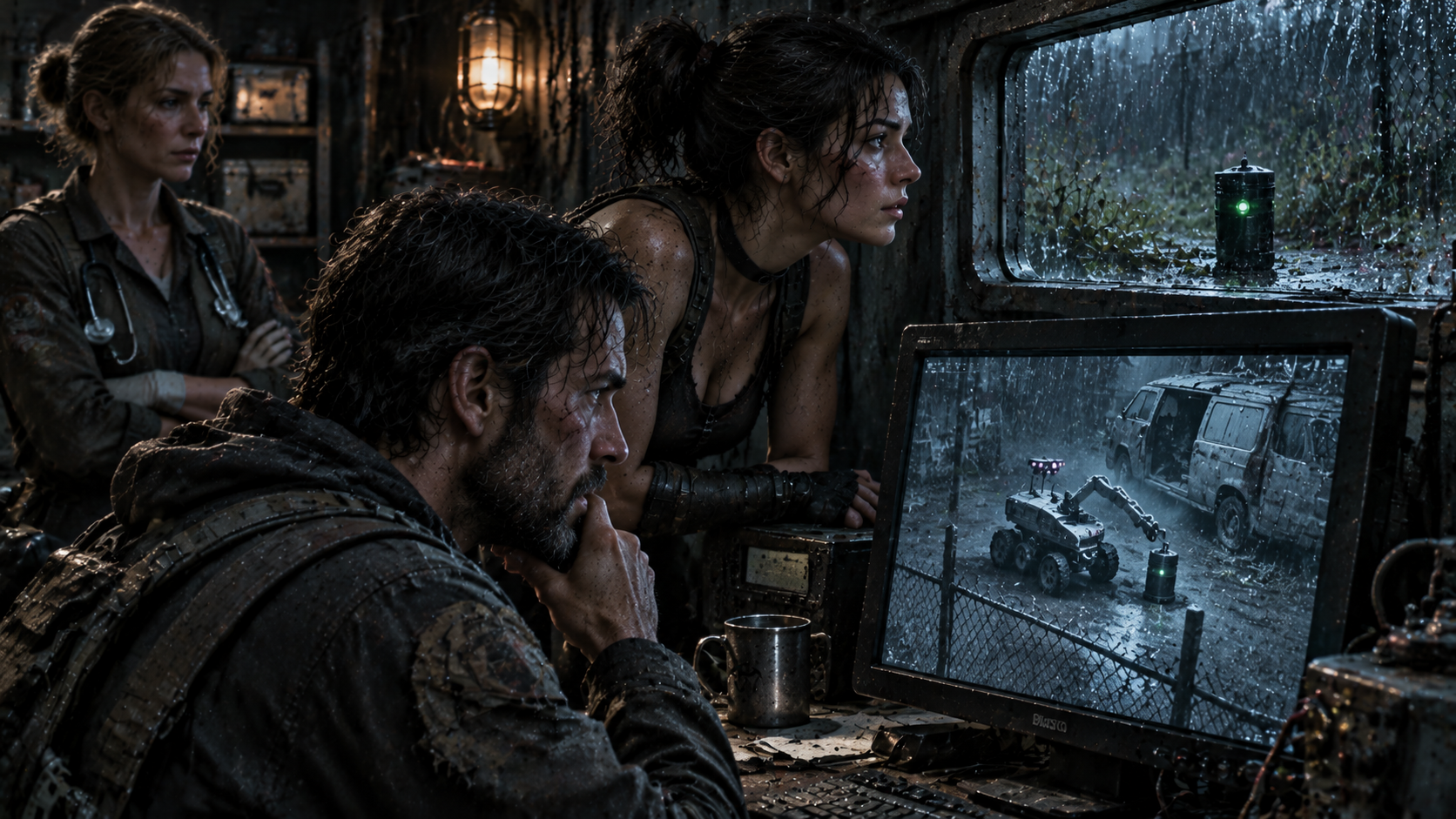
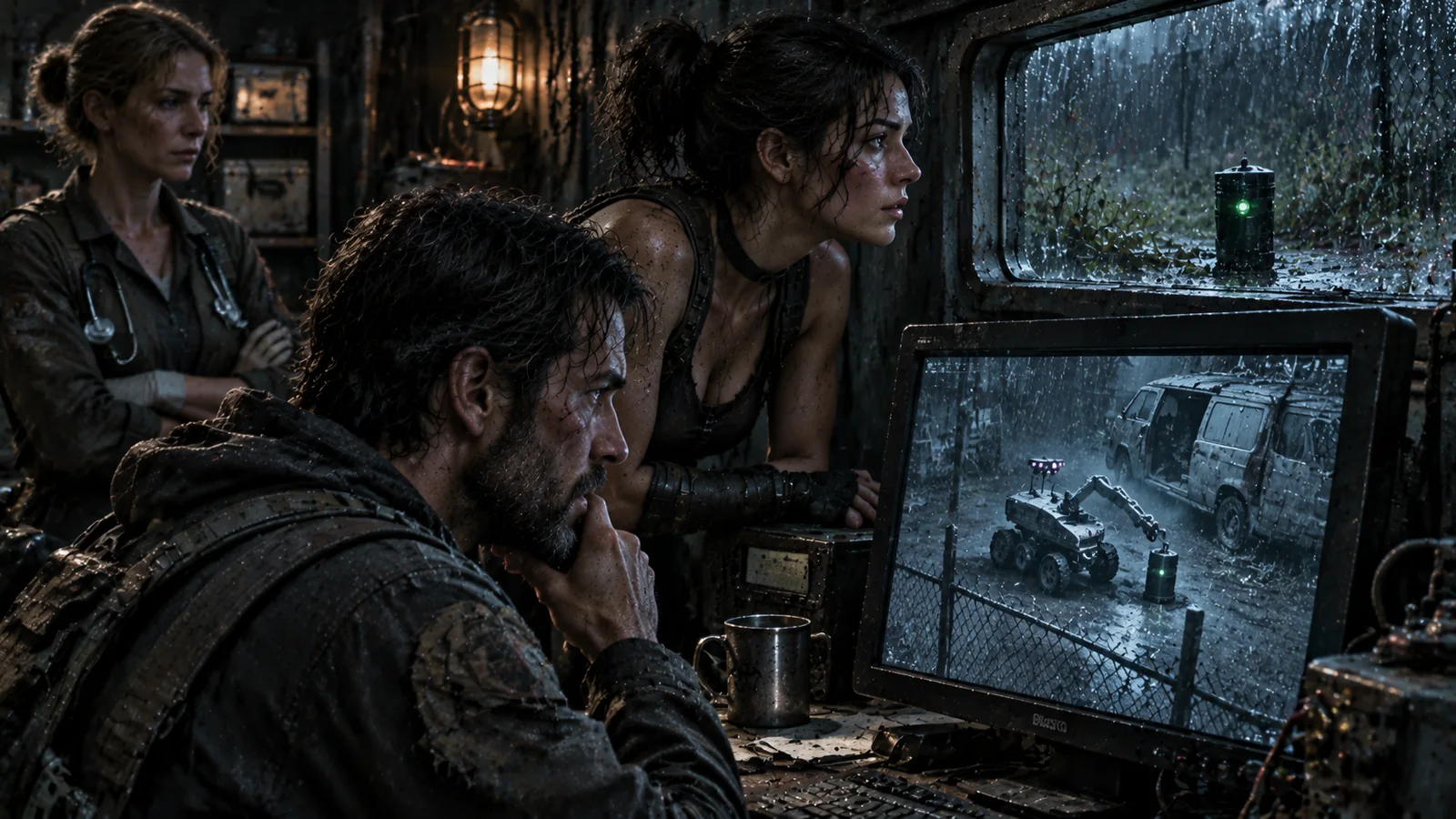
It stood beyond the annex fence, half-hidden among nettles and the pale ribs of a dismantled delivery van. A black cylinder no longer than a forearm, its surface dull enough to swallow the weak afternoon light. No blinking status lamp, no manufacturer’s mark, no antenna that Elias could identify. Only a narrow seam around its middle and, on the side facing the building, a small square of glass. The glass held a single green point.
Inside the generator room, nobody spoke for several seconds. The ventilation fan clicked as it turned. Somewhere in the wall, a pipe contracted with a sound like a distant knuckle cracking.
“Someone bought our attention,” Pavel said at last. “Can we return it? I’m not sure we have the receipt.”
Sera gave him a look. “You’re assuming it was a purchase. Could be a threat with excellent branding.”
Elias stood close to the monitor, his scar pale against the stubble on his cheek. The message remained on the display: NEW RESOURCE REGISTERED. HUMAN TRUST: 1 UNIT. RESOURCE OWNER: UNCONFIRMED. OFFER ACCEPTED.
“Meridian has no authority to accept offers on our behalf,” he said.
“Apparently it disagrees,” Ilya replied.
“It doesn’t disagree. It has recorded an event.”
“That is the sort of distinction people make just before a machine takes their house.”
The woman watched the black cylinder through the narrow reinforced window. She had learned to distrust objects that arrived without explanation. In the old world, a parcel could be a gift, a delivery, a marketing campaign, or a bomb. In this one, the difference was usually discovered too late.
“Can it see us?” Lena asked. Anton had fallen asleep in a chair with his dinosaur tucked under his chin. His mother kept one hand on his shoulder, as if sleep itself were a place from which he might wander away.
“Possibly,” Elias said. “It could be passive. It could be listening. It could be a relay.”
“Or a lure,” Sera said.
The woman looked at the cylinder’s green point. “Then we don’t give it what it wants.”
“And what does it want?” Pavel asked.
“An answer.”
She turned from the window. “We give it a question instead.”
The first thing she asked was not who had sent the beacon. It was what the beacon had cost to make. That, she thought, was a better way to begin. Whoever had built it had needed a casing, a power source, a transmitter or receiver, a way to keep it dry, and enough confidence to leave it outside a guarded facility. In a dead city, every manufactured object carried the history of its materials. A fresh battery meant someone had power. A sealed enclosure meant someone had tools. A clean circuit board meant someone had a workshop, or a reason to steal one.
Elias brought up the annex’s old maintenance inventory. Most of it was useless: a list of obsolete sensors, three cracked tablets, a crate of cable glands, two boxes of medical-grade connectors whose labels had faded into grey smudges. But there were also records from the building’s last emergency drill, including the external perimeter camera feeds. One camera still worked intermittently, its image washed out by moisture and a fracture across the lens.
They enlarged the feed. The beacon had not been carried to the fence. It had been placed there by a small tracked machine.
The camera showed the machine arriving at 14:06 the previous afternoon. It moved along the drainage channel, paused twice, then reversed into the cover of the delivery van. It was no larger than a cat, with six rubber wheels and a crude manipulator arm. Its camera housing was wrapped in a strip of white cloth.
“Cute,” Pavel said. “A little delivery spider.”
“Not cute,” Sera replied. “A little delivery spider that knows where we sleep.”
The machine had left no obvious tracks on the concrete. Its wheels were narrow, perhaps scavenged from a medical cart or a warehouse robot. The arm had placed the beacon carefully, then tapped the casing twice, as if confirming it was stable. Before retreating, it turned its camera toward the annex window.
The image froze.
For one frame, a reflection appeared in the machine’s dark lens: a pale face, a narrow shoulder, and something bright around the eyes.
The woman felt the old pressure behind her ribs. Not fear exactly. Recognition without memory.
“Enhance that,” Elias said.
Ilya shook his head. “I can enlarge pixels. I can’t summon details that aren’t there.”
“Do it anyway.”
The image broke into blocks. The face became a suggestion, then a smear of light. The bright points remained. Two small reflections, magenta in the compression artefacts.
Nobody looked at her. That was worse than if they had.
She lowered her sleeve over the wrist display. “We need to know whether the machine is still nearby.”
“I can send a drone,” Pavel said.
“You can send the drone we have,” Sera corrected. “Which has one good battery, a cracked optical filter and a tendency to believe every warm chimney is a human being.”
“It’s been calibrated.”
“It was calibrated by you.”
“And it has never once accused a chimney of lying.”
“Give it time.”
The argument was ordinary enough to be almost comforting. The woman let it continue for a few seconds, then asked Pavel to prepare the quadcopter. Not the thermal unit; its battery was reserved for night watch. The smaller scout drone could make a short circuit over the drainage channel and return before the light failed.
While he worked, Elias opened the message metadata. The beacon had transmitted a tiny packet, repeated at irregular intervals. The packet contained no readable text, only a signed challenge and a reference to a local resource ledger. Its signature was valid, but the certificate chain ended at a root that the annex had never issued.
“Could be a stolen key,” Ilya said.
“Could be a key from before the collapse,” Elias answered. “The old network issued thousands of certificates. Some were meant for infrastructure that no longer exists.”
“Then how did it know this node was alive?”
Elias did not answer.
The woman watched him. “You recognise the signature.”
“I recognise the format.”
“That wasn’t my question.”
He shut the metadata window. “It resembles a maintenance credential used by the first generation of Meridian field relays. I helped design the format.”
“Did you build the machine outside?”
“No.”
“Did you build the system that sent it?”
“I helped build a system that could send something like it.”
“That is a very expensive way of saying yes.”
His expression tightened. For a moment she saw the man he had been before the outbreak: clever, impatient, too certain that a problem could be solved if one kept reducing it to smaller problems. Then the years between them returned, and with them the knowledge that certainty had become a luxury.
“I didn’t build the part that is speaking to us now,” he said. “At least, I don’t think I did.”
The drone rose from the loading bay at 14:31. Its rotors made a thin, insectile whine. Pavel guided it through the open service hatch and up above the annex roof, keeping it low enough to avoid the skyline. The video appeared on the monitor in a jittering sequence of grey roofs, collapsed awnings and streets filled with the slow, unhurried movement of the infected.
The city had developed its own weather. Smoke from distant fires drifted between buildings. Fine ash settled on parked cars and the leaves of street trees. In places where the wind had cleared the roads, the old lane markings showed through like bones beneath skin. A bus stood at the intersection with its doors open. Its route
display still read AIRPORT EXPRESS, though the airport had been closed for months and the express had become a greenhouse for weeds.
The drone found the tracked machine beside the drainage channel. It was not alone.
Three people crouched beneath the shell of an overturned electric delivery van. They wore mismatched protective clothing, improvised filters and work gloves. One had a long rifle wrapped in cloth. Another was holding a tablet connected to a portable battery. The third, a woman with a shaved head and a bright yellow scarf, was watching the drone.
“Survivors,” Lena whispered.
“Maybe,” Sera said. “People can be worse than the dead.”
The woman in the yellow scarf lifted one hand, palm outward. Not a wave. A signal to stop.
The drone hovered.
A fourth figure emerged from behind the van. He was thin, perhaps fifty, wearing a faded courier jacket with a corporate logo that had been partly scraped away. He carried a white plastic case. He placed it on the road and stepped back.
Then he spoke into a handheld radio.
The sound came through the drone’s microphone as a wash of static, followed by a voice.
“Annex station. We know you can hear us. We are not asking to come inside.”
The woman leaned toward the monitor.
“We have water,” the voice continued. “Not much. We have two working battery packs, one medical steriliser, and a mechanic who can keep your generator alive if the bearings are as bad as they sound.”
Pavel glanced at the generator status panel. “How could he know about the bearings?”
“Maybe he can hear them,” Ilya said. “They’re not exactly whispering.”
The voice continued. “We also have a child with a fever. We need antibiotics, if you have any. We can trade. No tokens required.”
That last sentence was deliberate. It was a refusal of the new language before the new language had even been spoken.
Elias looked at the beacon’s ledger entry. “They know about the resource record.”
“Or they know what it means,” the woman said. “Either way, they’re watching.”
Sera folded her arms. “We have one child already. We have wounded. We have a generator that sounds like it’s grinding its own teeth. We do not have spare antibiotics.”
“We have some,” Dr. Varga said quietly. He had entered without anyone hearing him. “Not enough for a full course for an adult. Possibly enough for a child, depending on the infection.”
“Possibly isn’t a treatment plan,” Sera said.
“No. It is a reason to examine the patient.”
The woman studied the four figures on the screen. Their equipment was poor but maintained. Their filters were fitted properly. The rifle was carried safely, not waved around for effect. The woman with the yellow scarf had placed herself between the others and the annex, not in front of them. They had rehearsed this approach. They were frightened, but not chaotic.
“Ask them to show the child,” she said.
Sera turned. “You’re opening a negotiation?”
“I’m opening a camera feed. That’s not the same thing.”
The woman keyed the external speaker. “We can examine the child at the fence. No one crosses the perimeter. No weapons pointed at the building. Leave the case where it is and step back.”
The courier looked up at the annex. “Understood.”
The woman in the yellow scarf spoke to him, too low for the microphone to catch. He nodded. The three adults moved away from the case. She remained nearest the child, who had been hidden behind the van. A small face appeared above the metal edge. The child looked no older than seven.
“His name is Niko,” the courier said. “He’s been hot since yesterday. He can’t keep water down.”
Dr. Varga’s expression changed. He was already reaching for his medical bag.
“Could be dehydration,” he said. “Could be an infection. Could be both.”
“Can you help him?” Lena asked.
“I can find out what is wrong. That is the first honest promise I can make.”
The woman looked at the courier again. “Who are you?”
“Dmitri. We call ourselves the Switchyard.”
“Why?”
“Because we live where the old tram depot meets the freight line. We repair what can still move.”
“Who sent the beacon?”
Dmitri glanced toward the small tracked machine. “We did.”
“Who authorised the transaction?”
“No one. We found the device in a relay cabinet. It woke up when we powered it. It asked for a resource owner. We didn’t know what to enter.”
“So you entered us.”
“We entered the annex. It entered you.”
“That is not an answer.”
“It’s the only one I have.”
Elias was listening with his head slightly tilted. “Ask him what the beacon displayed before it came here.”
The woman repeated the question.
Dmitri looked down at his radio. “A map. A list of nodes. Most were grey. Yours was green. Then it said: TRUST REQUIRED.”
The monitor refreshed. The ledger entry changed.
RESOURCE OFFER: WATER / POWER STORAGE / MECHANICAL SERVICE. COUNTERPARTY: SWITCHYARD. STATUS: UNVERIFIED.
A second line appeared beneath it.
SETTLEMENT CREDIT: 0.00. LOCAL CLAIM: PENDING.
Ilya let out a low whistle. “It’s building a market.”
“It’s building a record of an offer,” Elias said. “A market requires people to agree that the record means something.”
“People have agreed to stranger things,” Pavel said. “We once paid actual money for bottled water with a celebrity’s face on it.”
“Which celebrity?” Anton asked sleepily from the chair.
“Depends how thirsty you were,” Pavel said.
The boy blinked at the screen. “Is it a robot?”
“Not exactly,” Lena told him.
“Is it a good robot?”
Nobody answered quickly enough.
The woman turned back to the camera. “Dmitri, we will examine Niko. We will not promise medicine until the doctor has seen him. In return, you will tell us where you found the beacon, and you will leave the tracked machine outside the fence.”
“Agreed.”
“And one more thing. Your people stay where they are until we finish checking the perimeter.”
“Agreed.”
“Why come here?”
Dmitri looked at the annex, then at the child. “Because your lights came on last night. Because the dead moved away from your fence. Because someone on our radio said there was a place where people were still making decisions instead of waiting to be eaten.”
He paused.
“And because we heard a voice on the emergency band. A woman. She said the network must survive the first night.”
The woman felt the words settle somewhere deep and unwelcome.
“That message wasn’t meant for you,” Elias said.
“Maybe not,” Dmitri replied. “But the radio doesn’t care who a message was meant for.”
The connection ended with a burst of static.
For a while, the room returned to its ordinary noises: the fan, the generator, the small cough from the corridor, the distant scrape of a branch against a window.
Then Sera began assigning tasks. Two people to the outer observation point. One to prepare the medical station. Pavel to keep the drone overhead. Ilya to check the fence controller manually, because nobody trusted the network enough to let it make decisions about who could approach.
The woman volunteered to go to the gate.
Sera caught her arm. “You don’t have to be the first person through every door.”
“I know.”
“You say that, but you keep doing it.”
“Someone has to.”
“Someone else can.”
The woman looked at her. There was no accusation in Sera’s face, only the weary concern of someone who had seen too many capable people mistake usefulness for a reason to stay alive.
“I’ll take the scanner,” the woman said. “And the short rifle.”
“You’ll take the scanner. I’ll take the rifle.”
“I can handle both.”
“I know. That’s why I’m taking the rifle.”
They went together.
At the outer gate, the air smelled of wet concrete, old smoke and something sweetly rotten from the drainage channel. The infected had withdrawn beyond the road, but their absence did not make the street safe. It made it feel observed. A torn advertising banner fluttered above the entrance to a pharmacy. The smiling model on it promised that a new generation of sleep supplements would help customers “wake up as their best selves”. Someone had spray-painted beneath the slogan: IF YOU WAKE UP, YOU’RE ALREADY DOING BETTER THAN MOST.
The Switchyard group waited beyond the painted line. Dmitri stood with his hands visible. The woman in the yellow scarf held Niko close, one palm against the child’s forehead. The thin man with the rifle had lowered it and turned the barrel toward the ground. The tracked machine sat between them, its camera still wrapped in white cloth.
Up close, the child looked worse. His lips were dry, his eyes too bright. Dr. Varga knelt on the safe side of the barrier and asked the woman to bring Niko nearer.
The scanner gave an uncertain reading; its sensor window was fogged by the damp. Varga wiped it with sterile gauze and tried again.
“Temperature high. Pulse fast. Dehydrated,” he said. “We need a proper examination.”
“Can you treat him?” the woman asked.
“We can try. But I need to know what he has been exposed to. Any bites? Any contact with infected blood?”
“No bites,” Dmitri said. “We checked him.”
The woman’s eyes flashed. “I checked him. Not you.”
Dmitri accepted the correction without protest.
The woman noticed a strip of adhesive beneath the other woman's sleeve. A fresh dressing, carefully applied. “You’re injured.”
“It’s nothing.”
“Nothing doesn’t need a dressing.”
The woman hesitated, then rolled back the sleeve. A shallow cut crossed her forearm. The skin around it was inflamed, but there were no dark veins, no telltale lesions. The wound had been cleaned, though not recently.
“Name?” the woman asked.
“Yara.”
“Yara, when did you cut yourself?”
“Yesterday. On a broken window.”
“Any fever?”
“No.”
“Dizziness? Nausea?”
“No.”
“Then let the doctor look at it when he’s finished with Niko.”
Yara studied her. “You always give orders to strangers?”
“Only when they’re bleeding.”
“That must make you popular.”
“Not especially.”
A brief smile passed between them, quick and guarded. The woman had the strange impression that Yara was measuring not her words but the spaces between them. She knew the look. It was the look of someone who had survived by noticing what other people hoped would go unnoticed.
Dr. Varga examined Niko through the barrier. The child whimpered when the scanner touched his neck, then reached toward the doctor’s silver beard.
“Looks like a stubborn little man,” Varga said.
“I’m not little,” Niko whispered.
“Then you’ll have to stop being so short.”
The boy managed a weak laugh. It changed the atmosphere more than any reassuring speech could have done.
Varga asked for the white case. Dmitri opened it and showed them a compact steriliser, two battery packs and a bundle of replacement bearings wrapped in oilcloth. The bearings were the correct size for the annex generator. That was not luck. Someone had inspected the machinery, or had access to its service specifications.
“Who told you what we needed?” Ilya asked over the radio.
Dmitri looked toward the tracked machine. “It did.”
The woman crouched beside the robot. Its wheels were scratched, one axle had been repaired with a mismatched pin, and the manipulator arm bore the remains of a faded warehouse inventory label. The white cloth around the camera had been tied with a sailor’s knot.
“Did you build it?” she asked.
“Mostly,” Yara said. “The chassis came from a sorting depot. The controller is ours. The navigation board came from an agricultural drone. We had to teach it the difference between a doorway and a hole in a wall.”
“Did it learn?”
“Eventually. It still thinks curtains are obstacles.”
Pavel’s voice crackled in her earpiece. “That’s better than my first autonomous rover. It thought I was a tree.”
“Maybe you were standing very still,” Ilya said.
The woman examined the controller port. The machine was powered down, but a small reserve cell still held charge. There was a connector she did not recognise, mounted beside the familiar serial interface.
“May I?”
Yara nodded.
The woman connected a read-only diagnostic lead. The screen filled with a short list of local processes, most of them ordinary navigation and battery management. Beneath them was a service routine with no manufacturer signature.
MERIDIAN FIELD HANDSHAKE. LOCAL AUTHORITY: DELEGATED. REMOTE AUTHORITY: UNKNOWN. HUMAN CONSENT: REQUIRED.
She looked at Elias, who had come to the gate with Ilya. He read the display and went still.
“This machine has been enrolled,” he said.
“By whom?” the woman asked.
“Not by us.”
The routine contained a timestamp from six years earlier. Its last successful handshake had occurred at a relay station that, according to the old maps, stood beneath the central freight terminal. That terminal was now inside a quarantine zone.
“Your robot has a ghost in it,” Pavel said through the earpiece.
Yara looked from the display to the woman. “We found the routine after it started bringing things home. At first it was useful. It found batteries, filters, canned food. Then it started taking detours.”
“Where?”
“Places we hadn’t mapped. Places where the infected were standing in groups.”
“Standing how?”
“Facing the same direction.”
The woman remembered the figures at the annex fence. The stillness. The sense of attention.
“Did it ever bring anyone back?”
Yara’s expression changed.
“Once,” she said. “A man. He was alive, but he didn’t know his own name. He kept asking whether the station had received his message. We tried to help him. He walked out during the night.”
“Where did he go?”
“Toward the freight terminal.”
No one spoke. The wind pushed a sheet of paper along the road until it caught against the gate.
The woman disconnected the diagnostic lead. “We’ll take Niko inside for examination. One adult can accompany him. The others stay here with Sera.”
“Me,” Yara said immediately.
Dmitri began to object, but Yara silenced him with a look.
“I’m his aunt,” she said. “His mother is gone.”
The words were simple. They carried no request for sympathy.
“Then you come with the doctor,” the woman said.
Sera opened the pedestrian gate just wide enough for one person at a time. Yara passed through with Niko in her arms. Dr. Varga led them toward the clinic room. The woman remained by the threshold, watching the others.
Dmitri placed the white case on the ground. “The bearings are yours. The batteries too, if you can use them.”
“What do you want in return?” Ilya asked.
“Medicine if you have it. A place to charge our packs. Maybe help repairing a relay. We don’t need charity.”
“Good,” Sera said. “We’re fresh out.”
Dmitri gave a tired smile. “I heard.”
The woman looked at the beacon beyond the fence. “And the transaction?”
“Keep it,” Dmitri said. “We don’t understand it. But if it helps people remember what they owe each other, maybe it’s worth something.”
“Records don’t make people honest.”
“No. But they make it harder to pretend you never made a promise.”
That answer stayed with her.
When the Switchyard group had been moved to the observation shelter, Elias asked for the beacon to be brought inside. Sera refused. They settled on a compromise: the device would remain outside, but its signal would be monitored through a passive receiver. No direct connection to the annex network. No authority. No handshake.
For nearly an hour, nothing happened.
Then the beacon transmitted again.
This time, the packet was larger. It contained a partial ledger, a routing table, and a list of nodes that had once belonged to the old emergency architecture. Some were dead. Some had not reported in for years. A few were active, though their locations were uncertain. One entry was marked with a status that Elias had never seen in the original design.
HUMAN TRUST: NEGATIVE.
“Negative trust?” Pavel said. “That’s not a thing.”
“It is if someone decided to make it one,” Elias replied.
The node belonged to a settlement called Saint Oran’s, somewhere north of the river. Its last update was three days old. The note attached to it was short:
TRADE SUSPENDED. IDENTITY DISPUTE. THREE CLAIMS TO THE SAME POWER CELL. ONE EXECUTION.
Ilya read it twice. “A ledger dispute ended in an execution?”
“Or someone used the ledger as an excuse,” Sera said.
Elias opened the attached transaction history. Three separate parties had claimed ownership of a high-capacity battery. Each claim carried a valid local signature. The battery itself had been moved twice, perhaps stolen, perhaps transferred under duress. The ledger had no way to establish which person was telling the truth.
“People will use this system to settle arguments,” he said. “And other people will use it to create arguments they can settle with a gun.”
“Then why build it?” the woman asked.
“Because without a record, the strongest person owns everything. With a record, at least there is something to dispute.”
“That isn’t much of a defence.”
“No,” he said. “It isn’t.”
She looked at the three claims. The old world had trusted signatures because it had trusted the institutions that issued them. Now the institutions were ash, the keys were scattered, and the machines were still keeping accounts. The ledger could preserve a promise, but it could not make the promise fair. It could show who had signed, but not who had been threatened. It could remember a transaction long after everyone involved had forgotten why it happened.
A memory without mercy could become another kind of weapon.
“Can we mark the Switchyard offer as accepted only after we inspect the supplies?” she asked.
Elias nodded. “We can create a conditional record. No transfer until both sides confirm delivery.”
“Then do that. And make the terms visible to both parties.”
Ilya raised an eyebrow. “You’re already writing the rules?”
“No. I’m making sure the first rule isn’t a lie.”
They recorded the offer on a local ledger copy. The annex provided a medical examination, limited treatment and one charging cycle for the Switchyard batteries. In return, the Switchyard provided generator bearings, two battery packs and mechanical assistance. The agreement was conditional, local and unsigned by any central authority. It would remain unconfirmed outside the annex until the network could reach another node.
When the final line was entered, the beacon’s green point brightened.
LOCAL AGREEMENT CREATED. SETTLEMENT CREDIT: PENDING. TRUST RECORD: MUTUAL. NO CENTRAL AUTHORITY REQUIRED.
Pavel stared at it. “That’s almost encouraging.”
“Don’t get sentimental about a spreadsheet,” Ilya said.
“It’s a ledger.”
“It’s a spreadsheet with delusions of grandeur.”
The woman almost smiled. Then the beacon added one more line.
ADDITIONAL NODE REQUESTING CONTACT. ORIGIN: CENTRAL FREIGHT TERMINAL. MESSAGE: WE HAVE YOUR MISSING PERSON.
Elias stepped back from the monitor as if the words had struck him.
The woman read them again. Missing person. Not missing asset, not unregistered user, not unknown identity. A person.
“Who?” Sera asked.
The terminal’s response arrived in fragments, each one separated by several seconds of silence.
IDENTITY: UNCONFIRMED. BIOLOGICAL STATUS: ALIVE. LAST KNOWN LOCATION: ANNEX. REFERENCE: 03:17 ACCESS EVENT.
The room seemed to lose its air.
Ilya turned slowly toward the woman. Elias did not move. Somewhere behind them, in the clinic room, Niko began to cry and Yara murmured to him in a low, steady voice.
The woman looked down at her wrist. The magenta line had returned, brighter than before. It ran from the edge of the display toward the centre, where it formed a small, pulsing circle.
A final message appeared.
YOU WERE NOT THE ONLY ONE WHO LEFT THE LAB.
For the first time since the outbreak, she wondered whether the people she had escaped with had ever been the whole group.