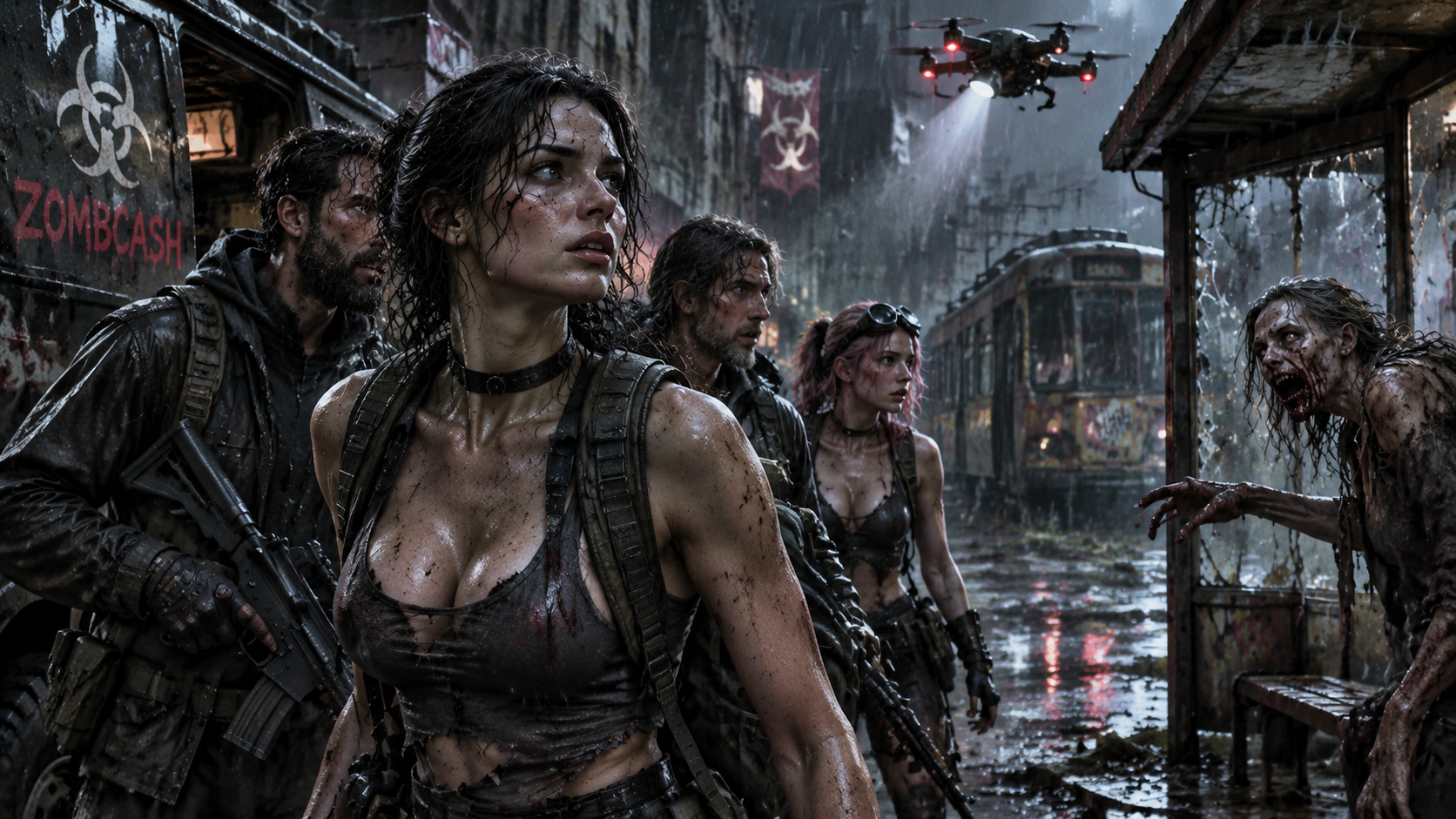
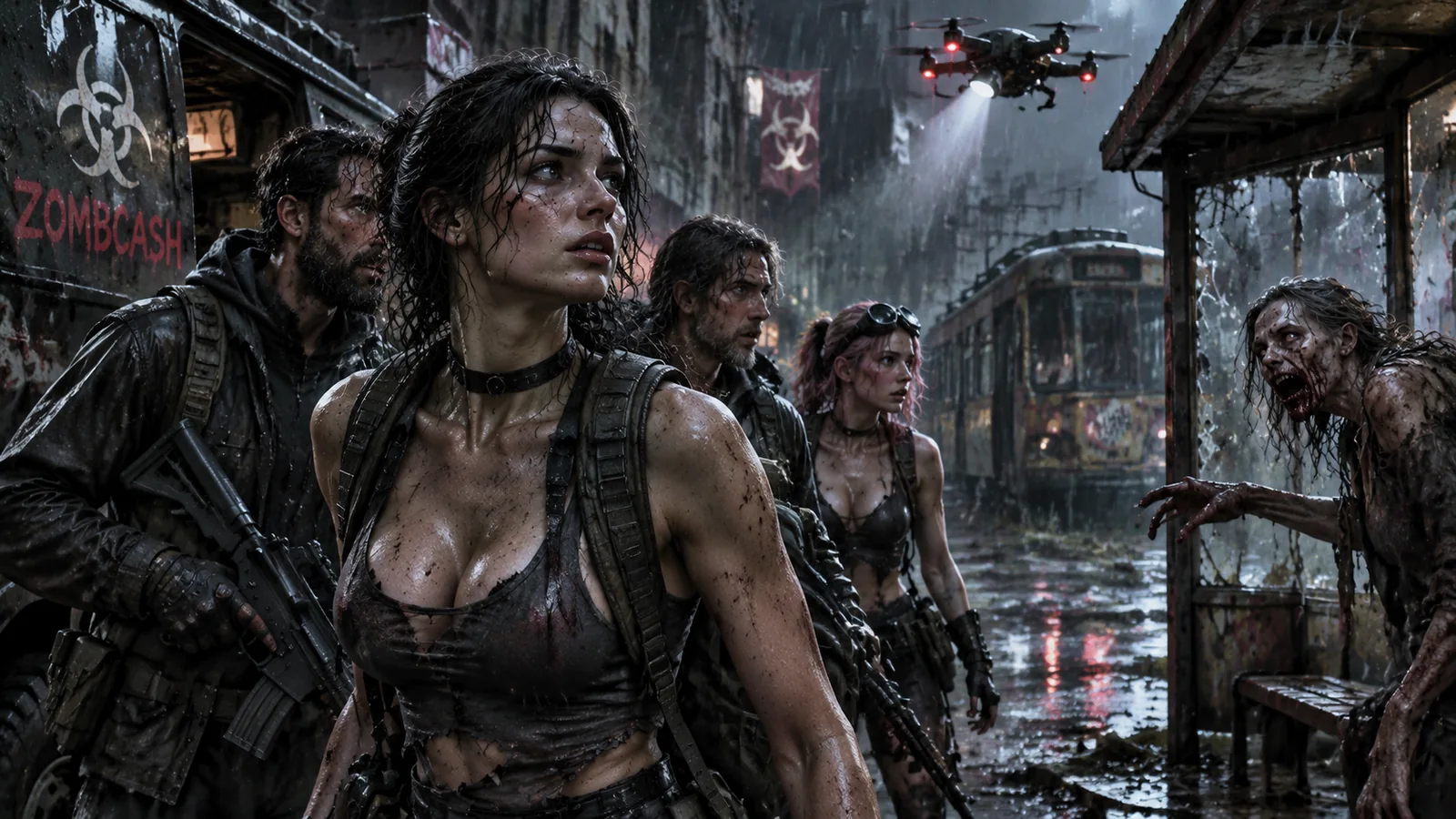
The figures did not move.
That was what frightened her most.
The infected she had seen in the city had been driven by appetite, pain, confusion or some damaged instinct that still resembled life. They had lurched toward noise, stumbled after movement, struck at doors and windows with the blind persistence of trapped animals. These three stood beyond the fence in the rain, spaced several metres apart, their heads angled toward the annex.
They looked less like a crowd than a set of markers.
The woman remained behind the lobby glass, watching them. The nearest wore a dark coat that hung open over a pale shirt. Its face was turned slightly upward, as if it were listening to the roof. The second stood beside the gate, one hand resting against the mesh. The third was almost hidden by the branches of a cypress tree.
“Are they moving?” Ilya asked.
“No.”
“Then perhaps they're not infected.”
“Perhaps.”
“Or perhaps they're waiting.”
She looked at him. “That's what I don't like.”
Ilya came to stand beside her. He had cleaned the cut on his forearm, but a small patch of gauze was already darkening at one edge. He followed her gaze through the glass.
“Could be a behavioural response,” he said. “Some kind of orientation. They hear the generator, or the server fans. Maybe the building's electromagnetic field —”
“Don't start inventing reasons.”
“I'm not inventing. I'm proposing.”
“Propose after you have evidence.”
He gave her a sideways look. “You used to be more fun.”
“I used to have coffee.”
“That's fair.”
Behind them, the annex generator finally caught. Its low vibration travelled through the floor, a mechanical purr that made the lobby lights steady. The old building was waking one system at a time: ventilation, emergency lighting, local network, water pumps. Every sound seemed too loud in the quiet.
The woman turned away from the window.
“We need to secure the perimeter. No one goes outside alone. No one opens a door because someone knocks. We check every person before they come in, and we record injuries, symptoms and contact.”
“Symptoms?” Ilya asked.
“Fever, confusion, agitation, loss of coordination. Anything unusual.”
“That's a fairly broad list.”
“It's a fairly broad disaster.”
They gathered the others in the staff room. Dr. Varga had converted the old meeting table into a triage station. He had arranged the remaining medical supplies in neat rows, separating sterile dressings from ordinary first-aid materials and placing the portable oxygen cylinder beside Mara's bed. Anton sat on the floor with his dinosaur, while his mother tried to call someone from a phone that showed no service.
Pavel had found a kettle and was examining it as if it were an unfamiliar weapon.
“Does this place have tea?” he asked.
“There's a vending machine,” Ilya said.
“Does it work?”
“It's a vending machine. It was designed to disappoint people. We should assume it works.”
The woman stood near the door.
“We have a perimeter problem.”
Dr. Varga looked up. “The infected?”
“Three outside the fence. They haven't approached.”
“Maybe they can't see us.”
“They're facing the building.”
The doctor considered that. “Some neurological conditions can produce repetitive orientation. A patient may fixate on a sound or light source.”
“Could they coordinate?”
“Not in any meaningful sense. Not without a mechanism we understand.”
“Do we understand any of this?”
“No.”
“Then let's not rule it out.”
Sera entered with a folded floor plan. “The fence has two vehicle gates and a service entrance. The service entrance is chained from the inside. The vehicle gates are powered, but the motors have manual releases. We can secure the doors with the maintenance bars.”
“How long?” the woman asked.
“Twenty minutes if the hardware isn't seized. Longer if it is.”
“Do it before dark.”
Sera glanced toward the windows. “It's already dark.”
Outside, the rain had thickened into a fine, persistent sheet. The sky was the colour of old steel, and the first lights of evening were appearing across the distant industrial district. Beyond the fence, the three figures remained in place.
She divided the work. Ilya would inspect the generator and server cooling loop. Dr. Varga would monitor the patients and establish a simple symptom log. Pavel would help Sera secure the internal doors and check the perimeter cameras. She would inspect the laboratory archive and see what the annex had retained.
It was a practical division. It also kept everyone busy.
She had seen panic take hold in a room before. It began as a question nobody could answer. Then another person asked it, and another. Soon the question became the only thing anyone could hear. Work gave the mind something to hold.
The archive room was at the end of a narrow corridor behind the old instrumentation laboratory. Its door had a mechanical lock, a keypad and a faded warning label about electromagnetic interference. The room had once stored
sensitive instruments and backup media. Now it held rows of sealed cabinets, two obsolete workstation towers and a compact storage array with a yellow maintenance sticker dated eighteen months earlier.
The terminal recognised her badge.
This time, it did not say welcome back.
It displayed a list of archived projects, most of them marked closed. She searched for the directory she had found earlier.
`LAST_HUMAN_PROTOCOL`
The directory was still there.
She tried to open the encrypted file again. The same key-source warning appeared. Beneath it, a small icon indicated that the file had a secondary metadata record.
She opened that.
A plain text note appeared, dated six months earlier.
Do not allow the primary archive to become the only copy.
There was no author name.
She read it twice, then checked the file properties. The note had been written on a workstation that no longer existed. Its certificate belonged to the old research directorate, a department dissolved before the annex closed.
A second metadata line showed a revision date.
Three days from now.
She leaned back.
The terminal clock was correct. The server's local time matched her wrist display. The file system's timestamps were consistent with the storage controller. Yet the revision date lay in the future.
She took a photograph, exported the metadata and copied it to two separate drives.
A soft click sounded behind her.
She turned.
The archive room door was still closed.
The click came again, this time from the workstation tower. Its power indicator had illuminated. The machine was not connected to the main server, and its power cable had been coiled and tied with a maintenance tag.
She approached slowly.
The monitor woke, displaying a black screen with a single line of white text.
YOU HAVE BROUGHT THEM TO THE ANNEX.
Her throat tightened.
She looked toward the door. No one had entered.
“Who is this?”
The cursor blinked.
THEY WERE ALREADY COMING.
“Who are they?”
THE FIRST GROUP IS NOT THE THREAT.
She stepped closer. “Then what is?”
The monitor flickered. A progress indicator appeared, advanced by a few pixels and stopped.
THE NETWORK.
She waited.
No further message appeared.
“Which network?”
The old workstation shut itself down.
She stood in the silence, listening to the generator hum through the wall. The machine had no active network connection. Its power cable was still tied. She checked the rear panel, then the cable, then the small uninterruptible power unit beneath the desk. The unit's battery was disconnected.
There was no obvious explanation.
She was beginning to dislike the word obvious.
When she returned to the staff room, Sera was waiting by the door.
“You've got a visitor.”
The woman stopped. “Who?”
“Someone at the service entrance. Says he knows you.”
“Did you let him in?”
“No.”
“Good.”
“He says his name is Elias.”
The name meant nothing for half a second. Then it opened a small door in her memory.
Elias had worked in the annex before its closure. He had been a network architect, an impatient teacher and a man with a habit of making jokes at precisely the wrong moment. He had left after an argument with the directorate. The official story was that he had taken a job overseas.
“What does he look like?” she asked.
“Tall. Thin. Grey coat. He has a cut on his cheek.”
“Is he alone?”
“Apparently.”
“Apparently isn't a useful answer.”
Sera gave her a brief smile. “That's why I didn't open the door.”
They approached the service entrance through the inner corridor. The door had a narrow reinforced window. Beyond it stood a man in a rain-darkened coat, his hands held away from his body. He looked older than she remembered, though perhaps the last few hours had made everyone look older.
His hair was longer, his face thinner. A pale scar crossed his cheek from the edge of his mouth toward his ear. He carried a canvas shoulder bag and a compact radio with a broken antenna.
When he saw her, he smiled.
“You look terrible,” he said through the glass.
She stared at him.
“Hello, Elias.”
“That's a disappointing greeting. I was expecting something warmer. Maybe a hug. Possibly a small orchestra.”
“You disappeared.”
“I've been told that.”
“You left without closing your accounts.”
“I knew you'd remember the important things.”
She looked at the cut on his cheek. “Are you injured?”
“Not in any way that matters.”
“That isn't an answer.”
“No bite. No fever. No blood contact that I know of. I fell through a glass door, which is an excellent way to discover how much you dislike glass.”
Sera stood just behind her, listening.
“Why are you here?” the woman asked.
Elias's smile faded.
“Because the old network woke up.”
She glanced at Sera, then back at him.
“Which network?”
“The one we were told didn't exist.”
“That's not good enough.”
“I know. Open the door and I'll explain.”
“No.”
He sighed. “Still charming.”
“Still alive. It's been a busy day.”
For a moment, he looked past her into the corridor. His expression changed, not with fear exactly, but with recognition.
“You have the archive key,” he said.
“I don't.”
“You found the protocol.”
She did not answer.
Elias nodded, as if that were enough. “Then you need to let me in.”
“Why?”
“Because the things outside aren't the only ones listening.”
Sera lifted her radio. “We need a name and a verifiable reason to open this door.”
Elias looked at the radio. “You can verify me through the old service node. The one beneath the north stairwell. It still has the original hardware certificate.”
Ilya's voice came over the corridor speaker. “I heard that.”
The woman turned. “You were listening?”
“It's a building full of microphones. I assumed we'd stopped pretending otherwise.”
Elias leaned closer to the glass.
“Don't connect the node to the main network,” he said. “Read the certificate locally. If the handshake comes from outside, kill the power.”
“Why?” she asked.
“Because it will answer.”
The words settled between them.
Ilya appeared at the far end of the corridor, carrying his tablet. “I can check the certificate. But I want to know what we're checking for.”
“An old signature,” Elias said. “A dead man's key.”
“Whose?”
“Mine.”
Ilya looked at the woman. “That's either very convenient or very suspicious.”
“Usually both,” she said.
They left Elias outside and went to the north stairwell. The service node was mounted inside a locked metal cabinet behind a fire hose reel. It was an old piece of equipment, built before the facility adopted its current security architecture. Its casing was scratched, and a maintenance label had curled away from one corner.
Ilya opened the cabinet and connected his tablet through a local diagnostic cable.
The node powered on.
Its status light blinked amber, then green.
A certificate appeared on the tablet. The signature was valid. The key belonged to Elias Venn, former network architect of the annex. The certificate had not expired.
Ilya frowned.
“There's a problem.”
“What?”
“The certificate has a revocation check.”
“Can you do it locally?”
“I can check the cached revocation list. But the list is newer than the certificate.”
“And?”
“And it says the key was revoked yesterday.”
The woman looked at the timestamp.
Yesterday.
Before the outbreak. Before the laboratory lockdown. Before Elias had appeared at the door.
“Why was it revoked?” she asked.
Ilya opened the record.
The reason field contained a single code.
COMPROMISED — ORIGIN UNKNOWN.
The node's green light changed to amber.
A line of text appeared on the tablet.
REMOTE HANDSHAKE REQUESTED.
Ilya pulled the cable.
The node continued to blink.
“Power,” she said.
He reached for the cabinet switch. Before he could touch it, the tablet displayed another message.
HELLO, ELIAS.
The corridor lights dimmed.
From somewhere beyond the service entrance came three slow knocks.
Not loud. Not urgent.
Three deliberate taps against the metal door.
Sera's voice sounded over the radio.
“Everyone away from the entrance.”
The woman looked at Ilya.
He was staring at the tablet.
A final message appeared.
WE HAVE BEEN WAITING FOR YOU.