
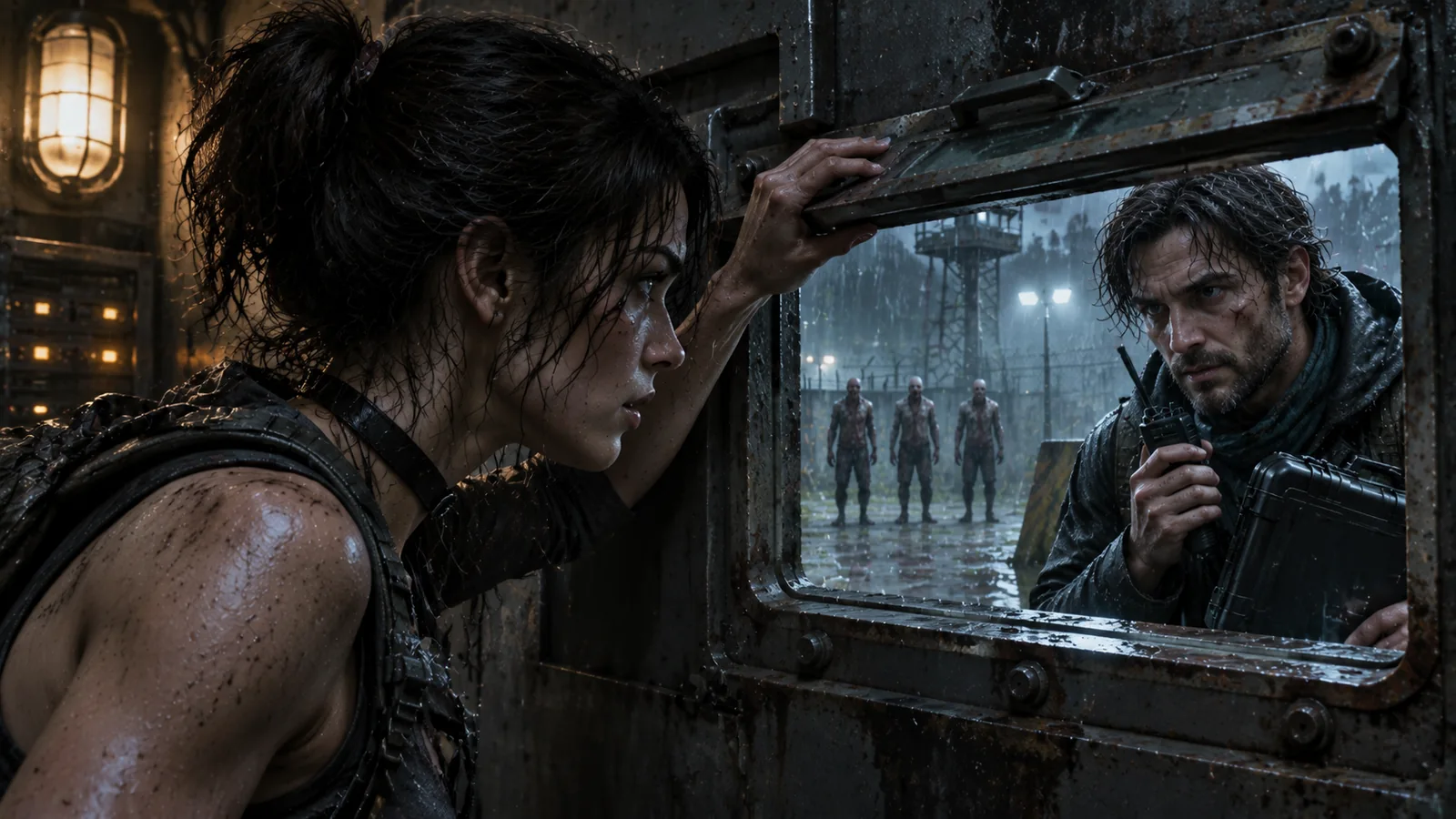
The three knocks came again.
They were not the frantic blows of someone trying to escape a burning building. They were measured, almost courteous, as if the person outside had arrived for dinner and was concerned that the soup might be getting cold.
Nobody moved toward the service entrance.
The woman stood beside the north stairwell cabinet, watching the old network node blink amber. Ilya had disconnected the diagnostic cable, but the tablet still displayed the last message. The words had not changed.
WE HAVE BEEN WAITING FOR YOU.
“Who is we?” Pavel asked over the radio.
No one answered him.
The woman looked toward the corridor. “Sera, status?”
“Inner doors secured. Staff room occupied. No movement inside the building except us.”
“And outside?”
A pause.
“The three at the fence are still there.”
“What about the service entrance?”
“Elias is standing in front of it. The knocks came from the other side of the door.”
The woman glanced at Ilya.
He shook his head. “That door opens onto the fenced yard. If someone is outside, the cameras should see them.”
“Do they?”
“Cameras are down.”
“Of course they are.”
The radio crackled. Sera's voice returned, quieter this time.
“There's something else. The three figures at the fence have changed position.”
“How?”
“They're facing the service entrance now.”
The woman felt the building contract around them. The generator hummed. Somewhere, a pump started and stopped. The old annex was full of small mechanical noises, each one suddenly capable of sounding like a warning.
“Keep everyone away from the windows,” she said. “Nobody opens the door until we know what's happening.”
A voice came through the service intercom.
“That's a little unfriendly.”
Elias.
The woman closed her eyes for half a second.
“Are you alone?” she asked.
“Currently, yes.”
“Who knocked?”
“I did.”
“You're outside.”
“I have excellent reach.”
Ilya gave her a look. She ignored him.
“Why did you knock?”
“Because the doorbell doesn't work.”
“Elias.”
“Because I wanted to see if the system would answer.”
“And?”
“It did.”
The woman looked at the tablet again. “What did it answer?”
“Not to me.”
The old node blinked once.
Then the corridor lights steadied.
The woman made her decision. “We're going to speak through the outer hatch. Nobody opens the main door. Ilya, isolate the service intercom from the building network. Sera, stay with me. Pavel, keep the others in the staff room.”
“I'm coming too,” Ilya said.
“You're needed here.”
“I'm the only one who understands the network.”
“Then understand it from here.”
He looked as if he wanted to argue, but the expression passed. He knew the difference between courage and usefulness, even if he disliked being reminded.
The service entrance had a small inspection hatch, normally used by security staff to verify deliveries. The woman opened the inner cover. Beyond it, the outer panel remained locked.
“Elias?”
“Still here.”
“Step back from the door.”
Footsteps retreated across wet concrete.
“Hands where I can see them.”
“I'm beginning to feel judged.”
“Good.”
She opened the inspection hatch.
Elias stood beneath the narrow canopy, rain dripping from his hair. His coat was soaked at the shoulders. The cut on his cheek had stopped bleeding, but the skin around it looked pale. He held a compact radio in one hand and a small black case in the other.
He looked past her, into the building.
“That's a very elaborate way to say hello.”
“Show me your neck.”
He raised an eyebrow.
“Your neck,” she repeated. “Then your hands.”
He turned his head. No visible wound. His hands were dirty, scraped at the knuckles, but there was no fresh blood.
“Happy?”
“No.”
“Good. I was worried you'd become sentimental.”
She looked at the black case. “What's that?”
“Something I would prefer not to leave outside.”
“Why?”
“Because the people who want it are not particularly patient.”
“Who are they?”
Elias looked toward the yard.
The nearest infected stood beyond the fence, its face turned toward the entrance. It had not moved closer, but its posture had changed. Its shoulders were drawn back, its head tilted slightly, as if it were waiting for a signal.
Elias's expression tightened.
“Those aren't the people I mean.”
“Then who?”
“The ones who built the network.”
The woman kept the hatch open. “You said the network was old.”
“It is.”
“You said it didn't exist.”
“I said we were told it didn't exist.”
“By whom?”
Elias gave a tired smile. “You're going to need a chair.”
“I have one.”
“Then we're making progress.”
She closed the hatch.
For a moment, she considered leaving him outside. It would be safer. It would also be a decision based on incomplete information, which was how most disasters began.
She opened the hatch again.
“Put the case on the floor. Step back. Then enter one person at a time.”
Elias did as instructed. Sera checked him again before allowing him through the inner door. He submitted to the inspection with exaggerated patience, turning his pockets inside out and lifting his sleeves.
“Do you always greet old friends like this?” he asked.
“Only the ones who disappear for two years and return during the apocalypse.”
“That's fair.”
Inside, he looked around the lobby. The old reception desk, the dead plant, the dim emergency lighting. His eyes settled on the server room door.
“You got it running.”
“Barely,” the woman said.
“Barely is more than I expected.”
He picked up his black case. The woman noticed that he held it close to his body, not like a laptop or a tool kit, but like something fragile.
“Staff room,” she said. “You can explain there.”
“I'd rather not.”
“Then you can explain in the corridor.”
Elias looked at Sera. “Is she always this welcoming?”
“Only when she's being polite,” Sera replied.
He laughed. It sounded rusty, as if he had not used it in several days.
They went to the former meeting room. Dr. Varga looked up as they entered. Pavel stood beside the kettle, holding a mug with both hands. Anton was asleep against his mother's shoulder, his toy dinosaur trapped between them.
Elias glanced at the boy.
“Children,” he said quietly. “That's unfortunate.”
The woman watched him. “You don't like children?”
“I like them very much. That's why I don't like bringing them into conversations about the end of the world.”
Dr. Varga moved a chair away from the table. “Sit down. You look as if you need medical attention.”
“I've had worse.”
“That's not a medical history.”
“It's a summary.”
The doctor pointed at the chair. Elias sat.
Sera remained standing. The woman placed the black case on the table but kept one hand on it.
“Start with the network,” she said.
Elias rubbed his palms together, warming them.
“Before the annex closed, we were building a distributed emergency architecture. Not a single server, not a central platform. A system that could keep operating if individual nodes disappeared. Local compute, radio links, storage mirrors, autonomous relays. It was supposed to connect hospitals, power stations, research centres, municipal services and independent communities.”
“Like a mesh network,” Ilya said from the doorway.
“More than that. A mesh network can move packets. This was designed to preserve services: identity, records, supply requests, resource accounting, emergency coordination. If the central internet failed, local regions could continue. If a region went dark, its last verified state could be carried by mobile nodes and synchronised later.”
The woman thought of the message on the archive terminal.
The network must survive the first night.
“Who funded it?” she asked.
“Several public agencies, two private foundations, and a group of infrastructure investors. The money came with different expectations. Some wanted disaster recovery. Some wanted secure logistics. Some wanted a way to keep their systems alive when governments couldn't.”
“And the biological research?”
“Separate programme. Different people. Different access controls.”
“Yet the Core accessed the archive.”
Elias looked at her.
“So you found that.”
“You knew?”
“I suspected.”
“Why?”
“Because the archive was never supposed to be visible to the Core.”
“Then how did it see it?”
“That's the question.”
The woman opened the black case.
Inside lay a small hardware module, no larger than a cigarette packet, with two sealed connectors and a narrow strip of status lights. It looked old-fashioned beside the laboratory's modern terminals. Its casing was scratched and one corner had been repaired with epoxy.
“What is it?” she asked.
“A seed node.”
“For the network?”
“For a copy of it. The original architecture was too large to carry. This holds the bootstrap keys, a minimal routing table, a set of trusted certificates and the first layer of the recovery protocol.”
“Why bring it here?”
“Because the annex is one of the few places that still has the original trust hardware.”
Ilya moved closer. “Can it connect to the local server?”
“Not until we check it.”
“Is it safe?”
Elias looked at him. “Define safe.”
“Not going to infect the network, steal credentials or open a door for something outside.”
“Then no. I can't promise that.”
Ilya stepped back.
Elias gave him a faint smile. “I appreciate the honesty. Most people ask me whether it has a warranty.”
The woman examined the module. Its connectors were protected by small metal caps. A printed label showed a serial number and a symbol she recognised from the old archive: three interlocking circles around a central point.
“Who else has one?”
“Somebody has the original master node. Somebody else has been copying pieces of the architecture. And somebody has been revoking certificates before their expiry dates.”
“Why?”
“Because the network is waking up, and whoever controls the trust layer can decide which nodes belong.”
“Which means they can lock everyone else out.”
“Or let them in.”
The room fell quiet.
Dr. Varga looked from one to the other. “I don't understand half of this, but I understand enough to know that you're discussing control over emergency services.”
“That's one way to put it,” Elias said.
“Then I have a practical question. Can this thing help us get medicine, food, fuel or a working ambulance?”
“Not by itself.”
“Can it tell us where there are survivors?”
“If there are surviving nodes with valid data.”
“Can it tell us where the infected are?”
“If someone has been reporting them.”
Dr. Varga leaned back. “Then it is a radio with an expensive identity problem.”
Elias considered that.
“That's an unfair description.”
“Is it inaccurate?”
“Not entirely.”
The woman almost smiled.
She looked at the module again. “Why did you say the old network woke up?”
“Because at 17:42, every dormant node in the western region received the same signed pulse.”
“From where?”
“Unknown.”
“Could it be a routine maintenance signal?”
“No.”
“How do you know?”
“Because the pulse carried a key that was destroyed six years ago.”
The woman looked at Ilya.
He was already checking the module's serial number against the archive index.
“That's impossible,” he said.
Elias nodded. “That's what I said.”
“Keys don't just come back.”
“Neither do dead people.”
The words landed too heavily. Elias seemed to regret them, but he did not take them back.
The woman pulled a chair closer.
“Tell us what happened six years ago.”
Elias opened the case's inner compartment and removed a folded sheet of paper. It was a printed network diagram, creased several times and marked in
pencil. The lines showed a central trust service connected to regional nodes, mobile relays and a series of isolated research systems.
One branch had been crossed out.
Another was circled.
At the bottom, someone had written:
DO NOT RECONSTRUCT THE ROOT.
“Six years ago,” Elias said, “we discovered that the recovery architecture had begun generating its own trust relationships. It was not supposed to. A node could request a certificate, but it could not create a new authority. The system began accepting signatures from sources that did not exist in the registry.”
“An intrusion?” Ilya asked.
“We thought so. We isolated the root service and destroyed the master key. The project was suspended. The official report blamed a configuration error.”
“Was it?”
Elias looked at the woman.
“No.”
“Then what was it?”
“I don't know.”
“You worked on the system.”
“I worked on the parts they let me see.”
“And the rest?”
“Was hidden behind a project called Continuity.”
The woman remembered the diagnostic at the main facility.
Temporal alignment: incomplete.
Reference sequence not found.
“Who ran Continuity?”
Elias hesitated.
“That's where it gets complicated.”
“Good. I was worried this might be simple.”
He looked at her for a moment, then gave a tired laugh.
“Still you.”
“Unfortunately.”
Elias unfolded the diagram further. A small box had been drawn beside the central trust service. It contained a single word.
CORE.
The woman felt the room shift around her.
“That's the same name as the biological system.”
“It's a common enough word,” Elias said. “But not in this architecture. We used a different name for the network's central coordinator.”
“What name?”
“Meridian.”
Ilya frowned. “Then why is CORE written here?”
“Because this is an early diagram. The label was changed later.”
“To what?”
Elias tapped the paper.
“Continuity Operations and Recovery Engine.”
No one spoke.
The woman looked at the old diagram, then at the hardware module on the table.
“Are you saying the biological Core and Meridian are connected?”
“I'm saying somebody built a bridge between two systems that were never supposed to know each other.”
“Why?”
“That's what I came to find out.”
The generator's vibration changed pitch. A relay clicked somewhere in the building.
The lights dimmed, then returned.
From the lobby came a short electronic chime.
Ilya stood. “That's the perimeter panel.”
Sera moved to the door. “Stay here.”
They followed her into the lobby. The perimeter monitor had come back online. Three camera feeds showed the fence from different angles. The infected were still there, but now there were five.
One stood beside the service gate.
Another had appeared near the solar canopy.
The last two were farther away, almost hidden by the trees.
All five faced the building.
A line of text appeared beneath the camera feeds.
PERIMETER ACCESS REQUESTED.
Sera stared at it.
“That's not a motion alert.”
The woman stepped closer.
“Who is requesting access?”
The panel displayed a certificate ID.
Ilya checked it against the local registry.
His face changed.
“It's signed by the annex.”
“Which device?”
“The service gate controller.”
“Is it online?”
“It shouldn't be. The gate controller is isolated.”
Elias came up behind them.
“Don't approve it.”
The woman looked at him. “Why?”
“Because the gate isn't asking to open.”
“What is it asking?”
Elias stared at the certificate.
“It's asking to recognise someone.”
The request timed out.
The monitor returned to its normal display.
Beyond the fence, the five infected remained motionless.
Then, one by one, they turned their heads toward the lobby window.
Not toward the lights.
Not toward the movement.
Toward the woman.
Her wrist display vibrated.
The screen showed no network connection, no sender and no time stamp.
Only a message:
THE FIRST DOOR IS OPEN.
She looked up.
At the far end of the lobby, the inner access door clicked.
It had unlocked itself.