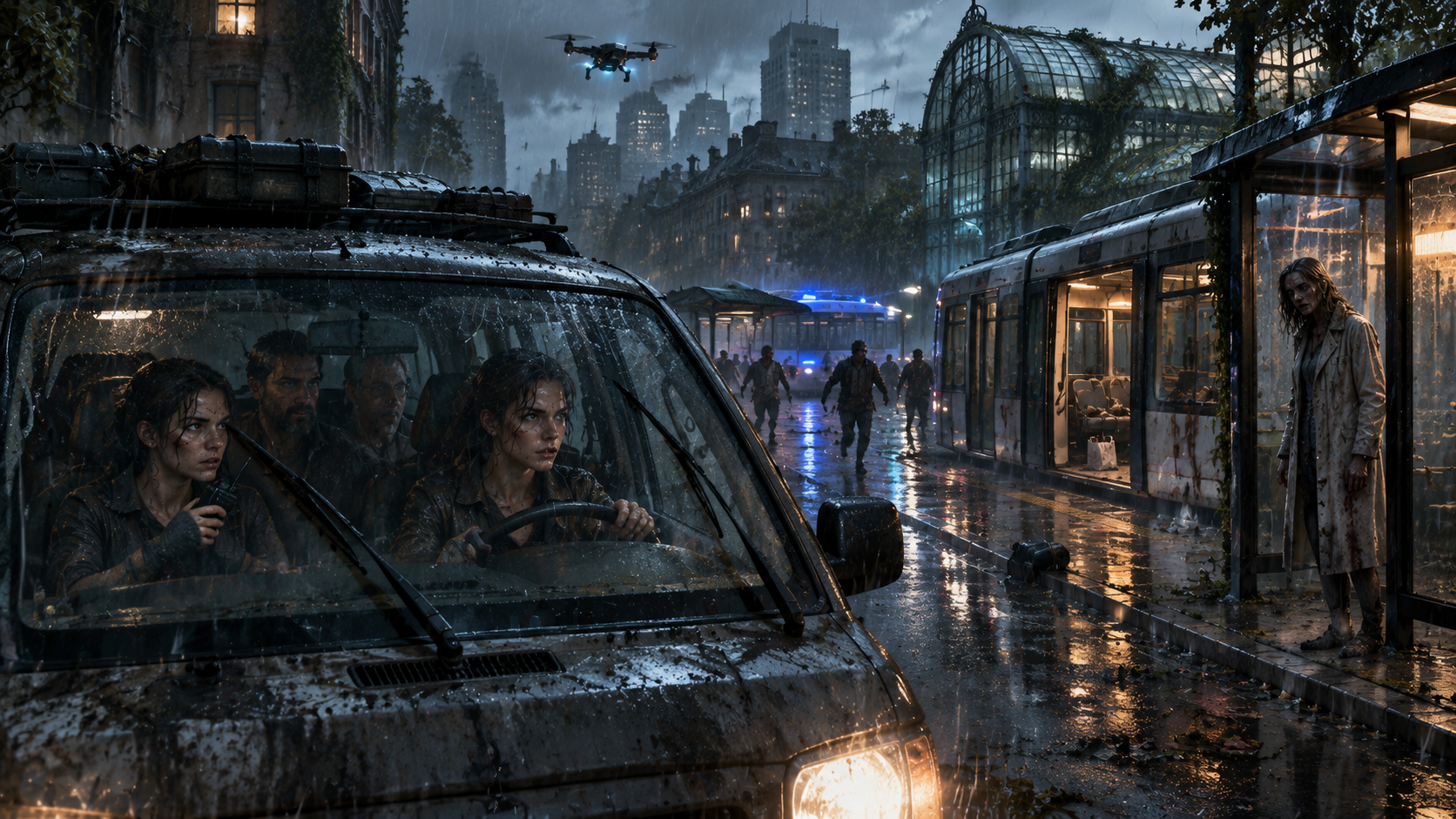
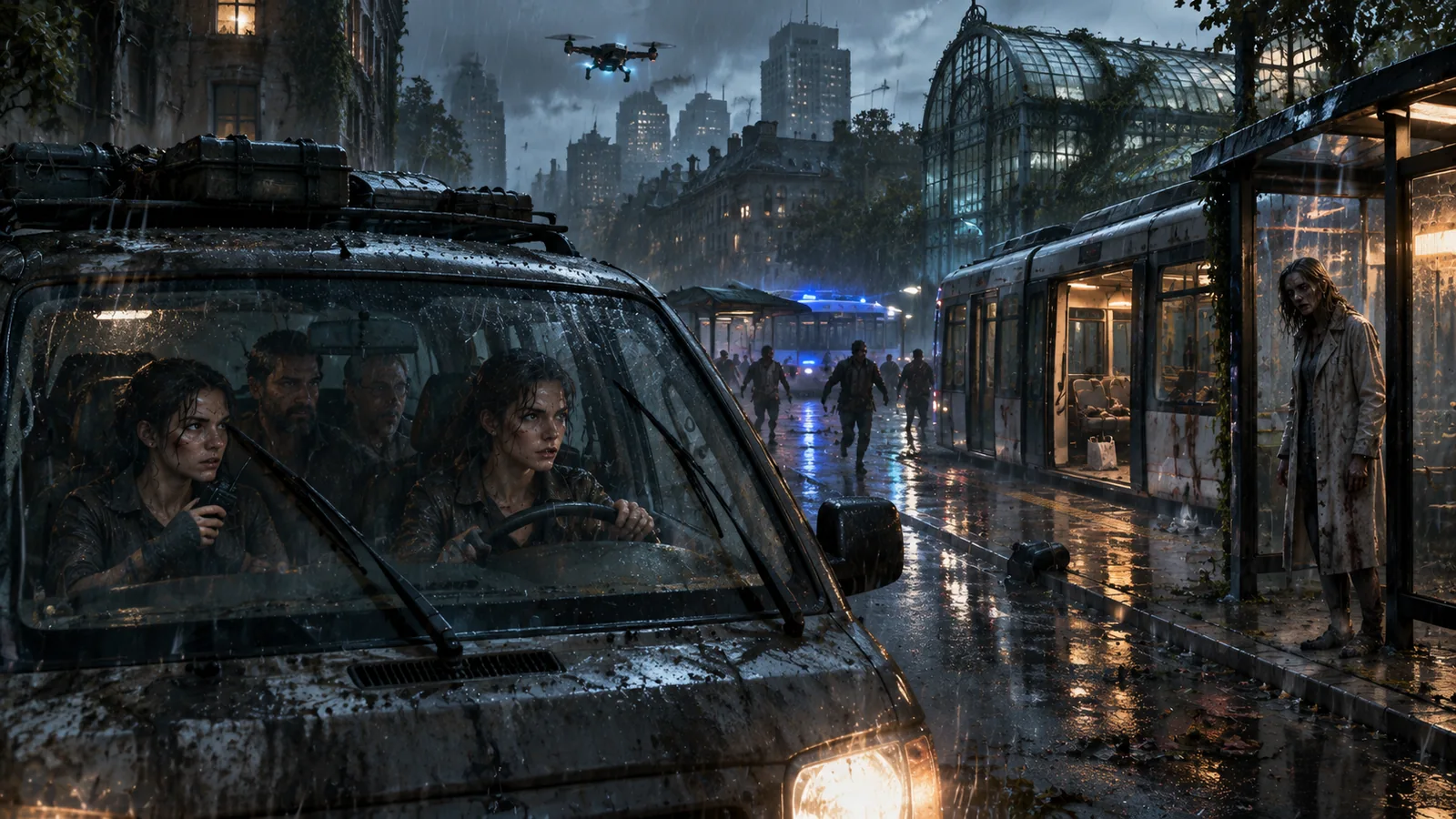
The city had always been loud, but until that evening she had never understood how much of its noise was made by things that expected tomorrow to arrive.
Engines complained at traffic lights. Elevators hummed behind walls. Delivery scooters buzzed between buses, and ventilation fans pushed the stale breath of a million rooms into the streets. Somewhere, a tram announced its next stop in a voice so calm that it could have been describing the weather on another planet. Even the rain had its own familiar music: tyres whispering through puddles, gutters overflowing, water ticking against metal awnings.
Now the noises were still there, but their purpose had changed.
A car alarm wailed into an empty intersection. A tram stood motionless with its doors open, its interior lights shining on abandoned shopping bags and a child's red mitten. A delivery drone drifted above the rooftops, circling the same patch of air because its route planner had lost the destination and could not imagine that the person waiting for the parcel might already be dead.
The van moved through the city like a guilty thought.
She kept it below the speed limit where the road was clear and slowed almost to walking pace where it wasn't. The windshield wipers dragged rain across the glass with a dry, uneven squeak. The left blade had been damaged at some point in the vehicle's life; every third pass left a narrow crescent of water directly in her line of sight.
A small defect. An ordinary inconvenience.
She found herself absurdly grateful for it. The world had not yet become entirely unfamiliar. Machines still had irritating little faults. The rain still found the one place the wipers could not reach.
Beside her, Sera held the radio close to her mouth and worked through the emergency frequencies. She had removed her outer jacket, revealing a dark shirt and a shoulder holster for the medical shears she used during training. Her hair, usually tied in a severe knot, had loosened around her face. In the dashboard light, the tired lines around her eyes made her look older than she had that morning.
“Any luck?” the woman asked.
“Depends what you call luck. I found a man reading the emergency evacuation instructions to a dog.”
“Was the dog listening?”
“More attentively than most of the people in charge.”
A faint burst of static swallowed the next transmission. Sera adjusted the dial.
In the back, Ilya had wedged the encrypted drive between two medical cases and was trying to connect his tablet to the van's local diagnostic port. The junior technician—whose name, she realised with a small shock, she had not used all afternoon—sat beside him, clutching a sealed bottle of water.
“His name is Pavel,” Ilya said, noticing her glance in the mirror.
“I know my own name,” Pavel muttered.
“Good. That saves us time.”
“You could try being useful.”
“I am being useful. I'm keeping morale alive.”
“Your morale is the only thing alive.”
“That's because it has excellent security.”
The exchange was so ordinary that for a moment she could almost believe they were driving home after a late shift. Then the van passed a bus shelter where a woman stood with her forehead pressed against the glass. She wore a pale coat, one hand lifted as if she were trying to stop a taxi. A dark stain spread across the front of it.
The woman turned her head as the van passed.
Her eyes followed the vehicle with a terrible, patient concentration.
Sera lowered the radio.
“Don't stop,” she said.
“I wasn't going to.”
“I know. I said it for the others.”
Pavel leaned forward, trying to see through the rear window. Ilya caught his shoulder and pulled him back.
“Don't make yourself interesting,” he said.
“What?”
“Nothing attracts trouble faster than looking like you have questions.”
The van turned west, away from the financial district and the river. The navigation screen showed a neat blue route that no longer existed in the real world. Three roads ahead were marked as open. One was blocked by a bus, another by a delivery truck that had mounted the central divider, and the third had become a corridor of people running in both directions.
She switched the navigation display to offline maps. The route line disappeared. In its place appeared the old street grid, pale and reassuringly inaccurate.
“We need to get to the ring road,” she said. “If we can reach the western service route, we can avoid the centre.”
“Assuming the ring road isn't a parking lot,” Ilya replied.
“Then we park somewhere else.”
“That's a very strong plan.”
“I've been practising.”
She took a narrower street lined with apartment blocks. Their windows reflected the grey evening in a thousand dark rectangles. On the ground floor of one building, a bakery's automatic door kept opening and closing. The sensor was reacting to something inside. Each time the doors parted, warm light spilled onto the wet pavement and revealed a trail of flour leading from the counter to the street.
A man in a white apron lay halfway through the doorway.
His legs were outside. His upper body had disappeared into the shop.
The door opened again, nudged his shoes, and closed.
Pavel turned away.
“Keep looking,” Sera told him, not unkindly. “You don't have to stare at everything. But don't pretend you didn't see it.”
The van passed without stopping.
At the next junction, a small electric car had been abandoned across the lane. Its hazard lights blinked steadily, as though the driver had stepped away to buy cigarettes. The battery indicator on its windscreen showed eleven percent. A charging cable trailed from the side, stretched tight to a public charging post.
The post's screen was still illuminated.
PAYMENT REQUIRED TO CONTINUE.
Someone had tried to charge the car during the collapse. Someone had expected the network to authorise the transaction, the power to remain available and the world to honour its little agreements.
She eased around it.
“That's going to be the new joke,” Ilya said from the back. “The end of civilisation, brought to you by a payment gateway.”
“Don't give the universe ideas,” Sera replied.
The first roadblock appeared near the old botanical gardens. A city bus had been turned sideways across the street. Two municipal vehicles stood behind it, their blue lights flashing without sirens. A dozen people crowded around the bus, shouting at a uniformed officer who was trying to keep them back.
The woman slowed.
“Don't,” Sera said.
“We need the road.”
“We need not to become part of that crowd.”
A figure climbed onto the bus roof. It was a young man, perhaps twenty, wearing a bright sports jacket. He waved both arms and shouted something she couldn't hear. The crowd surged toward him.
Then the people at the front began to fall.
Not all at once. One stumbled, another was pulled down, and a third vanished beneath a sudden tangle of bodies. The officer drew his sidearm. The weapon flashed once in the rain.
The crowd broke apart.
Some ran. Some stood frozen. The people on the ground did not stay there.
The woman reversed before the road became impassable. A horn blared behind them. She turned into a side lane, scraped the van's rear quarter against a parked car and kept going.
“Was that a warning shot?” Pavel asked.
“No,” Sera said.
He swallowed. “How do you know?”
“Because warning shots are supposed to warn someone.”
No one spoke after that.
They reached a small square where the old tram depot had been converted into a public transport hub. Its glass roof was cracked in several places. A row of charging lockers stood beside the ticket machines, most of them open. A municipal maintenance robot had stopped in the middle of the square, one arm extended toward a fallen traffic sign. Its wheels spun slowly, unable to climb over the metal.
The robot's speaker repeated, “Obstacle detected. Please clear the area.”
It said this to an empty square.
Then it said it again.
The woman felt a strange tenderness toward the machine. It had been built to help. It had a map, a purpose and a set of instructions. It was doing exactly what it had been designed to do, and none of those things were enough.
She drove around it.
A few blocks later, the radio crackled.
“—west district medical station—any vehicle with capacity—”
Sera leaned forward. “This is a medical transport team. Identify yourself.”
“Station Four. We have patients. We need evacuation.”
“Are you secure?”
A pause. A burst of breathing.
“Negative. We have barricaded the front entrance.”
“What's your location?”
The voice gave a street name and a building number.
The woman knew it. Station Four was a small urgent-care clinic near the old market, less than two kilometres away. It was not on their route.
“We're not going there,” Ilya said.
Nobody had asked him.
“We have medical supplies,” Sera replied.
“We have four people in a van and no idea what happens if we stop.”
“Those people are asking for help.”
“And we might become people asking for help.”
The woman kept her eyes on the road. “How many patients?”
Sera asked. The answer came back in fragments: six staff, eleven patients, two injured security guards, one ambulance unable to start. There were children in the waiting room.
Ilya exhaled sharply. “Of course there are.”
The woman glanced at the map. The clinic stood near a broad avenue that led to the western service road. If they could reach it, they might get medical information, a working radio and perhaps fuel. If they could not, they would lose time and risk the van.
She thought of the bakery door opening and closing over the dead man's shoes. She thought of the officer firing into the rain. She thought of the morning's training, of Sera saying that people repaired the robots and replaced the filters.
The world had not ended in a single instant. It was breaking into separate rooms, each with someone inside who still needed something.
“Take us there,” she said.
Ilya swore softly.
Sera did not thank her. That would have made the decision sound cleaner than it was.
The clinic occupied the ground floor of a converted office building. Its sign was still lit, though one letter had gone dark. The front windows were covered with temporary security shutters. A red emergency beacon flashed above the entrance, reflecting on the wet pavement.
A delivery van blocked the ambulance bay. Its rear doors were open, and boxes of medical gloves lay scattered across the road. The side of the vehicle was streaked with blood.
The woman stopped twenty metres from the entrance.
“Engine stays running,” she said. “Doors locked until we know who comes out.”
Sera took the radio. “Station Four, we're outside. How do we identify your people?”
“Two staff at the side entrance. Blue medical jackets. One has a bandage around his head.”
“Any security?”
“Not anymore.”
A side door opened. Two people emerged cautiously, both wearing blue jackets. One had a strip of gauze wrapped around his forehead. The other carried a fire extinguisher like a club.
Sera lowered her window only a few centimetres.
“Show your hands.”
The man with the bandage did. The second looked offended.
“Really?” he said. “We're the people asking for help.”
“Today that doesn't tell us much,” Sera replied.
He lowered the extinguisher.
The clinic staff approached. Their faces were exhausted, pale and streaked with sweat. The woman recognised the expression: the moment when adrenaline had begun to drain away, leaving the mind to count everything it had been too busy to fear.
The bandaged man introduced himself as Dr. Varga. He was a broad- shouldered man in his fifties with a silver beard and the calm, slightly irritated manner of someone who had spent decades telling people that their symptoms were not unique.
“Thank God,” he said. “We need transport for the children and the stable patients.”
“How many can walk?” Sera asked.
“Eight. Four need assistance. Three are injured. One is—”
A crash sounded from inside the clinic.
Dr. Varga turned.
The second staff member raised the extinguisher again. “They're in the treatment room.”
“Who?” the woman asked.
“Patients.”
“Are they conscious?”
“Some of them.”
The doctor rubbed his face. “We had a man come in with a fever and a deep bite wound. He became violent. We sedated him. Then another patient—”
A scream rose behind the side door.
It ended abruptly.
Sera was already moving. “Get the children out through the side entrance. No one goes back inside alone.”
The woman followed her to the doorway.
Inside, the clinic smelled of antiseptic, wet clothing and the metallic tang of blood. The waiting room chairs had been pushed against the walls. A television played a silent news broadcast showing aerial footage of a city intersection. The caption beneath it read PUBLIC ORDER INCIDENTS — AUTHORITIES URGE CALM.
A little boy sat beneath the reception desk, holding a toy dinosaur by its tail. He was wearing one yellow sock and one grey sock. His mother crouched beside him, trying to keep him quiet.
The woman knelt.
“Hello.”
The boy stared at her.
“Is that a dinosaur?”
He nodded.
“Good choice. They had a difficult time, too.”
His mother gave a short, broken laugh. It was the first human sound in the building that did not contain fear.
“What's his name?” the woman asked.
“Anton.”
“Anton, we're going to take a little trip. You can bring the dinosaur, but it has to stay quiet. Dinosaurs are very good at that.”
The boy pressed the toy against his chest.
Behind the reception area, something struck a door.
The sound was heavy and irregular.
Dr. Varga appeared with a medical bag. “We need to go. Now.”
They began moving the patients. Sera organised the walking wounded into pairs. Ilya carried the medical cases. Pavel helped an elderly woman down the short flight of steps to the entrance. The woman stayed near the rear, watching the treatment corridor.
A nurse came out carrying a portable oxygen cylinder.
“There's one more,” she said. “A girl in the observation room. She's conscious, but she can't walk.”
“Where is she?”
“End of the corridor.”
The woman looked at the door behind the reception desk. The impacts had stopped.
“Who is with her?”
“No one.”
“Then we go together.”
They moved down the corridor. The ceiling lights flickered, and the emergency strips cast long shadows beneath the doors. The nurse carried a small medical monitor. Its battery warning flashed amber.
The observation room was open.
A young woman lay on the bed, perhaps twenty, with an oxygen cannula beneath her nose. Her dark hair stuck to her damp forehead. She was conscious and watching the door.
“I'm Mara,” the nurse said. “We're getting you out.”
The patient tried to speak. Her throat was too dry.
The woman checked the monitor. Oxygen saturation was low but stable. The patient had a deep laceration on her thigh, not a bite wound. A pressure dressing had been applied correctly.
“Can you stand?” she asked.
Mara shook her head.
“Then we'll carry you.”
They lifted her onto a transfer sheet. The woman took the upper end, the nurse the lower. The patient weighed less than the medical bag.
As they turned into the corridor, a door at the far end opened.
A man stepped out wearing a hospital gown. His bare feet left wet prints on the floor. His head hung forward, and one arm was held against his chest as if it had been broken. He looked at them.
The nurse stopped breathing.
The man made a low, wet sound.
“Keep moving,” the woman said.
He took a step.
Then another.
The woman's attention narrowed. She saw the angle of his shoulders, the dragging foot, the way his head tilted toward the sound of the transfer sheet sliding over the floor. He was not looking at their faces. He was listening.
She lowered her voice.
“Don't run.”
The nurse's eyes filled with panic.
“Don't run,” the woman repeated. “He hears movement.”
The man accelerated.
The woman shoved the transfer sheet toward the nurse. “Take her.”
She stepped sideways, grabbed a stainless-steel instrument trolley and pushed it hard across the corridor. The wheels shrieked. The trolley struck the man's knees and toppled. He fell over it, hitting the floor with a crack that made the nurse flinch.
The woman did not wait to see whether he could rise.
She ran.
They reached the waiting room with the patient still on the sheet. Sera saw their faces and opened the side exit. Rain and cold air rushed in.
“Move!”
Outside, the van's rear doors stood open. Ilya and Pavel were loading the last of the supplies. The doctor was helping the children climb in. Sera guided the walking patients toward the vehicle.
Then the clinic alarm began to sound.
The side door behind them slammed open.
The man in the hospital gown stumbled into the rain. He had a metal instrument lodged in the fabric at his shoulder. He moved toward the nearest person.
The nearest person was Pavel.
Pavel froze.
The woman crossed the distance between them and struck the man with the edge of the van's open rear door. The impact knocked him sideways. Sera pulled Pavel away and shoved him into the vehicle.
“Inside!”
The man turned toward the sound.
His mouth opened. A dark string of saliva hung from his lower lip.
The woman slammed the door.
For a second she stood in the rain, one hand on the handle, listening to the body hit the metal from the other side.
Then she climbed into the driver's seat.
“Everyone accounted for?” she asked.
Sera counted heads. Dr. Varga answered for the clinic staff. The mother held Anton. Mara lay across the rear bench with an oxygen cylinder secured beside her. Ilya was bleeding from a shallow cut on his forearm, possibly picked up while loading supplies. Pavel looked as if he might vomit.
“Where did that come from?” Sera asked, pointing to Ilya's arm.
“Metal edge. I think.”
“Show me.”
He did.
Sera cleaned it and covered it. “We'll monitor it.”
“That's comforting.”
“It's meant to be accurate, not comforting.”
Dr. Varga leaned forward between the seats. “You have to understand. The first patients weren't like this. They had fever, confusion, agitation. Some had seizures. Then their vital signs collapsed, and after that—”
“After that they got up,” the woman said.
The doctor looked at her. “Yes.”
“Do you know what causes it?”
“No.”
“Is it contagious?”
“I don't know.”
“Through bites?”
“Possibly. Blood contact, saliva, respiratory exposure—we don't have enough data. We don't even know whether all the cases are the same.”
Sera's expression hardened. “Then we treat every exposure as dangerous.”
The woman started the van.
The clinic's sign flickered in the rear window. One letter went dark, then another. The building disappeared behind a curtain of rain.
For several minutes, the only sounds were the engine, the wipers and the breathing of people who had survived something they did not yet understand.
Then Anton lifted his toy dinosaur.
“Does it eat people?” he asked.
His mother closed her eyes.
The woman looked at him in the rear-view mirror. “Only rude people.”
“Like monsters?”
“Especially monsters.”
Anton considered this. “Then it can eat the bad ones.”
“That's the plan,” she said.
Ilya laughed once, unexpectedly. It was a small, cracked sound, but it loosened something in the van. Even Sera's mouth moved at the corner.
The western service road was less crowded. They passed warehouses, a closed shopping centre and a row of charging stations where electric vans stood in neat lines, connected to power that had already failed. Beyond them, the city thinned into low industrial buildings and rain-dark fields.
The woman took the old access road toward the research annex.
The facility had been closed after a funding dispute and a change in the ownership of its parent company. It was officially awaiting redevelopment. In practice, it had become a storage site for equipment nobody wanted to pay to move. The main building was small, the laboratories modest, and the power system independent enough to keep the freezers running for a limited period.
She had visited it twice during the previous year.
The first time, to inspect a set of archived instruments.
The second time, because the Core had requested a data comparison that the main facility could not perform.
She had never asked why the system needed that particular archive.
Now she wished she had.
The access road ended at a chain-link gate. Beyond it, the annex stood in a shallow hollow, surrounded by wet grass and a perimeter fence. The windows were dark. A weather station turned slowly on the roof. Beside the gate, a solar canopy covered four electric service carts. One had been left with its charging cable attached.
The woman stopped the van.
“Is this secure?” Dr. Varga asked.
“No.”
“Then why are we here?”
“Because I know the building. It has water storage, an independent generator and a radio mast. We can secure the perimeter and decide what to do next.”
“That's not the same as secure.”
“No,” she said. “It's the difference between a place we understand and a place we don't.”
Sera looked at the fence. “We'll need to clear the grounds.”
Ilya checked the battery status on the dashboard. “And the generator.”
Pavel stared at the dark windows. “What is this place?”
“An old laboratory.”
“Another one?”
“I'm beginning to suspect we should have chosen a different profession.”
The woman opened the gate with the manual key from her ring. The motor was dead, so she had to pull the gate along its track. Rust and grit made it resist. The sound carried across the empty grounds.
Nothing moved.
She drove through and parked close to the entrance.
The annex door accepted her badge on the third attempt. The lock clicked, then the door opened inward with a sigh of stale air.
Inside, the lobby was cold and smelled of dust, plastic and old paper. A reception desk stood beneath a wall display showing the facility's former logo. Someone had left a potted plant beside it. The leaves had turned brown, but a new green shoot had appeared near the base.
Ilya noticed it.
“Look at that. Something in this place is still trying.”
“Don't encourage it,” Sera said. “It'll ask for a salary.”
They secured the entrance, checked the side doors and moved through the building room by room. The first laboratory was empty except for dismantled
equipment and a row of steel benches. The second contained sealed storage cabinets. The third held a compact server rack with a local battery unit.
The battery display showed sixty-two percent.
“Not bad,” Ilya said. “If the cooling loop still works, we might have a few days.”
“Don't promise days until you've tested it,” the woman replied.
“I said might.”
“You also said the coffee machine would be easy to fix.”
“That machine was a criminal.”
Sera and Dr. Varga organised the patients in the former staff room. Mara was placed near the portable oxygen supply. Anton and his mother were given a small office with a door that could be locked from inside. Pavel helped carry water containers from the storage room.
The woman went to the server rack.
A terminal woke when she touched the keyboard.
The local system recognised her badge, then displayed a message she had never seen before.
WELCOME BACK.
She frowned.
The annex had been offline for months. Its user database should have been frozen at the date of closure.
A second line appeared.
ARCHIVE INDEX UPDATED: 17:42.
She checked the time.
It was 19:16.
The system claimed that the archive had been updated ninety-four minutes earlier.
She opened the index. Most of the files were routine: instrument logs, archived model versions, calibration records and experimental data. Near the bottom was a directory with no description.
`LAST_HUMAN_PROTOCOL`
Her mouth went dry.
The directory had not existed when she last visited.
She opened it.
There was one file.
`FIELD_COPY_01`
The file was encrypted. The local terminal offered a key request, but the request returned a warning.
KEY SOURCE: UNAVAILABLE.
She tried her own credentials. Rejected.
She tried the facility's archive certificate. Rejected.
Then the terminal displayed a line of text.
THE NETWORK MUST SURVIVE THE FIRST NIGHT.
She read it twice.
Behind her, the annex generator coughed, failed to start and tried again. The lights dimmed. Somewhere in the staff room, Anton began to cry.
She closed the file.
Outside, beyond the fence, a figure stood in the rain.
It was too far away to identify. It did not approach. It simply faced the building, motionless beneath the grey sky.
The woman watched it through the lobby glass.
A second figure emerged from the darkness near the gate.
Then a third.
They were not moving like the infected she had seen in the city. They were not stumbling or rushing. They stood at intervals along the fence, each facing the annex as if waiting for someone to open the door.
Her wrist display vibrated.
No network. No sender.
A new message appeared.
DO NOT LET THEM INSIDE.
She looked from the screen to the figures beyond the fence.
For the first time since the alarms began, she wondered whether the dead were the only things that had found their way out of the city.