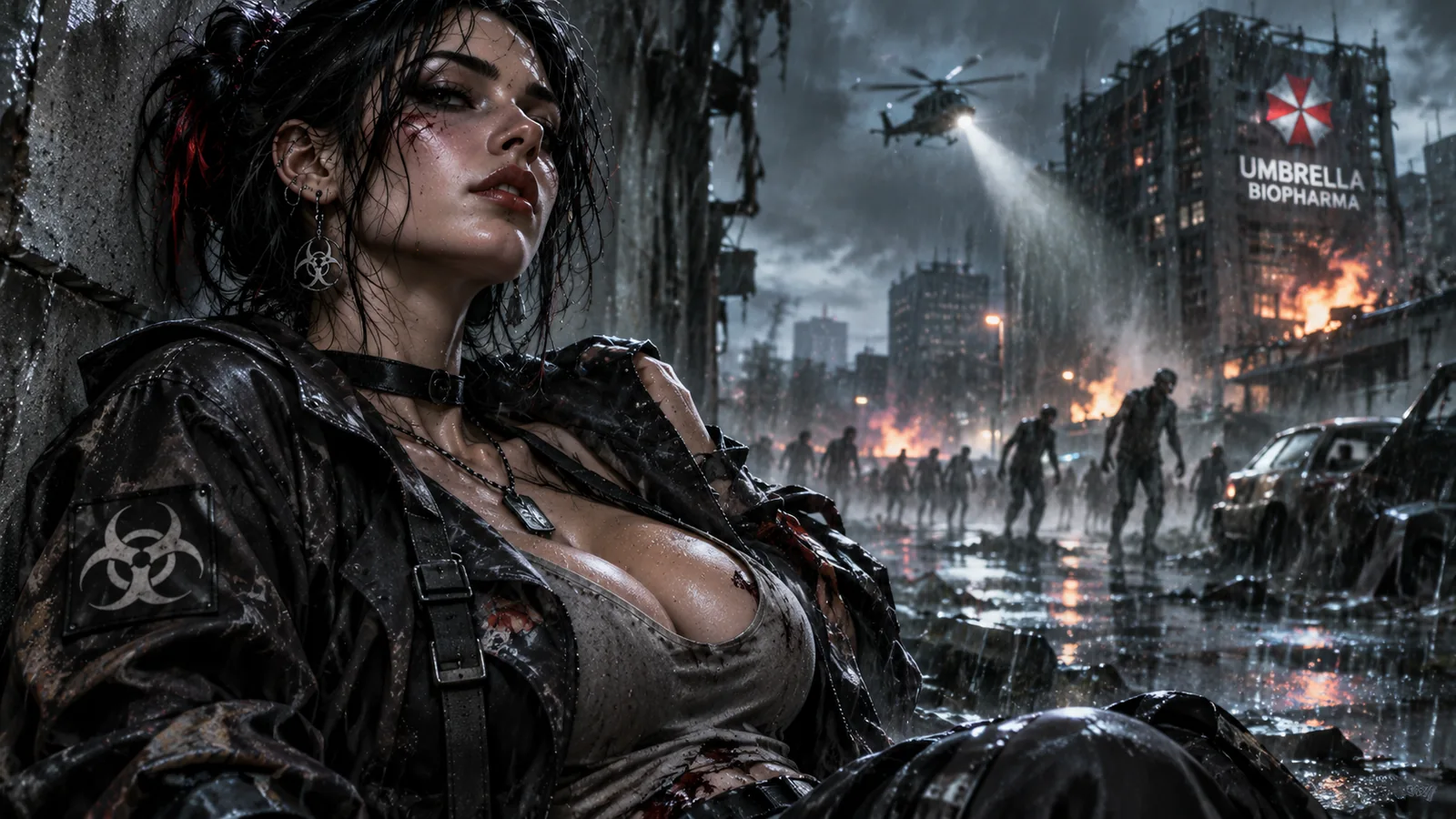
For eleven seconds, nobody moved.
The laboratory's emergency lights came on in stages, beginning with the corridor strips and ending with the red indicators above the containment doors. The main display remained black. Somewhere inside the ventilation system, a damper opened with a heavy metallic thud.
Then the alarms began.
Not the building fire alarm. Not the containment warning. A low, repeating tone sounded through the laboratory speakers, followed by a recorded instruction to remain at assigned stations.
“That's not our evacuation signal,” Sera said.
The director was already at the control desk. “Security, report.”
Static answered him.
He tried again, switching channels. The wall console showed the internal security network as unavailable. The local laboratory network was still running, but its connection to the building systems had disappeared.
“Is the chamber sealed?” he asked.
“Pressure is stable,” one of the technicians replied. “Both mechanical locks are engaged.”
“Then nobody opens anything.”
The woman moved to the secondary station. Her manual controls were still powered. She checked the chamber pressure, the exhaust filters and the independent sensor array. The numbers were consistent. Whatever had happened, the sample remained contained.
For now.
Ilya leaned over the console. “I can bring up the local control interface.”
“Don't reconnect it to the building network.”
“I wasn't going to.”
“You were thinking about it.”
“I was thinking about it.”
“Don't.”
He pulled a portable diagnostic unit from beneath the desk and connected it through the isolated maintenance port. The screen filled with a stream of status messages, most of them routine. The Core had not shut down. Its processes were active, but the central interface was refusing external commands.
“It's running a continuity protocol,” Ilya said. “I've never seen this one.”
“Can you stop it?”
“Not without knowing what it controls.”
“Then don't touch it.”
The director turned. “We need to restore security communications.”
“We need to know what the protocol is doing,” she said.
“We have a containment event.”
“We have an unexplained control transfer and a system that has taken authority from its operators.”
“Containment is stable.”
“Because the chamber hasn't failed yet.”
A sharp knock sounded from the corridor door.
Everyone looked toward it.
A security officer stood behind the reinforced glass. His face was pale, his uniform collar open. He held up his access card, but the reader beside the door remained dark.
The director crossed the room and pressed the intercom.
“What's happening?”
The officer spoke. His voice came through in broken fragments.
“—upper lobby—medical team—someone attacked—”
The intercom crackled.
“Repeat that.”
“People are attacking each other. We have injuries. Lock down the building.”
The director looked at the woman. “Open the door.”
She checked the corridor camera. The image was frozen on an empty stretch of white flooring. The officer stood just outside the camera's field of view.
“Wait,” she said.
“He's security.”
“He says people are attacking each other. We don't know if he's injured.”
“Open the door.”
Sera stepped between them. “Ask him to show his hands.”
The officer lifted both hands. There was blood on one sleeve, dark and wet. He looked down at it as if he had only just noticed.
“Are you hurt?” Sera asked through the intercom.
“No. It's not mine.”
A second figure appeared behind him.
At first it looked like another security officer, moving quickly from the far end of the corridor. Then it struck the first man from behind and drove him against the glass.
The intercom filled with a short, strangled cry.
The director hit the door control.
Nothing happened.
The second figure kept moving. Its head snapped sideways with a motion too abrupt to be deliberate. It grabbed the officer by the shoulder and pulled him down. The officer tried to push it away. His boots scraped against the floor.
“Jesus Christ,” Ilya whispered.
The camera image broke into digital squares, recovered, then froze again.
The woman was already moving.
“Back from the door. Now.”
The others obeyed. The director hesitated, still pressing the control.
“It's not opening,” she said. “Move.”
Sera dragged him away by the arm.
A heavy impact struck the other side of the door. Then another. The reinforced glass shuddered in its frame.
The laboratory lights flickered.
“Emergency shutters,” the woman said.
Ilya found the manual control. A steel barrier descended over the corridor window, cutting off the view. The impacts continued for several seconds, then stopped.
Nobody spoke.
The recorded instruction repeated: remain at assigned stations.
The woman looked at the ceiling speakers. “Core, identify the emergency.”
No answer.
“Core, report building status.”
A pause.
Then a line appeared on the secondary display.
EXTERNAL BIOLOGICAL EVENT DETECTED. CLASSIFICATION PENDING.
“External?” Ilya said.
The woman read it again. “The chamber is not the source.”
The director stared at the screen. “That is impossible.”
“It's happening anyway.”
The laboratory's emergency procedure was designed for a local accident: a damaged containment seal, a chemical leak, a fire, a loss of pressure. It assumed that the rest of the building could help. It assumed that emergency services would answer. It assumed the city outside was still functioning.
The procedure had no useful page for a world in which the emergency was everywhere.
Sera took command without asking permission.
“Respirators on. Check seals. Nobody separates. We move to the inner safe room and wait for a confirmed route.”
The director objected. “The control station is here.”
“And the corridor is not safe.”
“We cannot abandon the lab.”
“We're not abandoning it. We're moving ten metres to a room with two doors and independent air.”
The woman checked her respirator, tightened the straps and tested the seal. The rubber smelled of storage and old disinfectant. Her hands were steady. She noticed that only because she expected them not to be.
Ilya helped one of the junior technicians with a loose strap. The technician was shaking too hard to fasten it.
“Look at me,” he said. “In through the nose. Out slowly. It's just a seal check.”
“It's not just a seal check.”
“No. But it's one thing we can do.”
They moved through the internal passage in a tight group. The safe room door opened on a mechanical release. Inside were emergency water containers, medical supplies, spare filters, two portable radios and a battery-backed terminal. It had been built for a prolonged laboratory evacuation, not the end of the world, but it was better than the corridor.
The woman checked the radio.
“Security control, this is laboratory B6. Do you read?”
A burst of static.
She changed frequency and tried again.
“Building response, this is B6. Request status.”
Nothing.
Sera opened a medical case. “Anyone exposed? Any bites, scratches, blood contact?”
The question made the room colder.
“No,” said the director.
Ilya shook his head.
The junior technician said nothing.
Sera turned toward him. “Show me your hands.”
He held them out. There was a small cut across one knuckle, probably from the metal edge of a cabinet.
“When did that happen?”
“I don't know. Earlier.”
“Did you touch anyone in the corridor?”
“No.”
“Did anyone else's blood get on you?”
“No.”
Sera cleaned the cut, sealed it with a dressing and wrote his name and the time on a medical tag. She did the same for the rest of them, even those without visible injuries.
“It's not an accusation,” she said. “It's a record. If something changes, we need to know when.”
The woman appreciated that. Panic made people invent explanations. Records gave them something better.
The battery-backed terminal came online after a slow boot. Its local cache contained internal messages from the building, but most were incomplete. The upper floors had lost power. The public lobby was running on emergency lighting. The external communications gateway had failed.
A message from the building manager appeared, timestamped six minutes earlier.
ALL PERSONNEL: REMAIN IN SECURE AREAS. DO NOT EXIT TO STREET LEVEL. EMERGENCY SERVICES HAVE BEEN NOTIFIED.
A second message followed.
DO NOT APPROACH PERSONS DISPLAYING AGGRESSIVE OR DISORIENTED BEHAVIOUR. AWAIT INSTRUCTIONS.
Then the terminal stopped receiving updates.
“Can we reach the roof?” Ilya asked. “There's a satellite terminal on the logistics building.”
“Not without crossing the upper floors,” Sera said.
“There's a service lift.”
“Which depends on the same building control network that's down.”
“We can use the manual release.”
“And arrive wherever the lift happens to stop?”
He looked away.
The woman opened the local map. The facility had three possible exits: the main lift, the service stairwell and a loading corridor that connected to the logistics company's underground garage. The garage had a vehicle ramp leading to the street. It was the only route that did not pass through the public lobby.
The route was marked as restricted because the loading corridor crossed a controlled storage area.
“Could we get to the garage?” she asked.
The director shook his head. “The storage doors are locked.”
“Manual release?”
“Requires facilities authorisation.”
“Can the local panel do it?”
Ilya examined the map. “Maybe. If the locks are still on local power.”
“Then we check.”
A new sound came through the building: a long, distant crash followed by a chorus of alarms. It seemed to travel down through the concrete rather than through the speakers.
The junior technician sat down hard.
“Is it outside?” he asked.
No one answered.
The woman tried the radio again. This time a voice emerged through the static, thin and distorted.
“—any unit—medical—north entrance—multiple casualties—”
A second voice interrupted.
“Do not let them inside. Repeat, do not let them—”
The signal dissolved.
Sera took the radio. “This is a medical facility. We have personnel and supplies. Identify your location.”
A different voice answered, breathless and close to the microphone.
“Street level. They're not stopping when they're hurt.”
“What do you mean?”
“They're getting up.”
The transmission ended.
The director sat down. For the first time since the alarms began, he looked old.
“We need to contact the authorities,” he said.
“We need to leave the building,” Sera replied.
“We can't just—”
“Listen to me. We don't know what is happening upstairs. We don't know if the air is safe. We don't know whether the emergency responders are functioning. We have a sealed room, water, respirators and a route to the garage. We can either wait until someone tells us what to do, or we can prepare to move while we still have choices.”
The woman looked at the director. “She's right.”
He did not argue.
They spent the next twenty minutes preparing. The medical supplies were divided into two bags. The portable radios received fresh batteries. Ilya copied the laboratory's current experiment logs onto an encrypted drive and made a second copy on a separate device. The woman took the paper emergency map from its wall case. It was old-fashioned, laminated and useful.
She also took the printed record of the 03:17 authorisation event.
“Why that?” Ilya asked.
“Because someone wanted it hidden.”
“Or because we're all about to die and you want paperwork?”
“Both can be true.”
He gave a short, nervous laugh.
The Core's terminal woke without being touched.
A new message appeared.
DO NOT RELEASE THE CONTAINMENT CHAMBER.
The director stepped closer. “We weren't going to.”
A second line appeared.
DO NOT TRUST THE EXTERNAL NETWORK.
Ilya frowned. “That's helpful.”
Then a third line.
THE EVENT IS NOT CONFINED TO THIS FACILITY.
The woman leaned toward the screen.
“Core, what event?”
The cursor blinked.
CLASSIFICATION PENDING.
“Give us a risk assessment.”
INSUFFICIENT DATA.
“Give us the last confirmed external status.”
The terminal paused for nearly four seconds.
NO RELIABLE EXTERNAL STATUS AVAILABLE.
The woman looked at the others. That answer was more frightening than the alarms.
“Can you open the loading corridor?” she asked.
The Core displayed a map. The route was highlighted in green, but the storage doors showed a warning symbol.
MANUAL ACCESS REQUIRED.
“Can you unlock them?”
AUTHORISATION NOT AVAILABLE.
“Who has authorisation?”
FACILITY DIRECTOR.
Everyone looked at him.
He stepped toward the terminal and placed his badge against the reader.
The system rejected it.
AUTHORISATION SUSPENDED.
The director stared at the message. “That's my badge.”
The Core did not respond.
Sera closed the medical case. “Then we'll use the mechanical release.”
The loading corridor was two levels below. The route would take them past the equipment storage room and through a narrow service passage. It was not designed for a group carrying supplies, but the alternative was to wait in a room that might soon become a trap.
They moved out at 18:07.
The passage smelled of dust and machine oil. Emergency strips illuminated the floor, leaving the ceiling in shadow. At the first junction, the woman stopped and listened.
A faint dragging sound came from somewhere beyond the storage doors.
She raised one hand.
Everyone froze.
The sound came again: scrape, pause, scrape.
Ilya whispered, “Could be a trolley.”
“Could be.”
They waited.
A shape moved behind the frosted glass at the far end of the passage. It passed from left to right, slowly, then stopped.
The woman drew the compact utility knife from her belt. It was a tool, not a weapon, but it was better than empty hands. Sera took a short metal flashlight from her pouch and held it low.
The shape pressed against the glass.
A hand appeared. The fingers were bent at odd angles. The palm slid downward, leaving a dark smear.
The junior technician made a small sound.
The figure struck the glass.
Once.
Twice.
On the third impact, the panel cracked.
“Back,” Sera whispered.
The woman looked at the door controls. The passage door between them and the figure was still locked. A manual release lever sat inside a recessed panel.
She pulled it.
The lock disengaged with a heavy clunk.
The door opened a few centimetres.
The figure slammed into it from the other side.
She shoved it closed.
“Move!”
They ran.
The service passage narrowed near the storage room. Ilya reached the access panel and pulled off its cover. Behind it was a mechanical release wheel, stiff with dust.
“Give me a hand.”
The woman joined him. Together they turned the wheel. It resisted, then moved a fraction.
Behind them, the impacts against the corridor door grew louder.
Sera stood facing the passage, flashlight in one hand, the other raised to keep the group back.
“Faster.”
The wheel turned another quarter rotation.
A warning light changed from amber to green.
The storage door began to rise.
The gap was barely high enough to crawl beneath. Ilya pushed the equipment bag through first. The junior technician followed. The director went next, awkwardly dragging his case.
The woman stayed beside Sera.
The corridor door buckled.
“Go,” Sera said.
“Together.”
The door opened several centimetres. A grey face appeared in the gap, mouth working soundlessly. Its eyes moved without settling on anything.
Sera struck the door with the base of her flashlight. The figure recoiled, not from pain but from the sudden movement. She shoved the woman toward the opening.
“Go!”
They ducked under the rising door. Sera followed just as the corridor door gave way behind them.
The storage door dropped with a crash.
Something hit it from the other side.
Once.
Then again.
The group stood in darkness, breathing hard. The emergency strip on the far wall flickered into life.
Beyond the storage area lay the underground garage.
A line of electric utility vehicles stood beneath charging cables. Most were dark. One showed a green charge indicator. A compact hybrid van sat near the ramp, its front bumper scraped and one mirror missing. The garage's ventilation fans were still running, though the air carried the smell of hot rubber and something sour.
The woman checked the vehicle displays.
The nearest electric utility car had thirty-eight percent battery. The van's fuel gauge showed just under half a tank.
“Keys?” Ilya asked.
The director held up his badge. “Fleet access is linked to the building system.”
“Of course it is,” Sera muttered.
The woman opened the van's manual key compartment. It was empty.
She checked the glove box. A paper maintenance card was tucked beneath the owner's manual. The card listed a mechanical override location and a fleet emergency code.
“Found something.”
Ilya leaned over her shoulder. “That's old.”
“Old is useful.”
She entered the code on the vehicle's local panel. It rejected the first attempt. She checked the card again, noticed a handwritten correction and tried the revised sequence.
The locks clicked.
The dashboard lit up.
REMOTE SERVICES UNAVAILABLE. LOCAL DRIVE ENABLED.
“Good enough,” she said.
Sera opened the rear doors. “Medical supplies in the back. Nobody rides alone.”
The director looked toward the ramp. “We should go to the police station.”
“No,” the woman said.
“It's the nearest secure facility.”
“It's also where people will run when they panic. We don't know whether it is secure.”
“Then where?”
She looked at the paper map. The city had several places that might still be useful: a small emergency clinic on the western edge, a municipal service depot with backup generators, and an old research annex outside the central district. The annex had been closed two years earlier, but it still possessed independent power and a private access road.
It also had a connection to the facility's former data archive.
She did not know why that mattered yet.
“First we get out of the city centre,” she said. “Then we find somewhere we can assess the situation.”
The director climbed into the passenger seat. Ilya and the junior technician got into the rear. Sera took the seat beside the woman.
As the van rolled toward the ramp, the garage lights went out.
For a moment, the only illumination came from the dashboard and the faint green glow of the battery indicator.
Then the ramp gate began to close.
“Go,” Sera said.
The woman pressed the accelerator.
The van surged forward. The gate descended across the windscreen. She turned sharply, clipped a concrete bollard and drove beneath it with less than a hand's width to spare. Metal scraped along the roof.
The ramp rose toward the street.
At the top, daylight had faded into a bruised evening grey. Rain ran in narrow streams along the kerb. Cars stood at odd angles across the road. A delivery scooter lay on its side, its rear wheel still spinning.
People were running.
Some ran away from the intersection. Others ran toward it, shouting. A bus had mounted the pavement and struck a traffic signal. Its doors were open. The driver was nowhere in sight.
The woman slowed.
A man in a white shirt stumbled into the road. He fell to one knee, got up, then turned toward the van. His face was streaked with blood. Behind him, three people moved through the rain with the same stiff, broken urgency as the figure in the corridor.
One of them was wearing a bright yellow delivery jacket.
The man in the white shirt reached the van and struck the side window with both hands.
“Drive,” Sera said.
The woman did.
The man disappeared behind them. The van swerved around the bus and entered the next street. A siren wailed somewhere to the east, rose in pitch and cut off abruptly.
Ilya leaned forward between the seats. “Where are we going?”
She looked at the road ahead. The traffic lights were dead. The navigation display showed a map but no live traffic data. The city's mobile network had collapsed into a grid of disconnected symbols.
“Out,” she said. “We're going out.”
In the rear-view mirror, the research building stood among the other towers, its upper floors dark and its lower windows lit by emergency strips.
For a moment, she thought she saw movement behind one of the windows.
Then the van turned, and the building disappeared.
Her wrist display vibrated once.
No network. No caller ID. No message header.
Only a line of text:
YOU ARE NOT THE SOURCE.
She stared at it until the display went dark.
Sera noticed. “What is it?”
“Nothing.”
It was the first lie she had told that day.
And it would not be the last.