OUTBREAK TRANSMISSION · MARKET MECHANICS 004
Liquidity Is Not Market Cap
A token can display a huge valuation and still have a very narrow exit. Learn what market cap, FDV and pool liquidity actually measure before trusting a headline number.
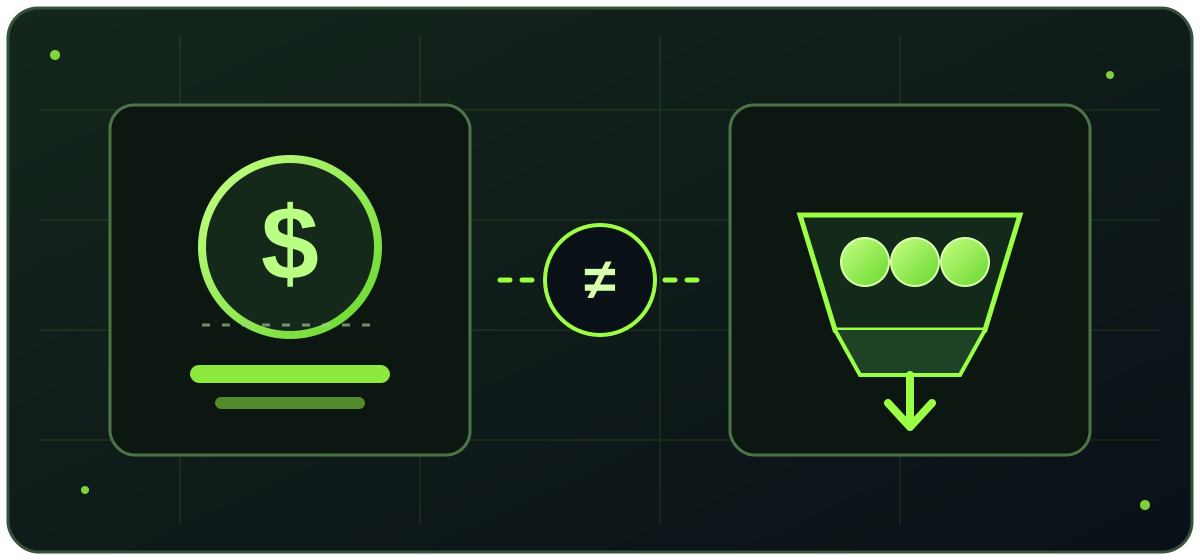
1. Three numbers, three different questions
Market cap estimates the value of a token supply at a quoted price. FDV applies a price to a broader supply figure, often the total supply after the source’s burn adjustment. Liquidity describes the assets available in a particular trading pool or route.
They are related, but they are not interchangeable. A market-cap figure is not cash sitting in a project treasury. A liquidity figure is not a promise that every holder can sell at the displayed price.
2. Market cap and FDV depend on supply assumptions
A common simplified market-cap calculation is token price multiplied by circulating supply. Fully diluted valuation (FDV) generally applies the price to total supply, subject to the data provider’s methodology. DEX Screener documents FDV as (total supply minus burned supply) multiplied by price; its market-cap figure may use circulating-supply information from a project or third-party source.
Always ask which supply number the screen uses, when it was updated, and whether the circulating supply is independently verified. A familiar ticker or a large valuation does not answer those questions.
3. Liquidity belongs to a pool and a route
On an automated market maker (AMM), liquidity comes from token reserves deposited with a paired asset. Solana’s terminology describes liquidity as the depth of orders or pooled reserves available to trade near the current price. Deeper liquidity generally reduces the price movement caused by a trade.
A token may have several pools on different DEXs, with different quote assets, reserve balances and prices. A screener may show a combined or selected liquidity figure. Do not assume every dollar shown is available in the exact pool or route your swap will use.
4. Why the displayed value is not your exit price
A market cap is a valuation calculation, not a buyout fund. Even a pool’s displayed dollar liquidity is not an amount that can all be withdrawn by sellers at the current price. A swap changes the pool balance and moves along its pricing curve; a larger order can receive a progressively worse average price.
Price impact is the effect your own trade has on the pool price. Slippage is the difference between the quote you expected and the execution you actually receive, which can change while the transaction is pending. Raydium’s documentation treats these as distinct concepts.
5. A practical check before you trade
First verify the full mint address and the Solana network. Then identify the exact DEX, pair address and quote asset. Compare the pool’s reserves and recent activity, and check whether liquidity is concentrated in one venue or spread across several independent pools.
Request a quote for the size you actually intend to trade. Compare it with a much smaller quote, read the estimated price impact and minimum received, and check fees and route details. A small test swap does not prove that a much larger exit will work at the same price.
6. The survivor’s rule
Treat market cap as a valuation estimate, liquidity as pool-specific trading depth, and volume as activity over a stated time window. None of them proves that a token is legitimate, that demand is organic, or that you can exit without loss.
If the source of supply data is unclear, the pool is thin, the route is unfamiliar, or the quote changes sharply with order size, pause. Never raise slippage tolerance simply to force a trade through, and never risk money you cannot afford to lose.
Before any swap
- Confirm the full mint address and network.
- Identify the exact pool, DEX, pair address and quote asset.
- Check reserves and liquidity in the route you will actually use.
- Compare a small quote with the intended order size.
- Read price impact, slippage, fees and minimum received before signing.
Survivor questions
Does a $10 million market cap mean $10 million is in the pool?
No. Market cap is price multiplied by a supply figure. It is not a cash balance or a redemption guarantee.
Can total liquidity be used as the amount I can sell?
No. The displayed value may include both pool assets and may aggregate markets. Your executable output depends on the exact pool, route, order size and current reserves.
Are price impact and slippage the same?
No. Price impact comes from your trade against pool liquidity. Slippage is the difference between the expected quote and the eventual execution price.
Primary references and tools
Check definitions against the primary documentation. Interface labels and data coverage can change; always verify the exact pool and timestamp.
Continue your research
Solana Memecoin Safety Checklist · Rug Pull Warning Signs · Wallet Security