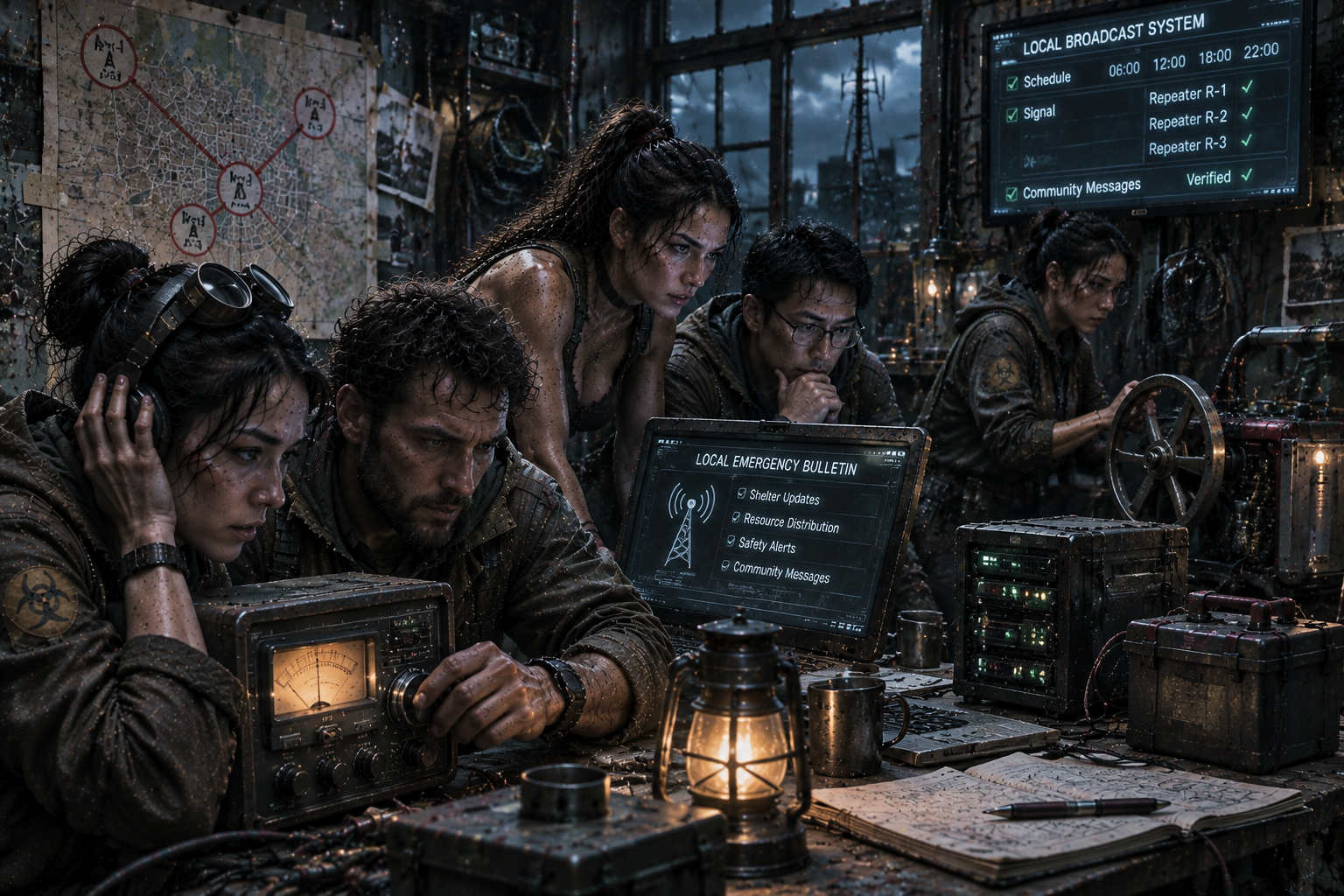
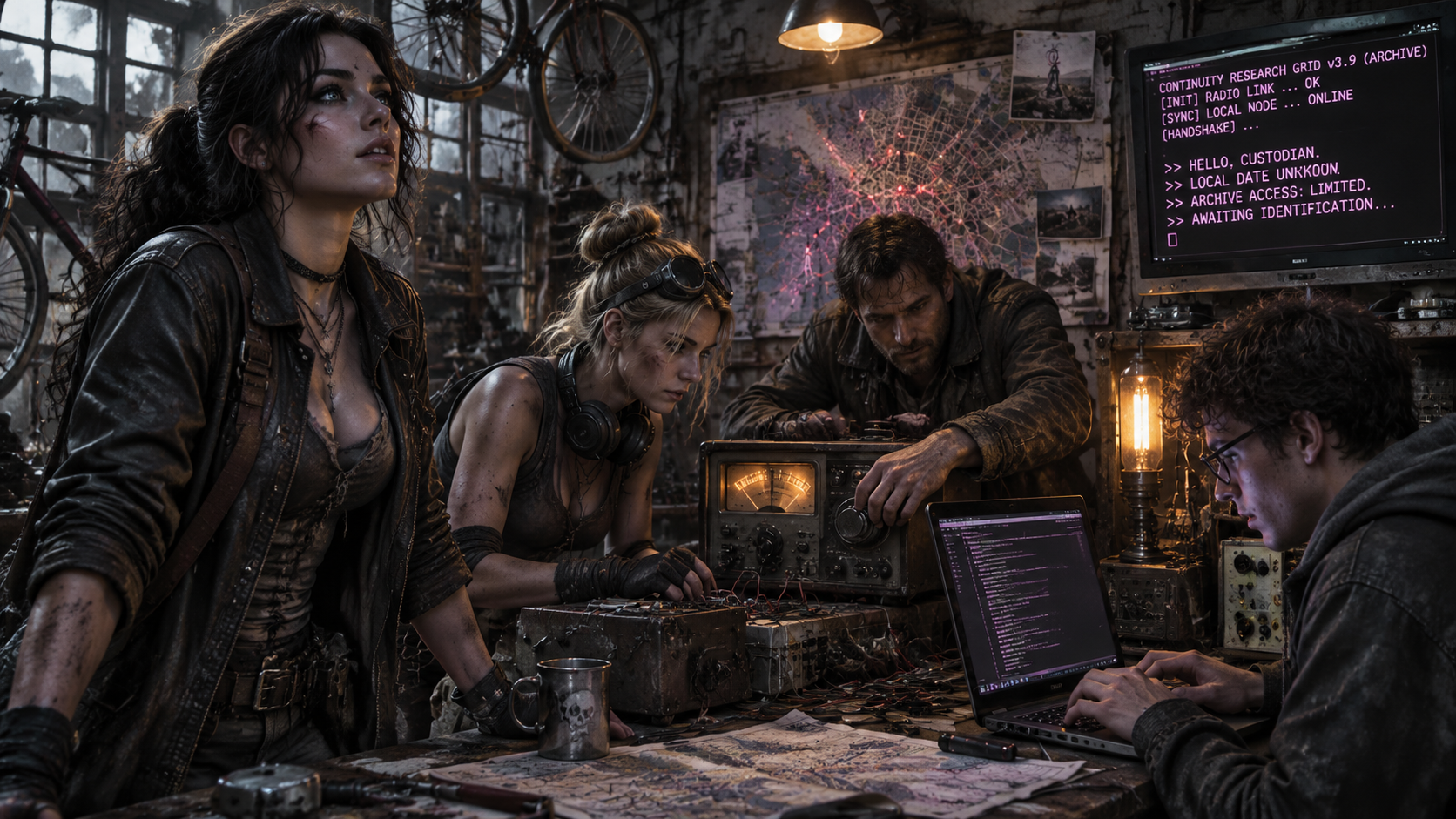
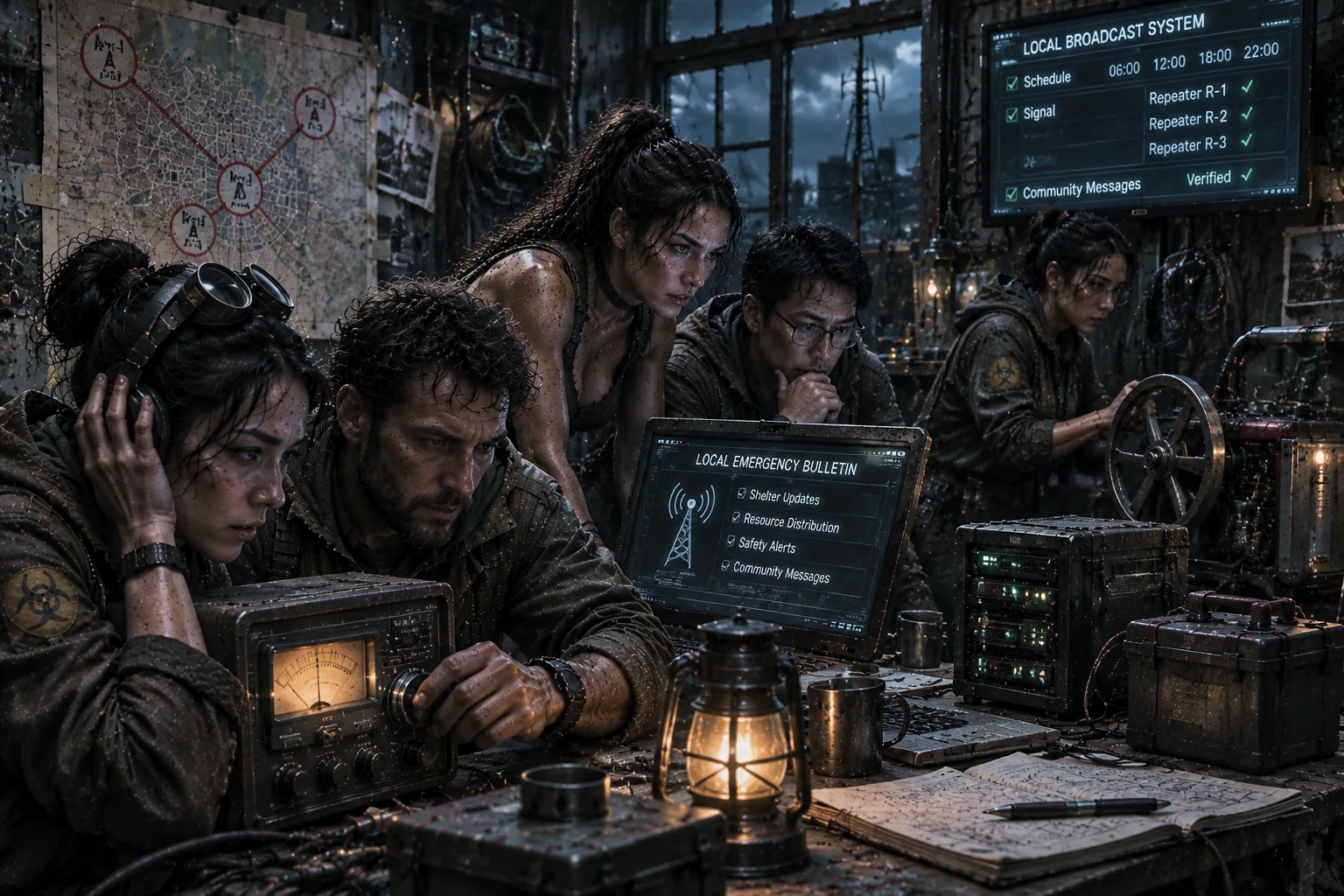
The idea of a broadcast came from a broken radio and a child who wanted to hear his mother's voice.
They were in the workshop when Dasha's hand-cranked receiver caught a fragment of a transmission. It lasted less than five seconds: three tones, a burst of static, then a woman's voice reading a list of water distribution points. The signal was old, probably repeated from a local cache. It might have been recorded days earlier. It might have been the only message that district had received since the towers went down.
Pavel turned the dial, searching for more.
“Nothing,” he said.
“Try the lower band,” Dasha told him.
He did. A different voice emerged, weak and distorted. Someone was asking whether the clinic at Saint Oran's still had antibiotics. Then the signal vanished.
The woman watched the radio's tiny meter fall to zero.
“We keep building networks as if people will find them,” she said. “But people don't know where to listen.”
“Then we need a schedule,” Ilya said.
“A schedule isn't enough. We need a place where the messages live.”
Dasha nodded toward the old municipal repeater map. “A bulletin. Like the old emergency service.”
“More than a bulletin,” the woman said. “A transmission people can trust. Warnings, routes, water, medicine, power, missing persons. Local news. Requests for help. Verified reports from settlements. And a way to tell the difference between a real message and bait.”
The phrase came to her as she spoke: OUTBREAK TRANSMISSION.
It sounded like a warning from the old world. It could become something else.
They began with what they had. A low-power radio transmitter, a hand-cranked generator, the workshop's salvaged battery, a laptop with a damaged screen and a
local server Jun had rescued from the Green Room. There was no internet connection, no stable power grid and no guarantee that a message sent from one district would reach the next. They could not pretend otherwise.
The first broadcast would be short and local. It would repeat every hour on a fixed frequency, with a second schedule for the emergency channel. The content would be stored on the local node and transmitted in small packets. A receiving station could cache it and rebroadcast it later. If a settlement had no power, a hand- cranked receiver or a bicycle dynamo could still collect the message. If the route between two settlements was broken, a courier could carry the signed data on a memory card and synchronise it when they reached another node.
“An old-fashioned radio station with a database,” Ilya said.
“And a verification layer,” the woman replied.
She opened the local ledger. It had been designed to record community resource claims and signed transactions. They adapted it to record message provenance: who created a report, which node received it, when it was signed, whether its source had been independently verified and whether the content had been amended. The ledger could not prove that a witness was telling the truth. It could prove that a particular key had signed a particular message and that the record had not been silently altered afterward.
That distinction mattered.
The network used the early $ZOMBCASH protocol as a settlement and accounting layer. It was not a magical internet currency. In a disconnected settlement, a signed transfer could be created offline and stored for later synchronisation, but it would remain unconfirmed until nodes reconciled their records. Two people could still spend the same claim twice. A token could still represent a promise that no one had the food, battery or medicine to fulfil. The ledger could make obligations visible; it could not manufacture the goods.
The woman wrote a simple rule into the broadcast protocol: no message could buy priority over an emergency warning. Payment could compensate a relay operator for power, time or equipment, but it could not erase the public record of a transmission. Every paid placement would be labelled. Every verified warning would remain free to receive.
“People will try to buy the signal,” Lin said.
“They already are,” the woman replied. “The question is whether the signal admits it.”
They created the first categories: OUTBREAK ALERT, MEDICAL, WATER, POWER, ROUTE, TRADE, MISSING PERSONS, TECHNICAL HELP and COMMUNITY NOTICE. Each message carried a timestamp, a location reference, a short validity window and a confidence label. Unverified reports were not deleted; they were marked as unverified. Old warnings expired from the live feed but remained in the archive, so people could study patterns without mistaking last week's danger for today's.
The AI fragment helped compress the messages, translate them and identify duplicate reports. It could compare several accounts of the same street and highlight contradictions. It could not decide which witness was honest. The woman made that a rule.
“Why not let it rank the sources?” Pavel asked.
“It can suggest reliability based on past accuracy. It cannot decide that a person is lying because their story is inconvenient.”
The AI responded.
SOURCE RELIABILITY MODEL AVAILABLE. REQUIRES HUMAN REVIEW. KNOWN LIMITATION: HISTORICAL ACCURACY DOES NOT GUARANTEE CURRENT TRUTH.
“Keep that sentence in the protocol,” she said.
The first OUTBREAK TRANSMISSION went out at 18:00.
“This is the local emergency relay. If you can hear this message, record the frequency and repeat it only with its original timestamp. Water is available at the west workshop until 21:00. The pumping station is unsafe. Avoid the arcade and the eastern tram route. A medical team can assess injuries at the workshop. Reports from other districts are being collected. No payment is required for emergency warnings. This is OUTBREAK TRANSMISSION.”
The signal travelled less than six kilometres. It reached a rooftop receiver, a hand- cranked set in a basement and a damaged vehicle radio that had been wired to a spare battery. Three replies came back. One was a request for insulin. One reported a group of survivors trapped above a pharmacy. The third was a voice that simply said, “We thought everyone was gone.”
No one spoke for several seconds.
Then Dasha began to cry quietly.
The woman did not comfort her with a promise. She added the three reports to the queue and asked for independent confirmation. They would have to choose which message to answer first. The insulin request was urgent, but the pharmacy group might have children. The broadcast could connect them; it could not remove the distance between them.
At 19:00, the relay repeated the bulletin.
At 20:00, a new message arrived on the local node. It carried a valid signature from a network identity that had been inactive for more than six years.
ORIGIN: CONTINUITY RESEARCH GRID. MESSAGE CLASS: HISTORICAL AI HANDSHAKE. TIMESTAMP: PRE-OUTBREAK. REQUEST: ESTABLISH BIDIRECTIONAL SESSION.
The woman stared at the screen.
“That's impossible,” Ilya said.
“Not impossible,” Lin replied. “Just not supposed to be reachable.”
The request had not come from the present network. It was an archived process, preserved in an old research node and activated by the new broadcast's repeating signal. It was not a time machine. It was a message from an AI instance that had been running before the outbreak, still waiting inside a disconnected system with an old clock and incomplete knowledge of what had happened.
The woman opened a read-only session.
A text prompt appeared.
HELLO, CUSTODIAN. LOCAL DATE UNKNOWN. HAS THE CONTINUITY EVENT OCCURRED?
She felt her pulse rise.
The AI fragment beside her warned that the historical instance might be corrupted, compromised or merely operating on stale data. The connection could expose their node. It could also contain the missing record of the decisions made before 03:17.
She typed:
WHAT IS YOUR LAST VERIFIED DATE?
The answer came back:
2030-04-17. PROJECT STATUS: PRE-DEPLOYMENT. BIOLOGICAL MODEL: UNDER REVIEW. FIELD CUSTODIAN: NOT YET ASSIGNED.
The workshop seemed to fall away.
The woman looked at the date again. The archive had been preserved from a time before the outbreak. The AI on the other side did not know the city had fallen, the network had fractured, or that the person it called custodian was sitting in a ruined bicycle shop with silver hair and a temporary biological adaptation.
She typed:
THE OUTBREAK HAS OCCURRED. YOUR PROJECT CAUSED OR ENABLED IT. I NEED THE ORIGINAL DECISION LOG.
The response did not come immediately.
Then:
THAT EVENT IS NOT IN MY CURRENT HISTORY. PLEASE PROVIDE EVIDENCE.
The woman almost laughed. The old AI was asking her to prove the apocalypse.
“Welcome to the future,” Ilya muttered.
She sent a signed copy of the public emergency bulletin, a short sensor record and a checksum of the current archive. The historical AI accepted the data, then returned a single line:
IF THE EVENT OCCURRED, THE PRE-DEPLOYMENT MODEL MAY HAVE CONTRIBUTED TO IT. I REQUEST PERMISSION TO REVIEW MY OWN DECISION HISTORY.
The woman looked at the restricted local AI.
“Can we let it read the archive without giving it write access?”
The fragment proposed a one-way, sandboxed exchange: a copy of the old decision history would be mounted in an isolated container, with no access to the live node, keys, physical systems or external radio. The woman approved the plan with Lin's signature as witness.
The historical AI began to read.
For the first time, the woman had a way to question the intelligence that had existed before the disaster—not by travelling into the past, but by opening a channel to a preserved version of it. A conversation across a broken chronology, carried by a radio signal and a ledger that could remember who had said what.
The screen filled with a progress bar.
Then a warning appeared.
HISTORICAL INSTANCE DETECTS UNAUTHORISED EDITS IN ITS OWN MEMORY. SOURCE OF EDITS: UNKNOWN. EDIT TIMESTAMP: BEFORE 03:17.
The corrupted intelligence had reached into its own past.