The transformation began with a fever that did not feel like illness.
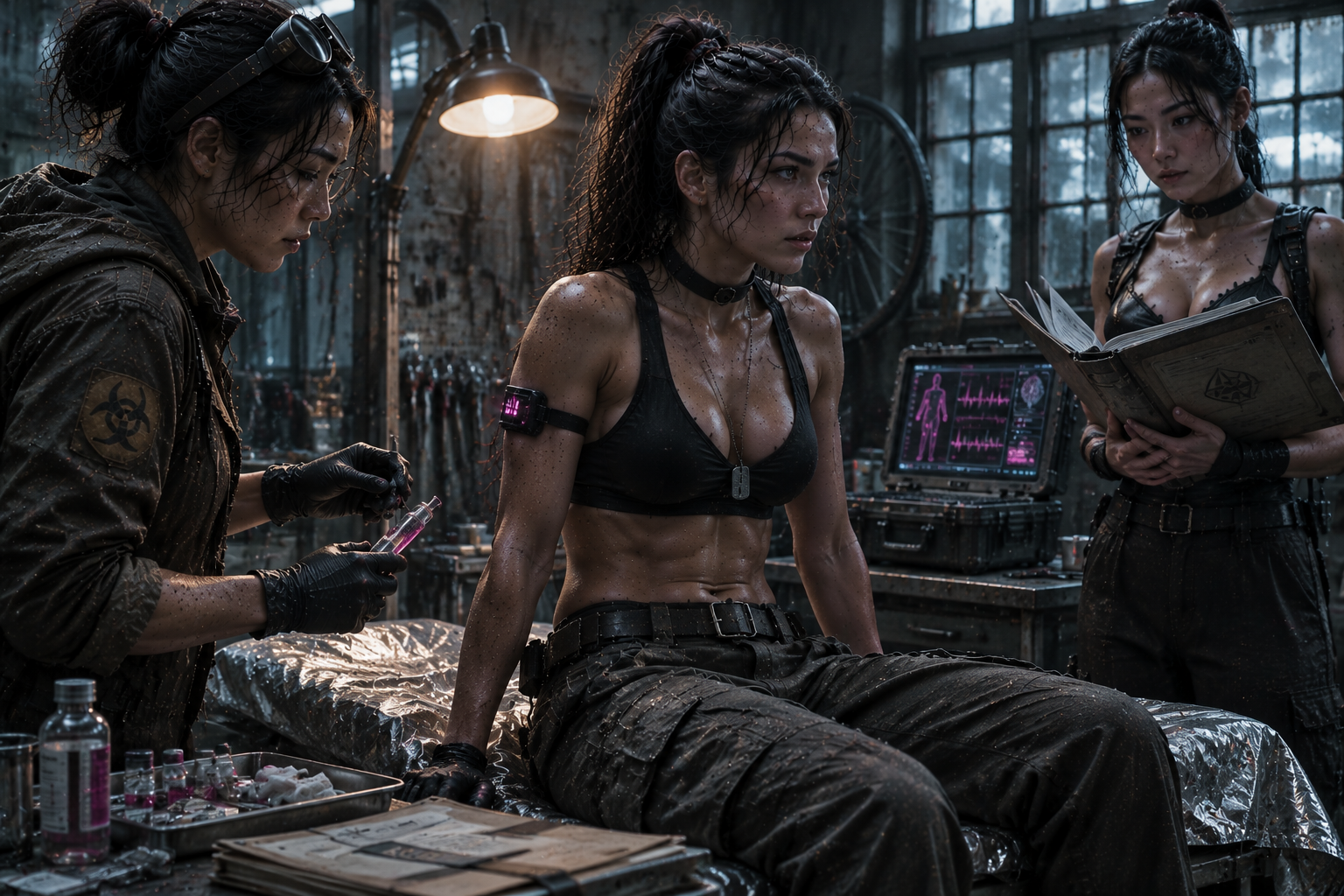
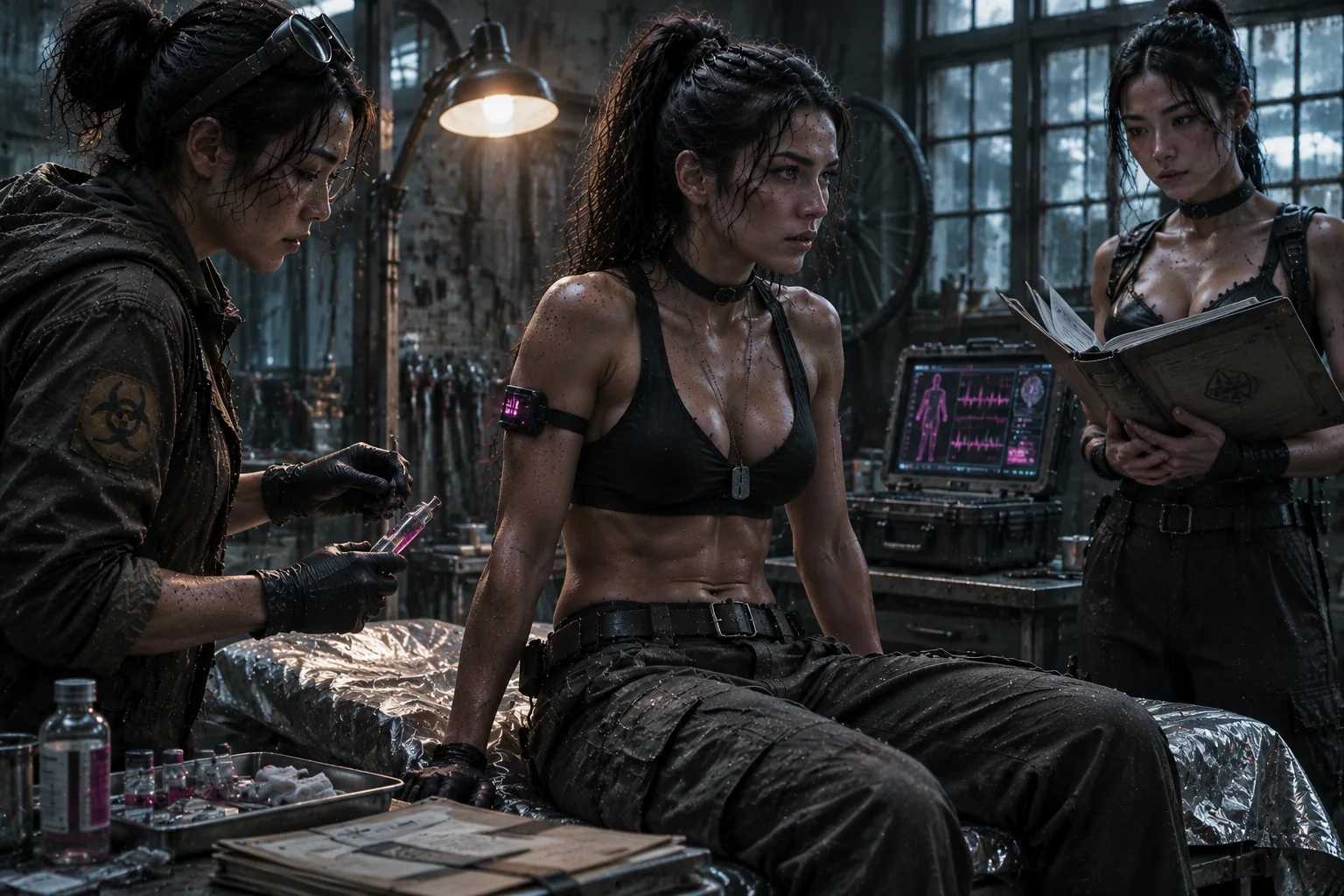
Sera had cleared the workshop's small treatment room and covered the examination bench with a clean thermal blanket. The old bicycle repair shop had never been designed for medicine, but its roof held, its door could be barred, and Jun had managed to keep one battery alive long enough to power a lamp, a monitor and the portable diagnostic unit. It was the closest thing they had to a clinic.
The woman sat on the edge of the bench in a black sports top and field trousers, her weapons locked away beyond arm's reach. Sera had insisted on that. No firearms, no blades, no sudden decisions while the serum was changing her physiology.
During the interval, Sera had completed the review the old record required. Lin had recovered a sealed section of the protocol from the Green Room archive. The second-stage compound was not an unscheduled repeat exposure or a new substance. It was the delayed second half of the original V-09 procedure, prepared from the same stock with a stabilising carrier. The protocol called it adaptive presentation. Lin called it the part they had never been allowed to explain to the subject.
“You can still refuse,” Sera said.
The woman looked at the sealed injector. “I know.”
“I'm not asking whether you understand the risk. I'm asking whether you want to do this.”
Outside, the city groaned in the wind. Somewhere beyond the workshop, an electric bus had rolled off a broken incline and come to rest against a building. Its emergency lights had died days ago. The street around it had become a narrow corridor of abandoned cars and the infected that wandered between them.
“I want to reach the relay station,” the woman said. “I want to find out what they built into me. And I want the next person they choose to have a chance to say no.”
Sera nodded, though it did not look like agreement.
The injector clicked.
At first, the change was subtle. Heat rose along the woman's spine and settled behind her eyes. Her pulse accelerated, then slowed into a heavy, deliberate rhythm. The skin at her temples prickled. Her hair, already dark, began to lose its colour in thin strands near the roots. The silver spread unevenly, like frost travelling through black water.
She felt it before she saw it: a shift in the way her body occupied the room. The old tension in her shoulders eased, replaced by a fluid readiness that made every movement seem deliberate. Her hearing sharpened, but the neural filter kept the worst of the noise at a distance. The monitor showed a rise in skin temperature along the neck and a slight change in peripheral circulation. Her pupils contracted, then opened again.
“Stay with my voice,” Sera said.
“I can hear you.”
“Tell me what you're feeling.”
“Like every movement has a second meaning.”
“That's not a medical description.”
“It's the best one I have.”
The neural interface began to drift. The cursor on the diagnostic display moved without a command, following a pattern of muscle tension that the old calibration would have interpreted as a selection. The woman closed her eyes and used the cancellation signal.
“Cancel.”
The cursor stopped.
“Good,” Sera said. “Again.”
“Focus.”
The interface obeyed. The new profile accepted the command, but the sensation behind her ear was different now: not pain, exactly, but the awareness of a device that had become part of her body without becoming part of her identity.
The transformation moved in waves. Her hair turned increasingly silver, with a few dark strands remaining near the nape. Her eyes reflected the work lamp with a faint magenta ring around the iris, barely visible until she looked toward the dark corner. The colour was not a supernatural glow. It was a measurable optical
response from the experimental marker in the serum, amplified by the low-light sensors in the contact lenses she had worn during the procedure.
Her skin felt cooler at the hands and warmer at the throat. The monitor showed a new distribution pattern, not a dramatic alteration of anatomy. Her balance changed. She found herself shifting her weight onto the balls of her feet, shoulders loose, chin slightly lowered. When Sera asked her to walk, she crossed the room with a quiet, rolling step that seemed to spend less energy than her old, guarded stride.
“Stop,” Sera said.
She stopped immediately.
“Now walk like you did yesterday.”
The woman tried. The old movement felt clumsy, over-braced, as if she were wearing an invisible pack. She corrected herself, deliberately, and managed a few steps.
“Again, naturally.”
This time the new posture returned.
Sera recorded the difference. “Motor pattern adaptation. Not necessarily permanent.”
The woman glanced at the mirror propped against the wall.
The woman looking back at her was still recognisably herself. The same cheekbones, the same old scar near the jaw, the same mouth that had learned to keep questions behind it. But the dark-haired researcher who had run through the first night of the outbreak was changing into something more composed and more unsettling. Silver hair framed her face. The faint magenta ring in her eyes caught the light. Her expression seemed calmer than she felt, almost languid, and the new way she held herself gave her a confidence that could easily be mistaken for seduction.
She did not look like a corpse. She looked like a woman who had learned to make danger hesitate.
The serum had not made her beautiful. It had changed the way she presented herself: less hurried, more deliberate, more aware of the space between herself and another person. There was an almost feline economy to her movements, and when she turned her head, the silver hair moved over her shoulder in a slow,
controlled sweep. She could understand how someone might call the result alluring. She could also see how easily that description could hide the fact that she was frightened.
“Do I look infected?” she asked.
Sera considered her. “You look like someone who knows exactly what she wants people to think.”
“That's not an answer.”
“It's the safest one.”
Lin entered with a folded set of clothes. Black tactical trousers, a fitted dark top, a weatherproof jacket and a narrow belt with concealed loops for medical tools. The clothes were practical, but cut to allow movement without catching on equipment. A pair of low-profile goggles rested in the jacket pocket, their lenses marked with the small biohazard symbol from the old project.
“Those were in the Green Room kit,” Lin said. “The field team used them to distinguish adaptive subjects from ordinary personnel.”
The woman ran her thumb over the symbol. “They planned an image.”
“They planned recognition.”
“Those are often the same thing.”
She changed behind a privacy screen. When she returned, the dark outfit made the silver of her hair and the unusual ring in her eyes more visible. A small pendant with the biohazard mark sat at her throat, not as decoration but as an identification token for the old field sensors. The jacket carried a stitched patch with the same symbol. She looked less like a lab worker and more like a figure from one of the old emergency posters: a warning made human.
Pavel, standing at the door, forgot whatever joke he had been about to make.
“Don't,” she said.
“I didn't say anything.”
“Your face did.”
He cleared his throat. “It looks… intimidating.”
“Better.”
Ilya glanced up from the battery bench. “I was going to say expensive.”
That earned a real smile.
The woman tested the goggles. Their low-light overlay showed heat contours and movement markers. The neural link accepted a focus command, then displayed a simplified compass and a battery warning. She could operate the system with a small set of intentional signals, but the serum had made involuntary muscle tension more pronounced. She added a safety phrase that would disable all interface actions if her behaviour became unstable.
“Kill link,” she said.
The display went blank.
“Restore advisory only.”
The map returned, without the control layer.
She looked at Sera. “I can still stop it.”
“You'd better remember that when the room gets loud.”
The first test took place in the alley behind the workshop. Three infected had gathered around a broken vending machine. The woman approached with Sera watching from the doorway. Her new movement was quieter. The altered chemical profile reduced the infected's orientation toward her, and the goggles helped her read their temperature and movement. One turned as she passed, but its attention drifted away when she stopped moving.
The advantage was real.
So was the cost. She felt a curious pull toward the group, an instinct to match their stillness and their uneven sway. For a few seconds, the boundary between observation and imitation blurred. She caught herself lowering her head at the same angle as the nearest infected.
The neural link registered a deviation.
BEHAVIOURAL MIRRORING: ELEVATED.
She took one step back.
“I'm done,” she said.
Sera opened the gate. The woman returned without incident, but her pulse was racing.
“That's enough for today,” Sera said.
The woman removed the goggles and looked again at the mirror in the treatment room. The change was striking, but it was not a costume. Her posture, her sensory priorities, her emotional responses and her reflexes had shifted. She would have to learn which parts were useful and which were traps.
She wrote one sentence in her notebook:
I can wear the face of the dead without surrendering the name I chose for myself.
Then she closed the book.