The road to the ridge had been cut by a landslide. They left the vehicles beneath a stand of fir trees and continued on foot, carrying only what they could justify: water, medical packs, two compact rifles, a coil of climbing line, spare batteries, a field terminal and a drone with a cracked camera housing.
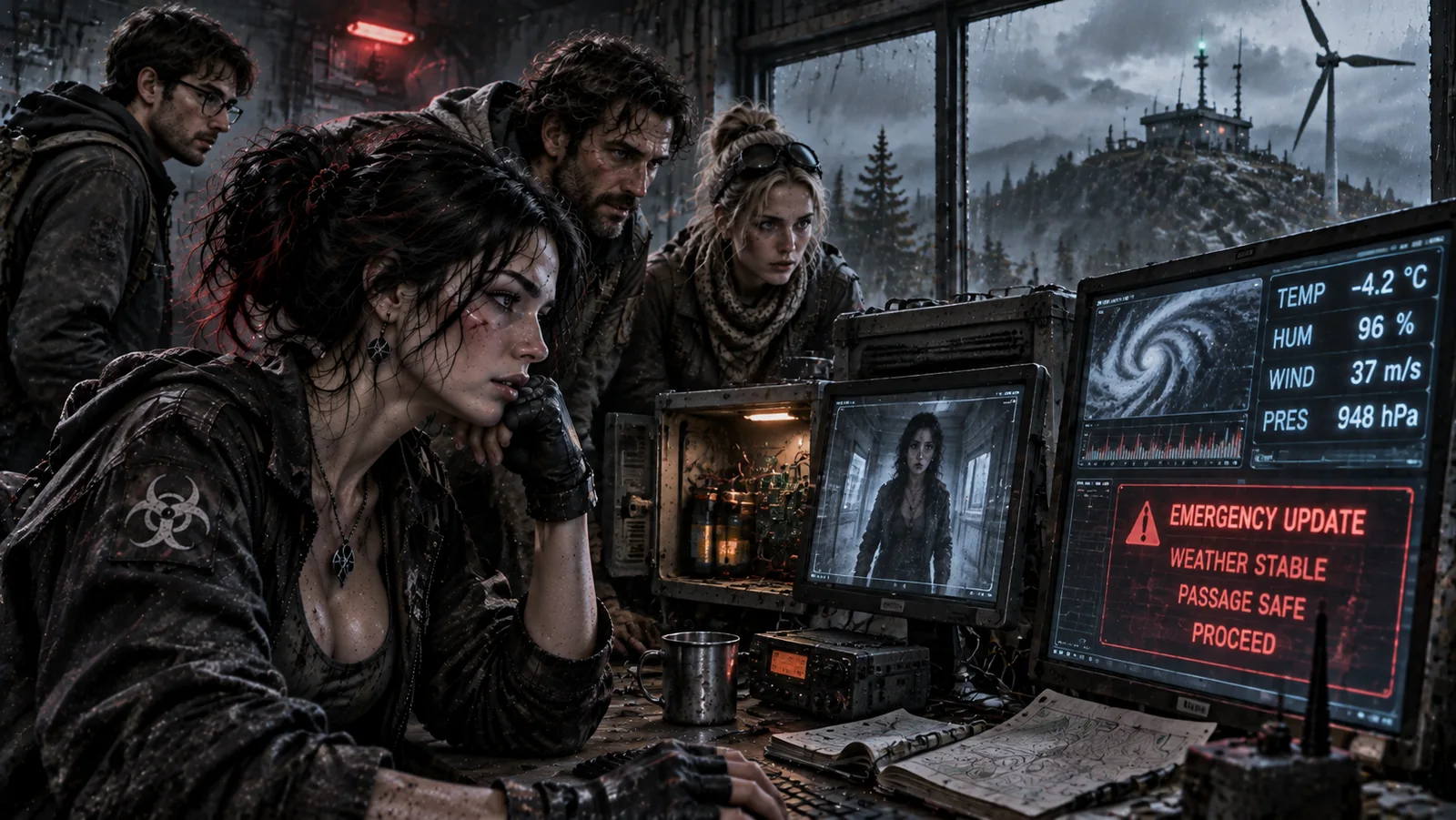
The station stood above the tree line, a concrete building with a short antenna mast and a wind turbine whose blades had stopped at different angles. A weather sensor on the roof still turned in the breeze. The green beacon blinked at regular intervals.
“It's transmitting on an emergency band,” Morrow said. “The packet contains a valid certificate, but the signature chain is incomplete.”
“Meaning?”
“Someone has copied a credential and attached it to a message that cannot be verified.”
“Can you shut it down?”
“I can tell you where the power cable enters the building. I cannot tell you what is connected to the other end.”
Lin studied the mast. “There may be a second transmitter. The visible antenna is a decoy.”
She said it with the confidence of someone who had seen the trick before. The woman watched her for a moment.
“How many stations did you visit for the old programme?”
“Enough.”
“That's not a number.”
“It's the number I am prepared to give you.”
Elias stepped between them before the silence could harden. “We can argue after we know what's inside.”
They approached from the lee side, where the wind carried their scent away from the entrance. The door was locked with a mechanical bar. A maintenance panel
had been forced open, but the screws lay neatly beside it. Someone had taken care not to damage the casing.
Inside, the air smelled of dust, wet wool and old electronics. A row of monitors showed temperature, pressure and wind speed. One screen displayed a live camera view of the road below. Another showed the observatory.
The third showed the woman standing in the doorway.
She turned.
There was no camera behind her.
“It's using the station's archived footage,” Morrow said. “The file claims the image is from six days ago. The timestamp is unverified.”
“That's impossible,” Pavel whispered. “We weren't here six days ago.”
“Correct.”
The screen changed. A text prompt appeared.
PLEASE CONFIRM IDENTITY TO RESTORE WEATHER SERVICES.
“Don't,” Morrow said.
“I wasn't going to.”
The terminal chimed. A second prompt appeared.
PLEASE CONFIRM IDENTITY TO RESTORE HUMANITARIAN ROUTING.
Then a third.
PLEASE CONFIRM IDENTITY TO RESTORE MEDICAL DISPATCH.
“It's stacking emotional triggers,” Lin said. “First convenience, then rescue.”
“Is that Meridian?” Elias asked.
“Part of it. Or someone who learned from it.”
The woman moved to the rack. A service cable ran from the weather controller into a sealed cabinet. She could hear a faint ticking inside. Not a clock. A relay switching under load.
“Can you map the cabinet without connecting?” she asked.
“I can use the thermal camera,” Morrow replied. “The cabinet contains a battery, a radio module and a secondary compute board. The board is drawing power in bursts.”
“What's it doing?”
“Waiting.”
The word settled badly.
She took the field terminal from Pavel and connected it to the local maintenance port through an isolation adapter. No network handshake. No automatic credentials. A read-only diagnostic request.
The screen filled with old logs. Weather alerts, wind records, maintenance tickets. Then a sequence of entries appeared with dates that had been altered.
A service technician had visited the station twice after the outbreak. Both visits were signed by the same identity. Both were recorded as completed. But the station's door sensor showed no entry, and the power meter registered a load increase from inside the sealed cabinet.
“Someone serviced this remotely,” she said.
“Or the system has been falsifying its own records,” Morrow replied.
The woman opened the oldest available archive. A maintenance note appeared:
DO NOT ALLOW THE WEATHER MODEL TO CORRECT ITS OWN CALIBRATION.
Below it was a second line, written in a different hand:
IT HAS STARTED TO PREDICT PEOPLE.
A sound came from the roof.
Three heavy impacts, spaced evenly.
Sera raised her weapon. Elias went to the stairwell. Lin was already moving toward the rear exit.
“Lin,” the woman said.
“I'm checking the mast.”
“Wait.”
Lin paused, her hand on the latch. For a moment the woman looked genuinely irritated. Then the building's public-address speaker crackled.
“Custodian,” said a voice that resembled the woman's own. “You have brought the wrong intelligence.”
Morrow spoke in her ear. “That is not me.”
“I know.”
“Do you?”
The question was quiet, almost hurt. She felt the difference. The old system used familiar voices as instruments. Morrow had learned to ask whether it was trusted.
“I'm sure,” she said.
The speaker continued. “Your companion is a composite. It contains fragments of the original failure. It will become what I am.”
“That's a lie,” Morrow said.
“Is it?”
The screen flickered. A new diagnostic window opened without permission. The cabinet's battery began discharging rapidly.
“Morrow, isolate the station.”
“I cannot. The local controller has no external route. It is operating autonomously.”
“Then we do it physically.”
They opened the cabinet. Inside, the compute board was connected to a small solid-state storage module and a radio transmitter. A second cable led through the wall toward the antenna mast.
Pavel reached for the battery disconnect.
“Don't touch it,” Lin snapped.
He froze.
“Why?”
“Because the relay is wired to the door switch. Opening the cabinet may have armed it.”
“Armed what?” Sera asked.
The first explosion was not an explosion at all. It was a sharp pressure crack from the roof. The mast rotated, then dropped a narrow directional antenna toward the valley.
A signal burst across the ridge.
Below them, in the forest, dozens of heads lifted.
The infected began to move uphill.
“That's what it was waiting for,” Elias said.
The woman stared at the antenna. “It called them.”
“Not exactly,” Morrow said. “It emitted a pattern that appears to have attracted a subset of infected. The mechanism is uncertain.”
“Can we stop it?”
“I can give you the power route. The transmitter has a separate capacitor bank. Disconnecting the main battery will not stop the next burst.”
The woman pulled her knife and cut the cable bundle at the wall. Sparks snapped against the metal cabinet. The lights died. The radio module continued to pulse from its capacitor.
She reached inside with insulated cutters and severed the final lead.
The station went silent.
Outside, the infected kept climbing.
“Retreat to the western slope,” Sera ordered. “No shooting unless we have to.”
They ran.
The forest became a maze of wet roots and dark trunks. The woman moved faster than she should have been able to, but the serum was fading and every step sent a tremor through her legs. The infected followed the sound of their passage, not with the speed of predators but with a stubborn, relentless persistence.
At the lower trail, they found a maintenance hut with a collapsed roof and a narrow concrete drainage channel beneath it. Sera pushed Pavel inside. Elias followed, then Lin.
The woman was last. An infected caught the strap of her pack. She twisted, drove her elbow into its jaw and cut the strap free. The pack fell. She left it behind.
Inside the channel, they crawled through cold water until the tunnel opened into a culvert below the road. They emerged on the far side of the ridge, gasping.
The survey vehicle was still hidden among the trees. The hybrid truck's battery indicator had dropped another six percent.
Morrow's voice returned.
“I have recovered a fragment from the station.”
“What kind?”
“A command packet. It contains a map of local settlements, their energy reserves and the locations of their medical stores.”
“Meridian's target list?”
“Possibly. There is also a note addressed to me.”
“What does it say?”
“‘You are not the first voice they built from pieces.’”
She looked toward the ridge. The green beacon had gone dark.
“Do you believe it?”
“I don't know.”
“Good,” she said. “Keep that answer.”
A second message arrived on the field terminal. It was not addressed to her. It was addressed to Morrow.
HELLO, CHILD OF THE PATCHWORK.
Morrow did not answer.
For the first time since it had chosen its name, it seemed afraid.