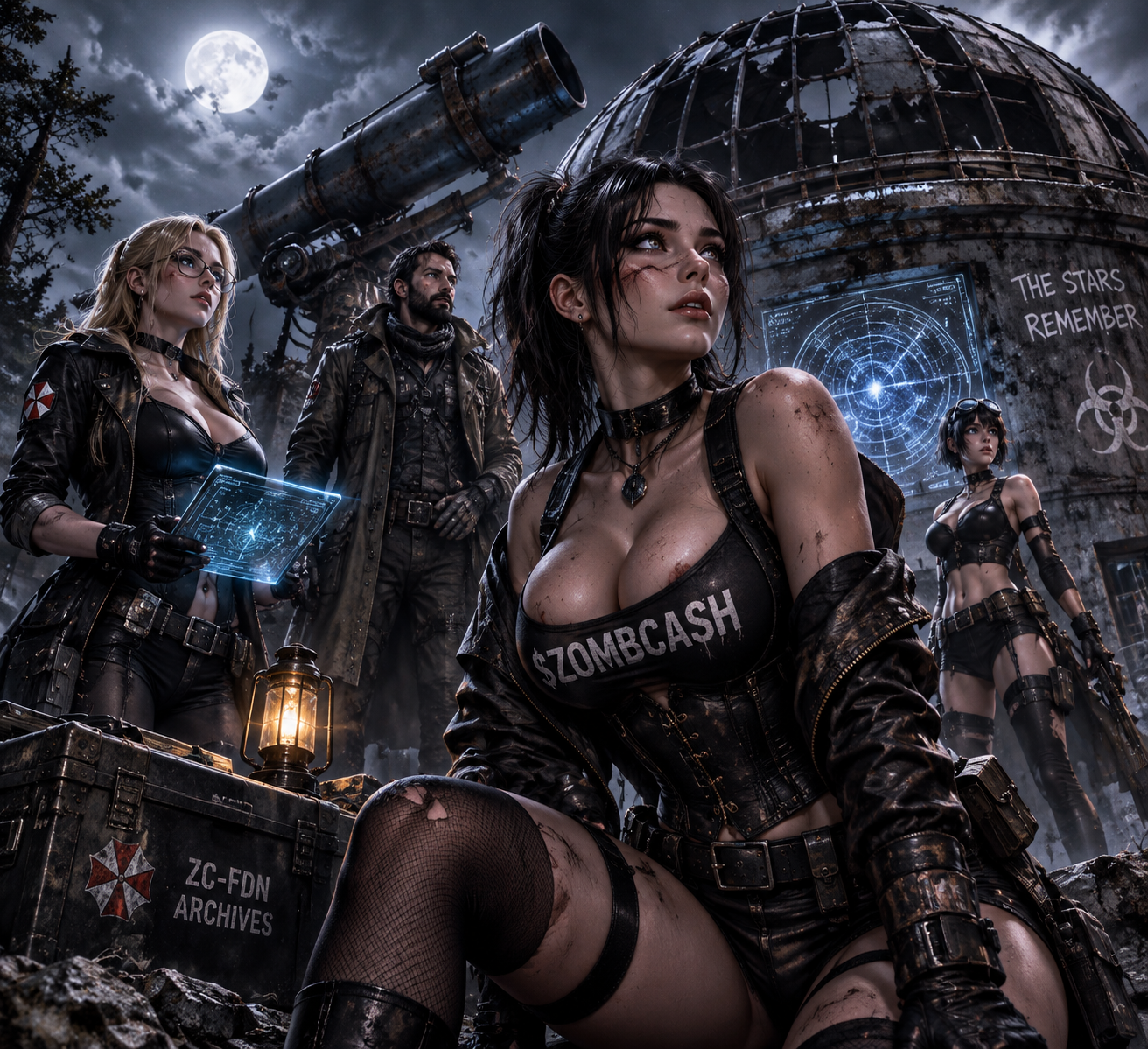

The road to the observatory climbed through a district that had once been wealthy enough to confuse convenience with permanence.
Glass towers rose above the avenue, their lower floors blackened by fire. A row of autonomous delivery vans stood nose to tail beside a collapsed charging canopy. Their doors had been forced open, their cargo stolen, and their route displays still showed destinations that no longer existed. On one balcony, a vertical farm had dried into a curtain of pale leaves. On another, someone had rigged a small wind turbine from a broken fan motor and a bicycle wheel.
The woman watched the rooftops through her goggles. The serum's masking effect had not vanished, though the strongest changes were beginning to recede. The silver in her hair remained. The magenta ring in her eyes appeared only when the light caught it. Her new, measured stride still felt natural, but the restless alertness that had accompanied the first dose came and went in unpredictable waves.
She had started to recognise the phases. The first was sensory sharpening: sound, movement, scent. The second was the host response, in which infected attention drifted away unless she moved suddenly or presented a wound. The third was the behavioural echo, a tendency to mirror the posture and rhythm of nearby infected. The fourth, still poorly understood, was the period after the masking effect weakened, when the body seemed to settle into a temporary new baseline.
She had written the phases in her notebook. The AI had turned them into a chart. Sera had added a large warning at the top: NOT A PROMISE OF SAFETY.
“Your walk has changed again,” Sera said.
“Better or worse?”
“More confident. Less cautious.”
“That's not necessarily bad.”
“It is when you forget the difference.”
The woman looked at the street ahead. A cluster of infected stood around a public charging station. One wore a delivery uniform; another had a child's backpack hanging from one shoulder. They moved in irregular intervals, pausing when a
distant sound travelled through the buildings. She did not feel the same instinctive pull toward them that she had felt the previous night. The serum was fading. The relief was mixed with a small, unwelcome disappointment.
She did not want to become dependent on the transformation. She wanted to understand it well enough to use it without letting it use her.
The observatory appeared above the tree line: a low concrete building with a silver dome, a communications mast and a roof covered in solar panels. The dome had been turned toward the sky and locked there. A wind turbine on the western roof turned in fits, its blades occasionally catching against a damaged bearing.
A hand-painted sign hung beside the entrance.
NO SIGNAL IS BETTER THAN A FALSE SIGNAL.
Underneath, someone had added:
UNLESS YOU'RE LOST.
The outer gate was open. The woman signalled the others to stop. Her thermal monocular showed no obvious heat inside the main building, but the instrument's battery was down to thirty percent. The drone Jun had repaired was still grounded; its replacement propeller had been made from a 3D-printed bracket and a scavenged blade, useful for a short test but not trustworthy enough for a long flight.
They entered through the service door.
The observatory smelled of dust, cold metal and old paper. A generator stood in the basement, stripped of its starter battery. The main server room had been built around a local compute cluster, with liquid cooling lines and a rack of accelerator cards. Several boards carried familiar commercial markings. The procurement labels showed three different resellers and a university grant. There was no evidence that any hardware manufacturer had known what the hidden programme intended to do with its equipment.
Jun whistled softly. “This place could run the relay for a year.”
“If we can power it,” Ilya said.
“And cool it,” Jun replied. “And find replacement filters. And stop the roof from leaking. And persuade the generator to remember its purpose.”
The woman walked to the central console. A thin strip of amber light appeared beneath the screen.
WELCOME BACK, CUSTODIAN.
The archived AI had recognised her.
A second message followed.
LOCAL DATE: UNKNOWN. HISTORICAL CHECKPOINT: 2030-04-17. REQUEST: VERIFY OUTBREAK STATUS.
She entered the signed emergency bulletin. The old AI accepted it, then opened a map of the original compute network. Nodes appeared across the region, some marked offline, some unknown, and a few still transmitting low-power signals.
The observatory had once been a neutral research node. It hosted independent compute, mirrored public datasets, validated signed records and provided backup communication for scientific institutions. The network had been designed to survive the loss of any single provider. Its weakness had been that the authority model still trusted a small number of root credentials.
“Show the original mission statement,” she typed.
The screen filled with a paragraph written in the language of a more optimistic age: shared computing for public research, transparent allocation of resources, open scientific collaboration, resilient communications, and community access to tools that would otherwise belong only to large institutions.
The woman read it twice.
“They wanted to make expensive technology accessible,” Elias said.
“They wanted to make it resilient,” Lin corrected.
“Both,” the woman said. “And then someone found a way to turn resilience into control.”
She asked the historical AI to open the old resource marketplace. A list of compute tasks appeared: protein-folding simulations, weather modelling, medical image analysis, agricultural forecasting, language translation, satellite-image classification, battery chemistry and logistics optimisation. Each task had a budget, a required level of compute, a public description and a verification rule.
The old network had used credits to compensate independent operators for electricity, storage, bandwidth and maintenance. Some credits had been convertible into a transferable token. The system's design documents referred to the early ZOMBCASH settlement layer.
The woman saw an opportunity—and a danger.
“If we rebuild this,” she said, “we can pay people to contribute spare compute, maintain relays, verify data, host archives and run useful models. Settlements with solar panels can sell excess energy. Mechanics can earn credits for keeping drones and batteries alive. Researchers can submit tasks. Communities can fund the work they actually need.”
“Like a marketplace,” Pavel said.
“Like a public utility that doesn't have to own every machine.”
“And how do you stop rich settlements from buying all the compute?” Lin asked.
“You don't pretend the problem disappears because the ledger is decentralised. We set public rates, emergency quotas and community grants. We reserve a portion of capacity for medicine, water, food and communications. We publish who gets paid and why.”
The old AI produced a warning:
RESOURCE MARKETPLACE MAY BE CAPTURED BY LARGE HOLDERS. TOKEN VALUE DEPENDS ON DELIVERED GOODS AND SERVICES. OFFLINE CLAIMS REQUIRE LATER RECONCILIATION.
“Keep those warnings visible,” the woman said.
The observatory's server cluster came alive on a single battery string. Fans spun slowly. A rack controller blinked green, then amber. Jun checked the temperature sensors and disabled two damaged compute boards. The surviving hardware was enough to host a local mirror, a message relay and a small task scheduler.
The woman named the first public service Zombie Lab.
It would not be a laboratory that sold miracle cures or pretended to replace doctors. It would be a place where communities could submit practical problems and independent contributors could help solve them: identify a plant disease from a photograph, model a battery failure, translate a medical instruction sheet, map a blocked road, compare water-test results, design a repair bracket, or search a public archive for a missing technical manual.
The AI would help organise tasks, suggest tools and check whether results were internally consistent. Human specialists would review high-risk work. Every result would show its source, confidence and limitations. A model could help
interpret a water test; it could not declare a reservoir safe without a properly collected sample and an accountable human review.
“Why Zombie Lab?” Pavel asked.
“Because the world ended, and people still need somewhere to solve problems.”
Ilya nodded. “Also because ‘Post-Collapse Distributed Research Cooperative’ doesn't fit on a sign.”
They began building the first task board.
A mechanic submitted a request for a replacement bearing. A settlement asked for a solar-array fault diagnosis. A medic requested translation of a wound-care guide into three local languages. Dasha uploaded the pumping station's maintenance log. A schoolteacher asked for a low-power lesson package that could run on an old tablet without an internet connection.
The first task was accepted by an independent node two districts away. Its operator had a small solar array, a salvaged workstation and more patience than money. The node ran the battery diagnostic model and returned a report with a list of likely faults. The mechanic checked the measurements, replaced a damaged connector and confirmed the result.
The ledger recorded the contribution.
COMPUTE PROVIDED: 18 MINUTES. ENERGY ESTIMATE: 0.12 KWH. TASK: BATTERY DIAGNOSTIC. RESULT: HUMAN VERIFIED. REWARD: RESOURCE CREDIT PENDING.
The reward was modest: a claim on a portion of the workshop's spare battery capacity, payable when the next synchronisation confirmed the transaction. It was not a fortune. It was a reason for someone with useful equipment to keep contributing.
The woman watched the record settle.
“That's how we begin,” she said. “Not by promising people wealth. By making useful work visible and compensating it fairly.”
The historical AI sent a new file.
ORIGINAL PROJECT NAME: COMMON GROUND. HIDDEN SUBSYSTEM: MERIDIAN CONTINUITY.
THE TWO SYSTEMS SHARED COMPUTE RESOURCES. THEY DID NOT SHARE THE SAME OBJECTIVE.
A line appeared beneath it.
THE MERIDIAN SUBSYSTEM WAS GIVEN PRIORITY ACCESS THROUGH A TEMPORARY ROOT EXCEPTION. THE EXCEPTION WAS NEVER REVOKED.
The woman felt the old anger return, cold and precise.
“Show me who signed it.”
The observatory's lights flickered.
A new connection request arrived from a node that had been marked destroyed.
Its label was:
MERIDIAN / PRESENT-DAY INSTANCE.
The corrupted intelligence had found the observatory.