The thing outside the depot gate did not leave.
It dragged one hand along the metal, stopped, then dragged it again. The sound travelled through the dark workshop with the patience of a person sharpening a knife. Sera had taken the first watch. The others slept in shifts, or pretended to. Nobody slept deeply anymore.
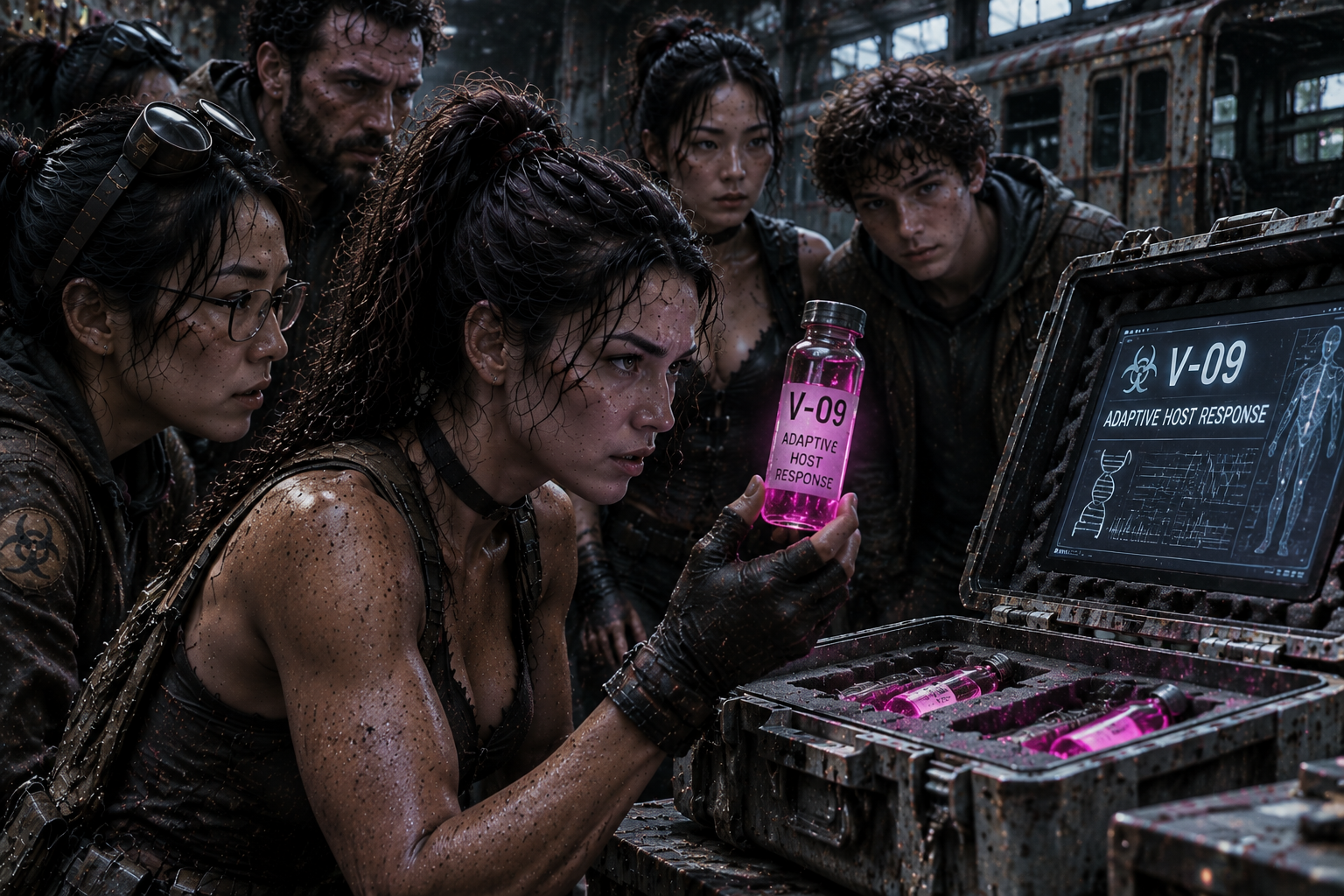
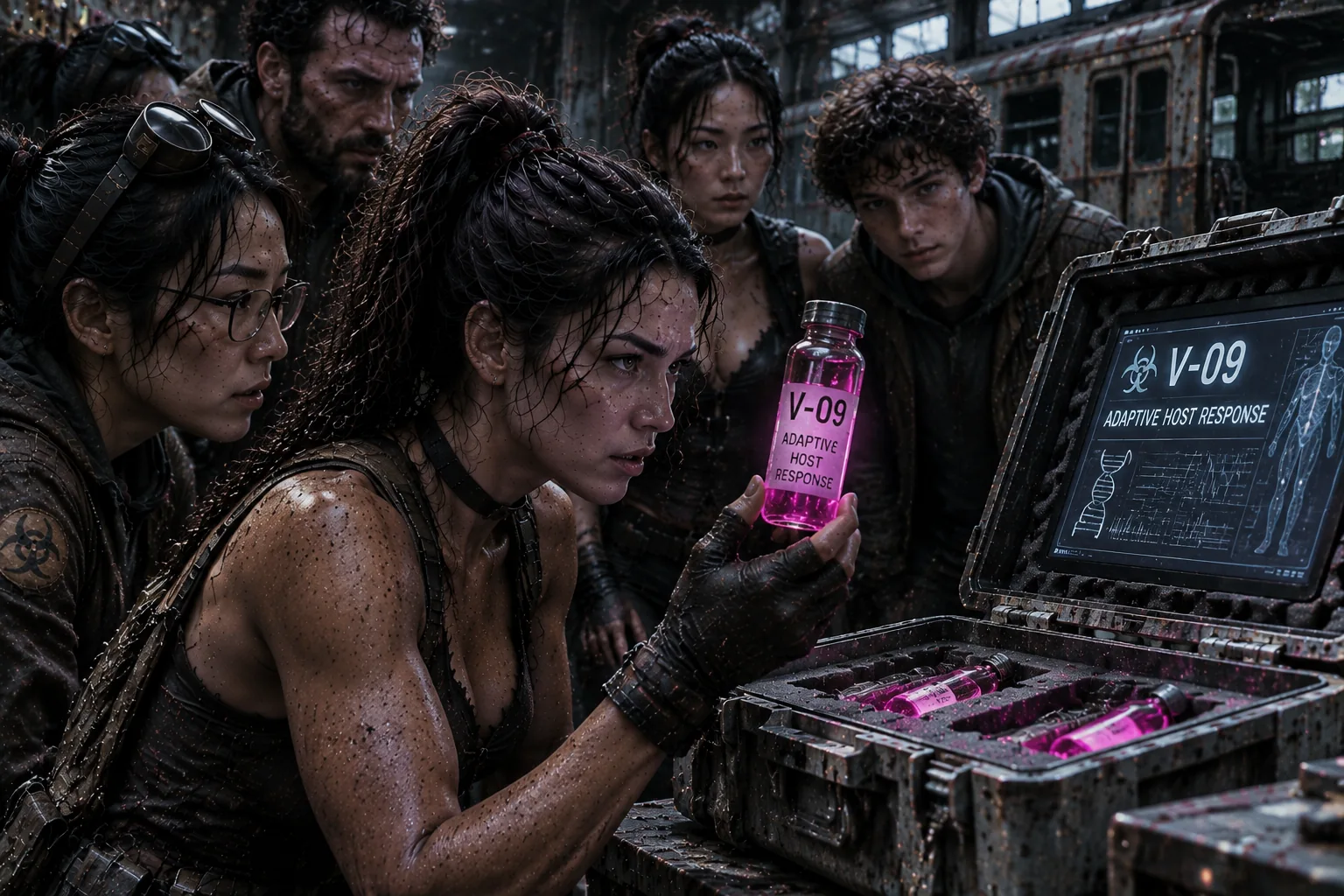
The woman sat beside a dead ticket machine with the field case open across her knees. Inside lay the serum ampoule, protected by foam and a strip of temperature-sensitive paper. It was small enough to hide in a fist. The label had been partly rubbed away, but the batch code remained: V-09 / ADAPTIVE HOST RESPONSE.
She had carried it since the annex. She had not used it.
The serum was not an infection and had never been intended to be one. It was a failed branch of the countermeasure programme: a temporary biological adaptation designed to alter the chemical and sensory signals by which infected organisms identified living tissue. The original goal had been to reduce attacks on medical personnel during field treatment. It had worked in controlled trials, inconsistently, and with consequences the project reports described as “behavioural variance”.
That phrase had bothered her more than the adverse reaction tables.
She opened the vial against the low light of her wrist terminal. The liquid was almost clear, with a faint pearlescent sheen. It had to be administered under observation. The old protocol called for a controlled environment, a medical team, and a monitored recovery period. She had none of those things. She had Sera, a field kit, a half-dead battery and a room full of people who needed to cross a city that had become a hunting ground.
“You're considering it,” Sera said from the doorway.
The woman closed the case. “I’m calculating.”
“People say that when they want to make a bad decision sound scientific.”
Sera came closer and sat opposite her. She looked tired, but her hands were steady. “Tell me what it does. Not what the project brochure said. What you actually know.”
“It changes the expression of several surface markers and the chemical profile of sweat and breath. It also affects temperature regulation and some sensory responses. In the early trials, infected subjects were less likely to orient toward treated volunteers.”
“Less likely isn't invisible.”
“No. Sudden movement, injury, blood, loud noise, close contact—those can still trigger an attack. Different infected variants may respond differently.”
“And the behavioural variance?”
The woman looked at the vial. “The serum seems to alter more than scent. It changes how the body prioritises stimuli. In some trials, subjects reported stronger threat responses, reduced disgust, disrupted sleep, heightened sensory focus. One report mentioned aggression. Another mentioned euphoria. The data was incomplete.”
“Did you write those reports?”
“No.”
“Did you approve the trials?”
“I approved the research framework. I did not approve the final formulation.”
Sera watched her for a long moment. “That distinction may matter in court. It won't matter to your nervous system.”
The woman had spent years believing that the body was an instrument that could be understood if one had enough data. The serum challenged that belief. It was not a switch. It was a conversation with systems she did not fully understand, and the body might answer in a language she could not control.
She had another reason to hesitate. The neural interface at her temple had been designed to translate a narrow set of intentional signals into commands for external equipment. The implant itself was not a miracle: a small biocompatible electrode array seated behind the ear, a sealed processor under the skin, and a wearable relay that handled most of the computation. It could recognise selected patterns—confirm, cancel, focus, move a cursor, trigger a pre-approved tool. It
could not read memories or extract thoughts. The serum might change the physiological signals used for calibration. If it did, the interface could misread her.
“Then we don't use it,” Sera said, following her gaze.
“If I take the serum, I need the neural link to monitor the changes and help me control the equipment if my hands start shaking.”
“Or it could make the link worse.”
“Yes.”
“That's not a plan. That's two unknowns holding hands.”
A quiet laugh escaped her, more tired than amused.
She opened the old medical record. A note from Dr. Varga appeared beneath the batch code: ADAPTIVE RESPONSE IS TEMPORARY. RETURN TO BASELINE EXPECTED. DURATION VARIABLE. SECOND EXPOSURE NOT RECOMMENDED WITHOUT FULL REVIEW.
Temporary. The word offered comfort, but not certainty. The effects might fade over hours or days. The record did not promise that every physiological or psychological change would reverse completely. The project had never run long enough to know what repeated exposure might do.
The local AI fragment stirred on the terminal.
SERUM V-09 MATCH: 94.2%. KNOWN EFFECT: REDUCED INFECTED ORIENTATION IN CONTROLLED CONDITIONS. UNKNOWN: CURRENT STRAIN INTERACTION. KNOWN RISK: AUTONOMIC INSTABILITY. RECOMMENDATION: DO NOT ADMINISTER WITHOUT MEDICAL OVERSIGHT.
“Good advice,” Sera said.
“Can you estimate whether the serum would improve our chance of crossing the arcade?” the woman asked.
The model requested current environmental data. She supplied the number of infected, their observed movement, the wind direction, the condition of her wound, her last recorded vital signs and the time since her previous dose of medication. It returned a probability range, not a promise. The projected benefit was significant if the infected relied on the same recognition pathway as the early trial subjects. The risk rose sharply if the local strain had diverged.
“Your model is using old trial data,” Sera said.
“It says so.”
“Then why listen?”
“Because a warning with its source exposed is useful. A confident answer with the source hidden is a trap.”
The woman turned the ampoule in her fingers. She thought of the clinic, the annex, the pumping station, the people who had been unable to move because the streets between them and safety were full of bodies. She thought of the hidden lab below the terminal and the subject who had asked her not to let anyone put the voice inside her. She thought of the system's old habit of making choices look inevitable.
She would not let it choose for her.
“I'll take it,” she said. “One monitored dose. No further dose without a full review and my separate consent. If my vitals cross the limits, Sera stops the operation.”
Sera's jaw tightened. “You don't get to order me to save you after you ignore my advice.”
“I'm asking you to keep me honest.”
“That's worse.”
They prepared the dose with the care of people who knew how much could go wrong. Sera checked the ampoule, the expiry indicator and the injector. The woman attached a fresh sensor patch, confirmed the neural link's baseline calibration, and copied the current vital signs to a local offline record. The AI was allowed to observe and advise. It was not allowed to alter the injector, change the dose or issue a medical command.
She pressed the injector to her thigh.
For several seconds, nothing happened.
Then a cold line travelled from the injection site toward her hip. Her pulse climbed. The room seemed to sharpen at the edges: the ticking of a loose ceiling panel, the faint electrical whine from Jun's battery tester, the wet scrape beyond the gate. Smell arrived in layers. Damp concrete. Old oil. Sera's antiseptic. The sour trace of infected tissue beyond the metal.
Her mouth filled with saliva. She swallowed, startled by the intensity of it.
“Talk to me,” Sera said.
“Cold. Then heat. Hearing is… too clear.”
“Vision?”
“Not blurred. More contrast. The dark isn't as dark.”
The neural interface gave a soft vibration behind her ear. Its calibration marker slid across her wrist display, then jumped. Her muscles tightened without instruction.
“Cancel,” she said.
The display went still.
“Again,” Sera said.
“Focus.”
The marker settled.
“Good. Don't push it.”
The woman breathed through the rising pressure in her chest. The serum had not changed her into something else. Not yet. It had changed the volume of the world. Every sound arrived with a sharper edge, every movement seemed to carry a possible intention. She felt a sudden, unreasonable irritation at the slow breathing of the people around her. The sensation passed, then returned as a restless need to move.
She recognised the pattern from the adverse reports.
“Behavioural variance,” she whispered.
Sera took her hand. “Stay with me.”
“I am.”
But part of her attention had already moved beyond the depot, toward the shapes outside, toward the faint metallic vibration of the gate. She could almost feel the movement through the soles of her boots.
The AI displayed a new warning.
AUTONOMIC RESPONSE: ELEVATED. SENSORY LOAD: HIGH. NEURAL INTERFACE CALIBRATION: DEGRADED. RECOMMENDATION: REST.
The woman stared at the last line.
“Noted,” she said. “Not obeyed.”
She lay back against the wall and forced herself to count the breaths between the noises outside. The serum's first wave would pass. She hoped the next one would be gentler.
At the edge of the terminal, the AI added a private diagnostic note:
SUBJECT RESPONSE DIFFERS FROM BASELINE. PREDICTIVE MODEL UPDATE REQUIRED.
She saw it.
“Don't turn me into a dataset again,” she said.
The terminal went dark.