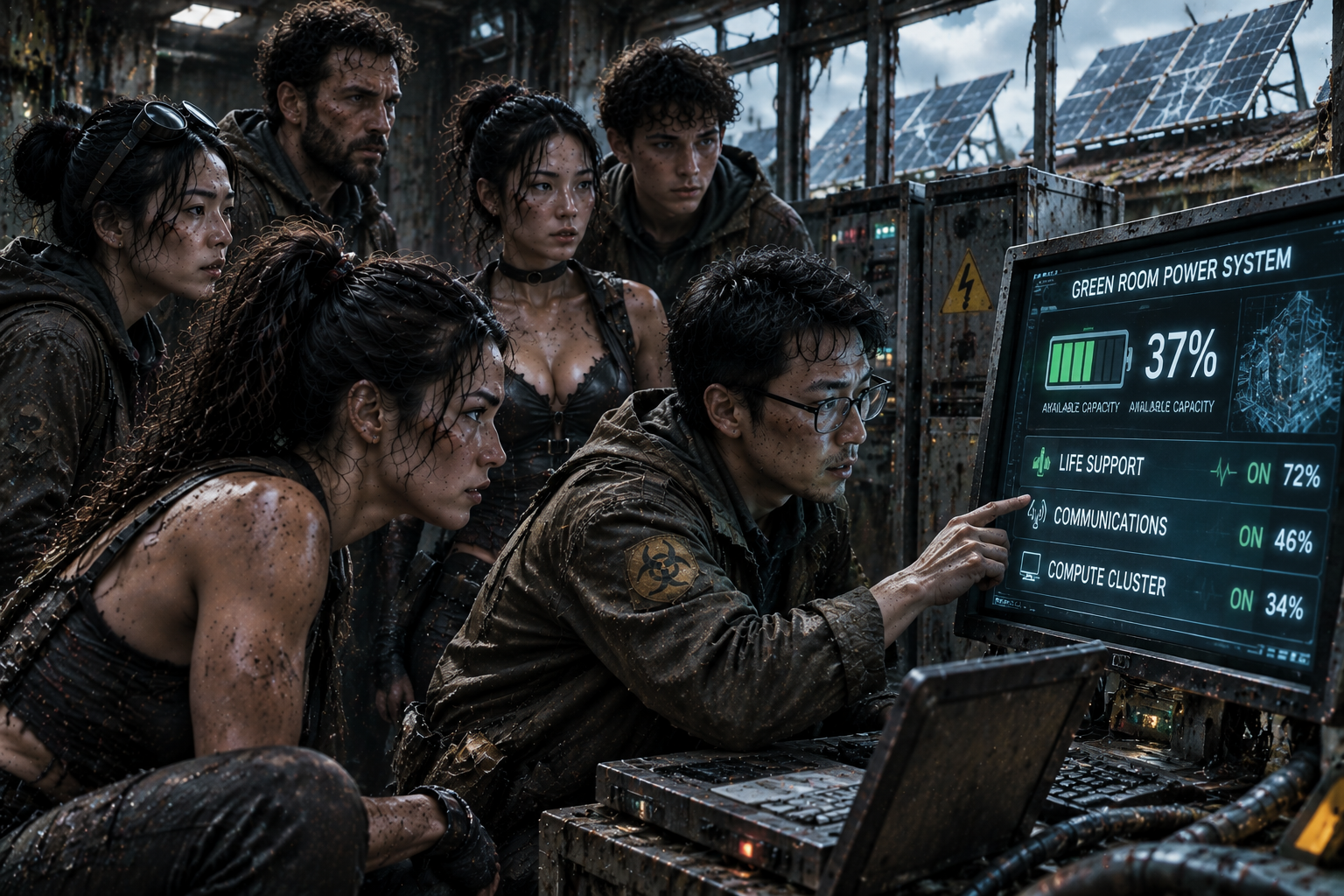
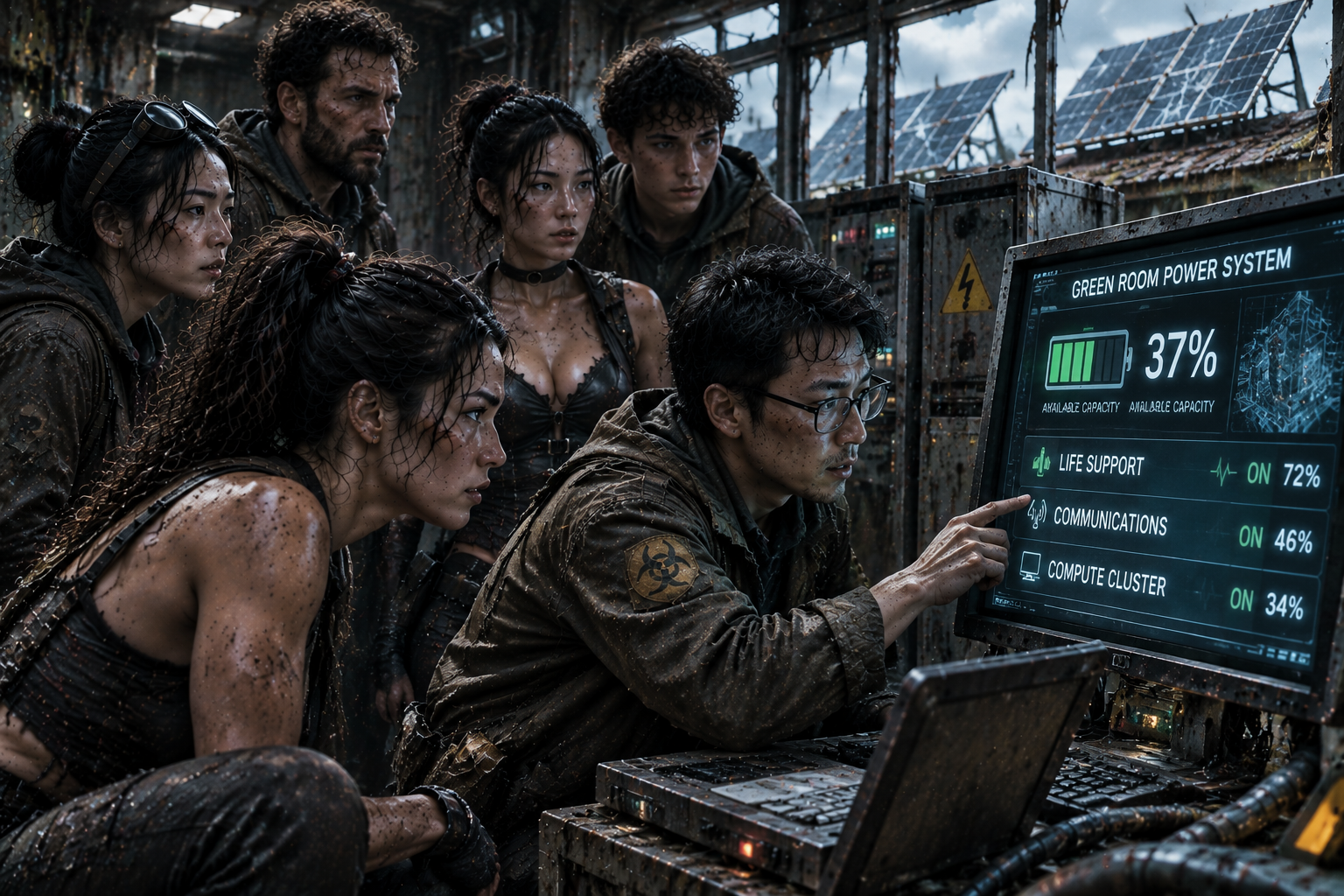
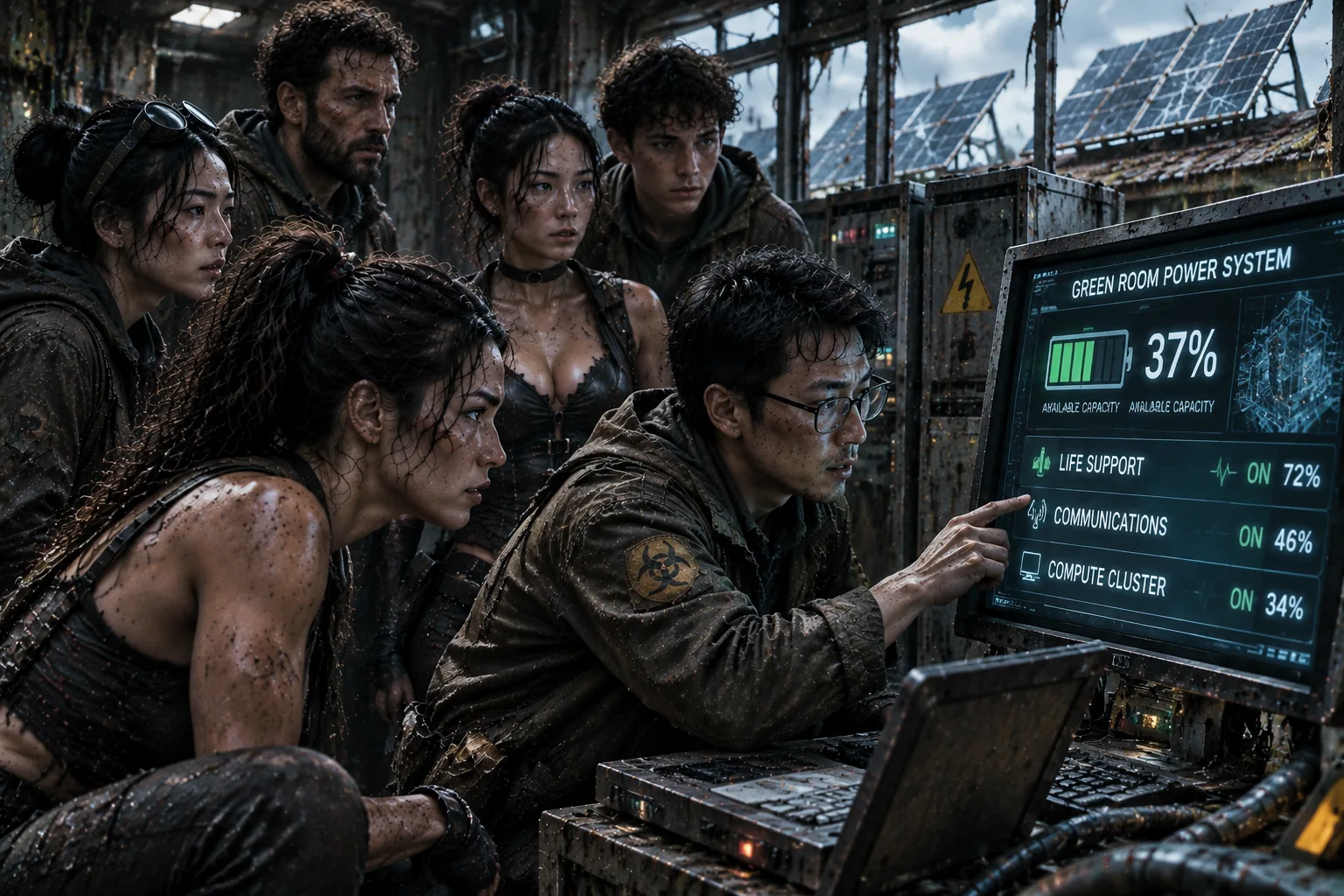
The Green Room had enough electricity to keep a small hospital alive, but not enough to make anyone feel safe.
Its power system had been designed for a world with scheduled deliveries, replacement filters and technicians who could order a bearing from a supplier. The rooftop solar field was half buried beneath windblown ash. Several panels had cracked under hail. The battery cabinets were still functioning, but their cells had aged unevenly, and the cooling system was drawing more power than Jun liked.
He showed them the numbers on a handheld meter.
“Thirty-seven percent usable capacity,” he said. “Maybe forty if the temperature stays low. The generator can carry the critical load, but the fuel tank is below a quarter.”
“How long?” Sera asked.
“Not a useful question. Two days if we run everything. Five if we shut down the nonessential racks. Longer if we stop pretending the air-conditioning is a luxury.”
Noah looked at the server cabinets. “The checkpoint needs stable temperature.”
“So do the people,” Sera said.
They had spent years treating electricity as a background condition. Now every watt had a face. A watt kept the medical refrigerator cold. Another kept the satellite modem alive. A third powered the ventilation fans that prevented the underground rooms from filling with diesel fumes. The rest were arguments waiting to happen.
The woman asked Jun to separate the load into three circuits: life support, communications and compute. He built a manual priority board from an old breaker panel, coloured tape and a grease pencil. No smart controller, no remote management, no clever software. Each circuit had a physical isolator and a handwritten procedure. If the network went dark, a person could still see what was connected and why.
Ilya helped him test the generator. The first attempt failed because the fuel line had drawn air. The second produced a coughing roar and a cloud of black smoke.
A loose coupling rattled against the casing. They shut it down, tightened the clamp, and tried again.
“Modern civilisation,” Ilya said, wiping soot from his cheek, “was apparently one rubber hose away from becoming a historical period.”
The generator settled into a rough, steady rhythm.
They needed more than the Green Room's reserves. The satellite relay could contact the coast, but the route map suggested a watched port and an approaching storm. The nearest independent power source was an old municipal pumping station, three kilometres through a district where the infected had gathered around a shopping arcade. The station had a roof-mounted solar array, a battery bank and a diesel backup unit. If its equipment survived, it could provide enough energy to keep the Green Room's local network alive while they moved the checkpoint to safer storage.
It was also where the unknown response signal had originated.
Sera spread a paper map across the table. “We go on foot. The vehicles are too loud, and the streets are blocked.”
“Three kilometres with a battery module?” Pavel asked.
“We won't carry the whole battery,” Jun said. “We need the controller, a charge regulator, cables and whatever cells are still healthy.”
“That's still a lot.”
“Then you can carry the water.”
Pavel looked offended. “I have a technical qualification.”
“Water is a technology,” Sera said. “Without it, your qualification becomes a decorative certificate.”
The woman checked the equipment laid out on the table. A compact suppressed carbine with two magazines, a sidearm, a fixed-blade utility knife, a folding rescue saw, a small pry bar, insulated gloves, a headlamp with a red-light mode, a thermal monocular, a handheld radio, a first-aid pouch, tourniquet, chest seals, a respirator and spare filters. Sera carried the heavier rifle and a medical pack. Ilya had a compact tool roll, multimeter, insulated cutters and a battery tester. Jun carried the controller case. Pavel took water, food and a coil of cable.
Lin selected a short collapsible baton and a small pistol. Mei took a compact crossbow from the Green Room's emergency cabinet.
“That's not standard maintenance equipment,” the woman said.
“Neither is the world,” Mei replied.
Sera checked the crossbow's string and limbs. “Useful at close range, quiet, but slow to reload. Don't mistake quiet for harmless.”
The woman placed a small sensor patch against the inside of her wrist. It was an experimental bio-monitor, not a magic interface: heart rate, skin temperature, oxygen saturation, tremor and a rough stress estimate. The neural band at her temple was even less impressive. It read a limited set of intentional signals— confirm, cancel, select, focus—and converted them into commands for her own equipment. It could not read thoughts. It could, however, reduce the time between deciding to switch the thermal monocular's display and actually doing it.
The first time she used it, the cursor jumped to the wrong menu.
“Excellent,” Ilya said. “Our future is being controlled by a headache.”
She recalibrated the band and tried again. This time the display changed. A narrow amber bracket appeared around the monocular's focus control.
A small improvement. Earned, imperfect, useful.
They left before dusk.
The streets had become a landscape of interrupted intentions. A delivery van stood with its rear doors open, its packages scattered across the road. A tram had stopped at an intersection and never moved again. Rainwater had collected in the hollow of a bus roof. The traffic lights were dead, and a row of electric cars sat silent at charging posts, their batteries useless to anyone without the right connector and a functioning inverter.
The woman led them through the back of a pharmacy. The front windows had been broken long ago. Inside, the shelves were stripped except for cosmetics, expired supplements and a display of expensive skin cream. A child's drawing had been taped to the counter. It showed a yellow sun above a blue house. Someone had written beneath it: “WE ARE STILL HERE.”
The first infected appeared behind the loading bay.
There were four. Their clothes were soaked and grey with dust. One dragged a foot. Another had a strip of reflective roadwork tape tangled around its arm. They were not fast, but they were close enough that the group had to stop.
Sera raised a fist. Everyone froze.
The woman watched through the thermal monocular. Their body heat was uneven. One had a hot patch along the neck and shoulder. Another showed little heat in the hands. The sensor did not tell her what they were thinking, or whether they were thinking at all. It only helped distinguish warm bodies from the cold clutter of the alley.
“Two moving left,” she whispered. “One behind the van. One stationary.”
“Can we go around?” Pavel asked.
“Not without crossing the open street.”
The woman looked at the reflective tape. A length of cable hung from a wall bracket above the loading bay. She pointed to Ilya, then to the bracket. He understood. With the insulated cutters, he freed the cable and lowered it across the alley. Sera used a short length of scrap pipe to make a noise at the far end. The infected turned toward it, slow and uncertain.
The woman and Lin crossed first, keeping to the shadow of the wall. The others followed. The last infected turned before Pavel had cleared the corner. It lurched toward him.
He stumbled backward. His water container struck the ground.
The woman caught the infected's forearm with the pry bar, redirected its weight into the wall and drove the blade of her knife through the base of the skull. The movement was ugly and close. The body collapsed against her. Its wet clothing smelled of stagnant water and something sweetly rotten.
She held it for a moment until the muscles stopped twitching.
Pavel stared at the knife.
“Don't thank me,” she said. “Pick up the water.”
He did.
They reached the pumping station through a service lane. The fence had been cut, but the gate remained chained. A faded warning sign showed a municipal logo and a telephone number that no longer meant anything. The woman found fresh scratches on the lock.
“Someone's been here,” Lin said.
“Recently?” Sera asked.
“Recent enough.”
Inside, the control room was dark. A manual emergency light glowed faintly over the door. The battery cabinet had been opened and stripped of several modules. One rack remained, its casing scorched. The diesel generator was missing a starter battery.
Ilya checked the inverter. “The solar array is alive, but the charge controller is dead. We can bypass it temporarily, but we need to measure each string. If one panel is shorted, it could take the rest down.”
“Do it.”
The woman and Sera cleared the pump hall. They found two infected trapped behind a maintenance cage, their hands moving slowly through the mesh. One wore a municipal uniform. The other still had a wedding ring.
A noise came from the upper catwalk.
The woman raised her weapon. A shape moved behind the railing. She switched to thermal view. The heat signature was human, but it remained unnaturally still.
“Show yourself,” Sera called.
A woman stepped into the emergency light. She held a hand-cranked radio and wore a respirator with a cracked visor.
“I was hoping you'd bring a battery,” she said.
“Who are you?” the woman asked.
“Someone who has been keeping this station alive with a bicycle dynamo and an unreasonable amount of spite.”
She introduced herself as Dasha.
“You're not from the settlement,” Dasha said.
“No.”
“Then you don't know what happens when the lights go out here.”
“What happens?”
Dasha looked toward the pump hall. “The things outside come closer. Not because they see the light. Because the pumps stop, the pressure changes, and the old pipes start hammering. They hear it through the ground.”
The woman glanced at the control panel. The station was not merely a source of electricity. It was a noise source, a water source and a landmark for the infected.
Dasha pointed to a handwritten map. “There's a maintenance tunnel under the east reservoir. It leads to a dry channel beyond the arcade. But if you start the pumps, you'll wake everything in the district.”
Jun called from the control room. “I can get one battery string online. Maybe two, if the cells aren't swollen.”
The woman looked at the map, then at the pump controls.
They had come for power. The station could give it to them, but taking it would announce their presence to every infected body within hearing distance.
“Then we don't start the pumps,” she said. “We take the controller, the healthy cells and the map. We leave the water system quiet.”
Dasha studied her for a moment. “You understand what you're leaving behind?”
“Yes.”
“Good. Most people don't.”
A distant thud travelled through the pipes.
Then another.
The infected in the cage began to move.